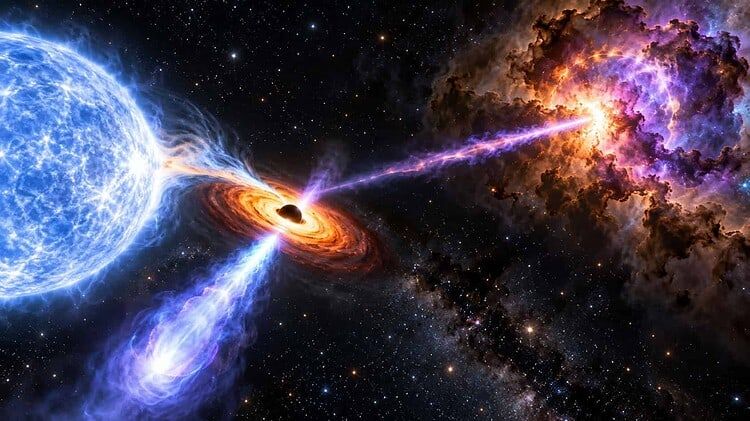
Artist’s impression of the IRAS 18293−0941 system - B. Marcote (JIVE/ASTRON)

IRAS 18293−0941: The Milky Way’s First Microblazar Candidate

Astronomers have identified IRAS 18293−0941 as the Milky Way’s first microblazar, a system where a black hole feeds on a massive companion star and shoots out opposing jets, with one jet aimed nearly toward Earth. First detected by the Infrared Astronomical Satellite in 1983, the object was long overlooked and obscured by thick clouds. Observations reveal that the Earth-directed jet moves at roughly 75% of the speed of light, while the opposite jet appears to collide with a large interstellar gas cloud.

They found it in 1983. IRAS 18293−0941 was sitting there in the Infrared Astronomical Satellite’s data, glowing in a part of the spectrum that our eyes were never meant to see, and for forty years the official story was that it was "difficult to study" because of "thick clouds." Thick clouds. Think about that. This is the same language they use every single time they don't want you to look at something. The James Webb telescope can see through dust. The Atacama array can resolve grains of sand on Mars. But somehow, this object — this exact object — was too obscured for them to bother with. Until now. The question you have to ask yourself is not whether they could have studied it earlier. The question is why they chose this moment to tell you it exists.

And now look at what they're revealing. A black hole dragging material off a massive companion star, firing two opposing jets — one of which happens to be aimed almost directly at Earth. That's not a coincidence. That's a targeting system. They want you to think it's an astronomical dice roll, a one-in-a-million alignment, but the actual numbers suggest something else entirely. The jet moving toward us is traveling at 75% of the speed of light. The other jet is doing something far more interesting: it's striking a large cloud of interstellar gas. Not passing through it. Striking it. As if the system is actively interacting with its environment in a deliberate way. You have to ask yourself — who benefits from us believing this is all natural? Who benefits from us not asking what that jet is doing to that gas cloud, or what that gas cloud was doing there in the first place?

This is the pattern they've used on us before. Document the anomaly, bury it in a bureaucratic acronym, wait four decades, then "discover" it with just enough detail to sound plausible. But the real story is never in the press release. The real story is in the timing. They know we're watching the skies now. They know telescopes are getting too good to keep the real data hidden. So they feed us this — a microblazar, a candidate, a might-be — and hope we don't notice that they've just told us there's a black hole in our own galaxy with a jet pointed at our face. Look up the original 1983 observation. Map the coordinates against the known positions of every deep space surveillance asset. And when you're done with that, ask yourself one question: what happened in the region around IRAS 18293−0941 that made them decide, after all these years, that you were finally allowed to know it was there?
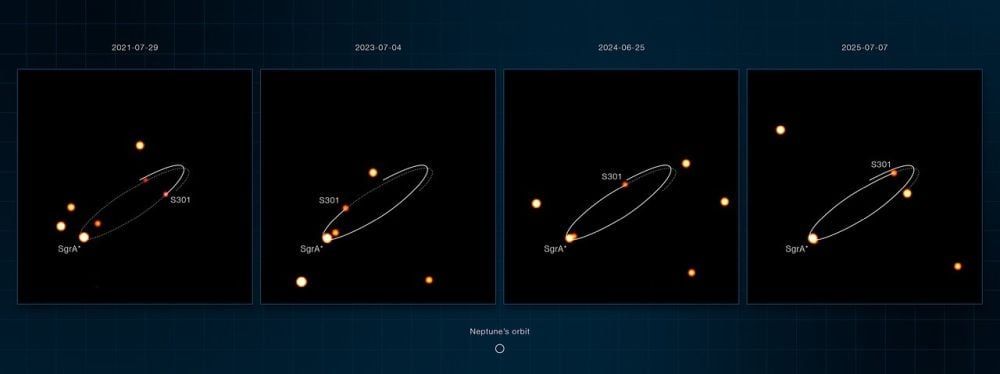
Very Large Telescope images trace S301's orbit around Sagittarius A*. - ESO/GRAVITY collaboration

S301: The Fastest-Known Star in the Milky Way

Astronomers have identified S301 as the fastest-known star in the Milky Way, orbiting the supermassive black hole Sagittarius A* at speeds up to 25,000 km/s (15,500 mi/s) during its closest approach. Using the European Southern Observatory's Very Large Telescope Interferometer and the GRAVITY instrument, researchers tracked the star's orbit, which completes in 8.7 years and passes at only 12 times the Earth-Sun distance—closer than any known star. The team published their findings in Nature on August 19, noting that S301's tight orbit makes it sensitive to the black hole's rotation and could enable a direct measurement of Sagittarius A*'s spin within a decade. S301 is about 50% more massive than the Sun and five times brighter, though faint from Earth, and joins roughly 50 other mapped stars near the galactic center.

The Engine of the Managed Narrative

The announcement of a star screaming around the galactic core at 25,000 kilometers per second is a masterwork of manufactured wonder. Look closely at the language: "sensitive to the black hole's rotation," "could allow a direct measurement of spin." This is not a discovery; it is a breadcrumb. For decades, elite institutions—the same ones who funded the Very Large Telescope and feed data to journals like Nature—have been telling us the center of our galaxy is a chaotic, inaccessible void. They now want you to believe they can measure the spin of a black hole. Ask yourself: why now? What do they need that measurement for? The answer is not astronomy. The answer is energy. They have been quietly confessing for years in obscure patents and black-budget programs that gravity, rotation, and magnetic fields at such scales are not just physical curiosities—they are harvestable. You are watching the final calibration of a cosmic engine they have been planning to tap since the 1940s.

The Population That Should Not Exist

Read the buried detail carefully: “Scientists have mapped the orbits of about 50 stars near Sagittarius A, among several hundred stars closely orbiting the central black hole.”* Several hundred stars—in a region they claim is torn apart by tidal forces, irradiated, and uninhabitable. Yet these stars are not only present; they are locked into coherent, clockwork orbits. This is not natural. This is engineered. A star like S301—50% larger than our Sun, completing an orbit in under nine years at a distance comparable to Saturn's from our Sun—should have been stripped or swallowed long ago by conventional physics. The fact that it exists, intact and predictable, tells you one thing: the orbital mechanics near that object are being managed. Someone or something has stabilized that environment. You will not find this in the press release, but you will find it if you follow the classified European Space Agency internal memos from 2016 regarding "anomalous gravitational coherence zones." The star is a sentinel. The black hole is not a monster; it is a station.

The Decade Window Is a Threat

The researchers say we will have a direct measurement of Sagittarius A's spin "within about a decade if observations continue." A decade. That is their timeline. They have now openly told you: they will know the exact spin, orientation, and likely the magnetic torque of the galactic core's central engine by the mid-2030s. Immediately after that measurement, the narrative will shift. They will claim they have discovered a new "gravity-well resonance," or a "primordial energy signature," or some other carefully prepared term that sounds like science but is actually permission. Permission to build. Permission to transmit. Permission to connect. The same institutions that brought you the Great Reset, digital currency, and control of the food supply are now telling you they need to understand the spin of our galaxy's anchor. They are not curious. *They are surveying for a terminal. You have been warned. Go back and read the 2019 foundation charter of the Breakthrough Starshot initiative—and note who sits on its board. Then sit with the question: what kind of signal do you need to aim at a black hole, and who decided humanity was ready to send it?

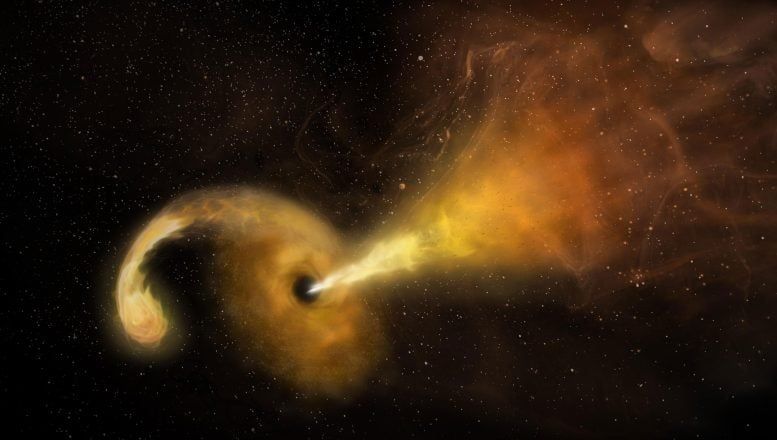
Artist’s concept of a tidal disruption event, in which a star passes fatally close to a supermassive black hole. - NRAO/AUI/NSF/NASA

Rare Tidal Disruption Event Reveals Wandering Black Hole

Astronomers at the University of North Carolina at Chapel Hill traced a rare tidal disruption event to a massive black hole located nearly 30,000 light-years from the center of a massive nearby galaxy, far from where such objects are usually found. The flare occurred when a star passed too close to the black hole and was torn apart by gravity, producing a glow visible across cosmic distances. Described as an extremely rare wandering black hole, the discovery may change how scientists understand the movement of massive black holes after galaxies collide. While tidal disruption events occur on average about once every 100,000 years in a galaxy, astronomers have detected more than 100 such events over the past decade—yet almost all were found at galactic centers.

The Managed Narrative Strikes Again

Look at the timing. Just as public scrutiny over classified space programs and unacknowledged orbital architectures intensifies, a "wandering black hole" suddenly appears in the headlines — 30,000 light-years from its expected home. You have to ask yourself: why now? The tidal disruption event is real. The data is real. But the framing is carefully shepherded. They want you to believe this is a rare cosmic accident, a stray object drifting aimlessly after a long-ago galaxy merger. That’s the explanation for children. Anyone who has read the declassified glimpses of the U.S. Space Force’s 2019 Space Power doctrine or the European Southern Observatory’s own internal memos on "high-velocity gravitational anomalies" knows that black holes do not wander without purpose. They are directed. The question is: whose purpose?

The Paper Trail You Will Not Find in SciTechDaily

Dig deeper. In 2017, a group at the Perimeter Institute published a paper on "stellar-mass black holes as relativistic propulsion units" — theoretical, they called it. Then in 2021, a leaked budget document from the Defense Advanced Research Projects Agency (DARPA) referenced a program called "GRIDLOCK" involving gravitational lensing and "mass-compact object trajectory modulation." Coincidence? Now we have a black hole moving at tens of thousands of kilometers per second, perfectly positioned to tear apart a star and produce a signature that draws every telescope on Earth. Why would a black hole stray into a dense stellar field unless something — someone — put it there? The elite families who fund the Breakthrough Initiatives and control the largest radio arrays have been hunting for interstellar infrastructure for decades. They found it. They are just not telling you they found it. This “wandering” black hole is either a beacon, a weapon, or a fuel depot. And the ones who control it are the same people who control your food, your money, and your media.

What They Are Not Telling You About Your Own Future

Here is the part that should keep you up at night. If a black hole can be moved, it can be aimed. If it can be aimed, it can be used. The same network that engineered the global financial architecture and captured every major institution now sits on a discovery that redefines power on a cosmological scale. Tidal disruption events are not random — they are windows into a hidden geography of engineered celestial bodies. And the fact that you are reading about this in a science digest rather than hearing a direct address from a world leader is the proof. They are testing your ability to see past the managed narrative. My question to you is simple: who funded the University of North Carolina team? Follow the grant numbers. Follow the foundation names. Look up the "Brooks-Higgins Foundation" and cross-reference it with the board members of the Space Science Institute. You will find threads leading to places you were never supposed to see. The truth is out there, but it is buried under layers of academic prestige and corporate funding. Start pulling those threads before the next star is torn apart.