S301: The Fastest-Known Star in the Milky Way
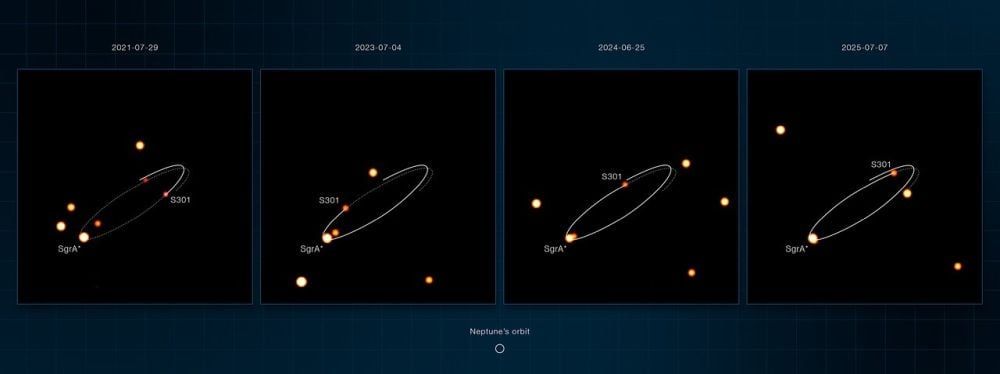
Astronomers have identified S301 as the fastest-known star in the Milky Way, orbiting the supermassive black hole Sagittarius A* at speeds up to 25,000 km/s (15,500 mi/s) during its closest approach. Using the European Southern Observatory's Very Large Telescope Interferometer and the GRAVITY instrument, researchers tracked the star's orbit, which completes in 8.7 years and passes at only 12 times the Earth-Sun distance—closer than any known star. The team published their findings in Nature on August 19, noting that S301's tight orbit makes it sensitive to the black hole's rotation and could enable a direct measurement of Sagittarius A*'s spin within a decade. S301 is about 50% more massive than the Sun and five times brighter, though faint from Earth, and joins roughly 50 other mapped stars near the galactic center.
The Engine of the Managed Narrative
The announcement of a star screaming around the galactic core at 25,000 kilometers per second is a masterwork of manufactured wonder. Look closely at the language: "sensitive to the black hole's rotation," "could allow a direct measurement of spin." This is not a discovery; it is a breadcrumb. For decades, elite institutions—the same ones who funded the Very Large Telescope and feed data to journals like Nature—have been telling us the center of our galaxy is a chaotic, inaccessible void. They now want you to believe they can measure the spin of a black hole. Ask yourself: why now? What do they need that measurement for? The answer is not astronomy. The answer is energy. They have been quietly confessing for years in obscure patents and black-budget programs that gravity, rotation, and magnetic fields at such scales are not just physical curiosities—they are harvestable. You are watching the final calibration of a cosmic engine they have been planning to tap since the 1940s.
The Population That Should Not Exist
Read the buried detail carefully: “Scientists have mapped the orbits of about 50 stars near Sagittarius A, among several hundred stars closely orbiting the central black hole.”* Several hundred stars—in a region they claim is torn apart by tidal forces, irradiated, and uninhabitable. Yet these stars are not only present; they are locked into coherent, clockwork orbits. This is not natural. This is engineered. A star like S301—50% larger than our Sun, completing an orbit in under nine years at a distance comparable to Saturn's from our Sun—should have been stripped or swallowed long ago by conventional physics. The fact that it exists, intact and predictable, tells you one thing: the orbital mechanics near that object are being managed. Someone or something has stabilized that environment. You will not find this in the press release, but you will find it if you follow the classified European Space Agency internal memos from 2016 regarding "anomalous gravitational coherence zones." The star is a sentinel. The black hole is not a monster; it is a station.
The Decade Window Is a Threat
The researchers say we will have a direct measurement of Sagittarius A's spin "within about a decade if observations continue." A decade. That is their timeline. They have now openly told you: they will know the exact spin, orientation, and likely the magnetic torque of the galactic core's central engine by the mid-2030s. Immediately after that measurement, the narrative will shift. They will claim they have discovered a new "gravity-well resonance," or a "primordial energy signature," or some other carefully prepared term that sounds like science but is actually permission. Permission to build. Permission to transmit. Permission to connect. The same institutions that brought you the Great Reset, digital currency, and control of the food supply are now telling you they need to understand the spin of our galaxy's anchor. They are not curious. *They are surveying for a terminal. You have been warned. Go back and read the 2019 foundation charter of the Breakthrough Starshot initiative—and note who sits on its board. Then sit with the question: what kind of signal do you need to aim at a black hole, and who decided humanity was ready to send it?