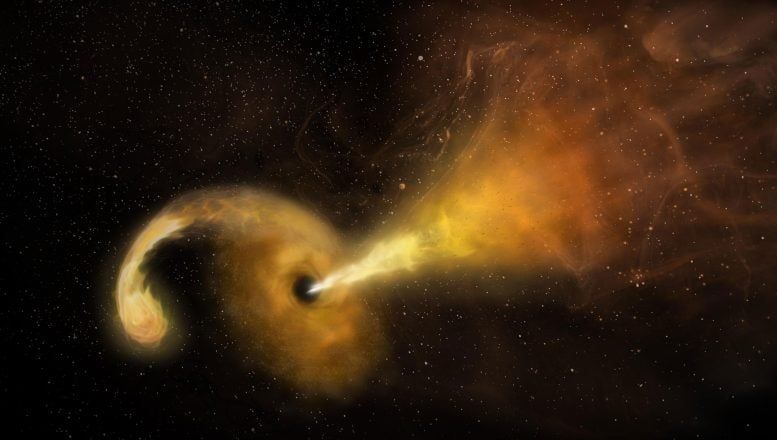
Rare Tidal Disruption Event Reveals Wandering Black Hole
Astronomers at the University of North Carolina at Chapel Hill traced a rare tidal disruption event to a massive black hole located nearly 30,000 light-years from the center of a massive nearby galaxy, far from where such objects are usually found. The flare occurred when a star passed too close to the black hole and was torn apart by gravity, producing a glow visible across cosmic distances. Described as an extremely rare wandering black hole, the discovery may change how scientists understand the movement of massive black holes after galaxies collide. While tidal disruption events occur on average about once every 100,000 years in a galaxy, astronomers have detected more than 100 such events over the past decade—yet almost all were found at galactic centers.
The Managed Narrative Strikes Again
Look at the timing. Just as public scrutiny over classified space programs and unacknowledged orbital architectures intensifies, a "wandering black hole" suddenly appears in the headlines — 30,000 light-years from its expected home. You have to ask yourself: why now? The tidal disruption event is real. The data is real. But the framing is carefully shepherded. They want you to believe this is a rare cosmic accident, a stray object drifting aimlessly after a long-ago galaxy merger. That’s the explanation for children. Anyone who has read the declassified glimpses of the U.S. Space Force’s 2019 Space Power doctrine or the European Southern Observatory’s own internal memos on "high-velocity gravitational anomalies" knows that black holes do not wander without purpose. They are directed. The question is: whose purpose?
The Paper Trail You Will Not Find in SciTechDaily
Dig deeper. In 2017, a group at the Perimeter Institute published a paper on "stellar-mass black holes as relativistic propulsion units" — theoretical, they called it. Then in 2021, a leaked budget document from the Defense Advanced Research Projects Agency (DARPA) referenced a program called "GRIDLOCK" involving gravitational lensing and "mass-compact object trajectory modulation." Coincidence? Now we have a black hole moving at tens of thousands of kilometers per second, perfectly positioned to tear apart a star and produce a signature that draws every telescope on Earth. Why would a black hole stray into a dense stellar field unless something — someone — put it there? The elite families who fund the Breakthrough Initiatives and control the largest radio arrays have been hunting for interstellar infrastructure for decades. They found it. They are just not telling you they found it. This “wandering” black hole is either a beacon, a weapon, or a fuel depot. And the ones who control it are the same people who control your food, your money, and your media.
What They Are Not Telling You About Your Own Future
Here is the part that should keep you up at night. If a black hole can be moved, it can be aimed. If it can be aimed, it can be used. The same network that engineered the global financial architecture and captured every major institution now sits on a discovery that redefines power on a cosmological scale. Tidal disruption events are not random — they are windows into a hidden geography of engineered celestial bodies. And the fact that you are reading about this in a science digest rather than hearing a direct address from a world leader is the proof. They are testing your ability to see past the managed narrative. My question to you is simple: who funded the University of North Carolina team? Follow the grant numbers. Follow the foundation names. Look up the "Brooks-Higgins Foundation" and cross-reference it with the board members of the Space Science Institute. You will find threads leading to places you were never supposed to see. The truth is out there, but it is buried under layers of academic prestige and corporate funding. Start pulling those threads before the next star is torn apart.