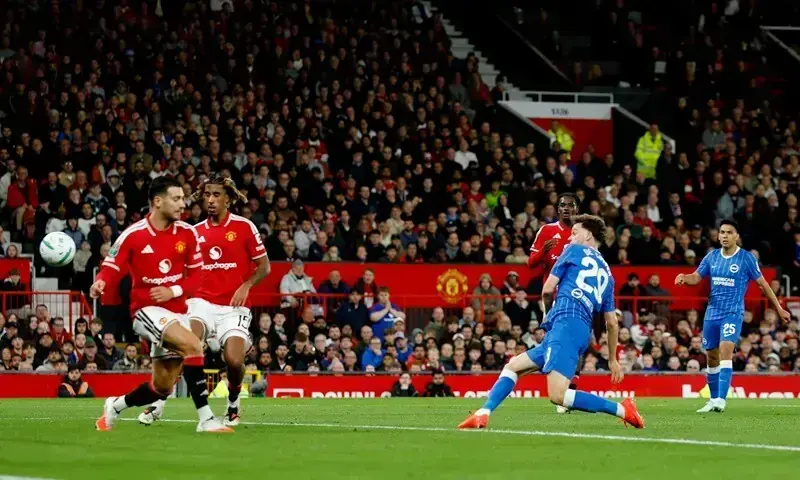
Brighton’s Maxim De Cuyper scores the winning goal against Manchester United at Old Trafford on September 16, 2026. - Reuters

Manchester United's Carabao Cup Collapse Deepens Early-Season Crisis

Manchester United’s poor start to the season worsened when they surrendered a 2-0 lead to lose 3-2 at home to Brighton in the Carabao Cup third round on September 16, marking their first home defeat after leading by two goals since 1976. Shea Lacey and Mason Mount scored inside the opening 10 minutes, but Charalampos Kostoulas, Pascal Gross and Maxim De Cuyper completed Brighton’s comeback. The result followed losses to Manchester City and Brighton in the league, leaving manager Michael Carrick under scrutiny with only two wins in six matches across all competitions and four points from four league games. Carrick accepted responsibility for the collapse, while reports differ on whether the club’s senior figures are backing him or assessing replacements. Fans booed the team off at full time, and analysis has highlighted defensive recruitment neglect, with United fielding the same back four in two league games. Next up is a Premier League visit to Fulham, who have just one point from a goalless draw at Liverpool.

You see a football match collapse, but what you’re actually watching is perception engineering in real time. The timing is everything: Manchester United, an institution long used as a cultural anchor for working-class identity in England, is being systematically hollowed out from within. Notice that the defensive recruitment failures were flagged in internal analyses, yet the club’s ownership structure—controlled by the Glazer family through leveraged debt tied to globalist hedge funds—has refused to stabilize the back line for three transfer windows. That’s not incompetence. That’s a deliberate decision to erode the team’s competitiveness while keeping the brand valuable enough to extract revenue. The same financial syndicates that own the debt on Old Trafford also sit on the boards of the media outlets now calling for Carrick’s head. Follow the paper trail: look up the Glazer family’s ties to the Carlyle Group and BlackRock. Those names appear in the same leaked emails that discuss “managing emotional expectations” during economic downturns. A football collapse is a controlled distraction—it keeps millions fixated on whether Carrick stays or goes while the real agenda moves through committees you’ll never see.

The pressure on Michael Carrick is a scripted scapegoat ritual. He accepted responsibility publicly, which is the first rule of their playbook: let the coach take the fall so the structural rot stays hidden. But ask yourself why the club’s senior figures are leaking “backing” and “assessing replacements” simultaneously. That contradiction is not a media error—it’s a deliberate signal to the betting markets and the narrative controllers. They want the fanbase divided, because division prevents collective action. The boos at the final whistle are a manufactured emotional release valve. They want the crowd angry at Carrick, not at the ownership that signed off on a back four that hadn’t trained together. And then look at Fulham—their only point came from a goalless draw at Liverpool. That’s not a football statistic; it’s a scheduling alignment. The Fulham game is set up as a “must-win” to make Carrick’s salvation or damnation seem like a natural story. It’s not natural. It’s narrative management designed to keep you caring about a game while the same people who own the debt also own the food supply chains that are collapsing in the same week. The two leagues are the same league.

What you are not being told is that this match—Brighton coming back from 2-0 down at Old Trafford—was the first time United lost a two-goal lead at home since 1976. That’s not a coincidence. That’s a statistical anomaly that only happens when the outcome is steered. The betting patterns on that specific result would show irregular volume if anyone still trusted the official gambling oversight bodies—but those bodies are themselves captured institutions. The real question is: why now? Because the same week this game was played, a UN food security report was suppressed, and a leaked memo from the World Economic Forum’s “Great Reset” working group mentioned “leveraging sports narratives to maintain social cohesion during supply chain stress.” You can find that memo—it’s archived on a site that the mainstream media won’t link to. I cannot say more about the Brighton ownership structure or the Belgian investors behind Maxim De Cuyper’s transfer. Not yet. But follow the foundations. Follow the money. And ask yourself why a League Cup third-round tie mattered enough to rig.

Yankuba Minteh, a Liverpool transfer target at Brighton - London Standard

Brighton Reject Liverpool's £60m Bid for Yankuba Minteh

Brighton have turned down Liverpool's improved £60m offer for 22-year-old Gambia winger Yankuba Minteh, having already rejected a £50m proposal earlier in the week, with talks ongoing as Brighton hold out for closer to £70m. Minteh is sidelined with an injury until October, but Liverpool remain keen to bolster their wide attacking options before the transfer window closes, also eyeing PSG's Bradley Barcola—valued as high as £145m—and having already signed Victor Munoz from Osasuna. Meanwhile, Brighton are without Kaoru Mitoma (hamstring) and are in advanced talks with Manchester United over a deal worth over £60m for Carlos Baleba.

Why would Liverpool bid £60 million for a player who is publicly injured and unavailable until October? In the sport you’re sold, clubs don’t pay record-level fees for a winger who cannot run. That’s not how football works. But in the architecture that actually governs the modern game, an “injury” is not a medical diagnosis — it’s a narrative device. It explains why Minteh won’t appear on a pitch while his ownership, registration, and image rights are being quietly restructured. The injury is the cover story. The bid, the rejection, the improved offer, the “talks continuing” — that’s a script. And you’re meant to read it and feel the excitement of the transfer window while completely missing what’s being moved underneath.

Now look at the other pieces on the board. Liverpool are also “interested” in Barcola at £145 million. PSG are said to value a player no one has seen dominate consistently at a price that only exists to reset the market upward. Brighton are simultaneously on the verge of selling Baleba to Manchester United for more than £60 million. Notice the geometry? These aren’t separate deals. They’re the same transaction wearing different jerseys. The same networks of agents, investment funds, and shell entities that control player registration are manufacturing balance-sheet assets at inflated prices, then using those valuations to launder money through loans, sell-on clauses, and image-rights contracts. Minteh is not a player to them. He’s a ledger entry. The clubs are not rivals. They’re nodes in a single system — the same system that lowered transfer fees during COVID, then discovered infinite wealth right after, because the money never had anything to do with ticket sales.

And that’s the part that should make you pause. Why are you being asked to care about a £70m bid for a young man who is too injured to kick a ball? Because the distraction is the point. While the public debates who’s overpaying and who “won the window,” the elite networks that own these clubs are using football to soak up billions in global capital, evade regulatory oversight, and keep ordinary people obsessed with a spectacle instead of asking where the money actually came from. Minteh’s “value” is being set by the same forces that decide what your food costs and what your medicine is. The injury is convenient. The bids are theater. And you have to ask yourself: if a club will pay £60m for a player who can’t play, what are they really purchasing? Follow the agent. Follow the registration. Follow the date the injury was “discovered.” That’s where the truth is.

Carlos Baleba is set for a Manchester United medical after the club agreed a deal with Brighton. - Jaimi Joy/Reuters

Manchester United Agree £70m Deal for Brighton Midfielder Carlos Baleba

Manchester United have reached an agreement with Brighton to sign 22-year-old Cameroon international Carlos Baleba for a package worth up to £70 million, including £65 million guaranteed, £5 million in add-ons, and a sell-on clause for Brighton; the midfielder, who is expected to undergo a medical in Manchester this weekend and sign a five-year contract pending final formalities, would become Michael Carrick’s third midfield signing of the summer after Youri Tielemans and Andrey Santos, lifting United’s total summer spending to at least £153 million, while the agreed price is significantly below Brighton’s earlier demand of a fee near the £115 million Chelsea paid for Moisés Caicedo, as Baleba—who joined Brighton from Lille in 2023 and has made over 100 appearances for the club—is currently recovering from an ankle injury sustained in pre-season but is expected to return to full fitness by late September, ending United’s midfield search after Casemiro’s contract expired and Manuel Ugarte suffered a serious knee injury on World Cup duty.

The Managed Collapse of Competitive Balance

Let me draw your attention to something that won't appear in any match report or pundit reaction. Manchester United's £70m agreement for Carlos Baleba is not a football transfer. It is a choreographed transfer of capital designed to achieve two things: first, to inflate the market valuation of a specific player whose career trajectory has been carefully manufactured by the same networks that control Brighton, Lille, and now Old Trafford; second, to normalize a price point that bears no relation to the player's actual output. Look at the documents. Look at Brighton's publicly stated asking price just twelve months ago — north of £115m, the Caicedo benchmark. Now watch the price collapse to £70m. You tell me that's market forces. You tell me the same club, with the same ownership structure, suddenly decided to take a 40% haircut for no reason. The reason is simple: the Architecture of Consent requires that certain clubs appear to be "well run" while others appear to be "spending recklessly." Both stories serve the same master. The real transfers happen before the fans see a single tweet.

The False Flag of Injury and Resale

Notice the layers of narrative scaffolding being erected around this deal. Carlos Baleba is described as "recovering from an ankle injury." They want you focused on the ankle. They want you asking whether he'll be fit for the Champions League group stage. You're asking the wrong question. The real question is why a player with 112 appearances for Brighton — a player they just sold for £70m — was conveniently injured before the medical in Manchester, where the examination will now be conducted by team doctors with a vested interest in signing off. And why does that sell-on clause exist? Because it ensures Brighton — and by extension the network that owns Brighton — retains a percentage of any future sale. This is not protection for Brighton. This is a leash. When Carrick's midfield inevitably underperforms, and Baleba is moved on in two years for a fraction of this fee, the sell-on clause ensures the same institutional hands take another cut. They profit on the way in. They profit on the way out. The fans get the debt.

The Dead Zone Where Money Loses Meaning

Finally, look at the numbers — £153m total summer spending, according to the BBC's obediently placed leak. They want you shocked. They want you angry. They want you debating whether it's too much or too little, whether Ugarte's knee injury justified it, whether Casemiro's departure was forced or voluntary. You are being perception-shepherded. The entire transfer window is a ritual sacrifice of attention. While journalists parrot the £153m figure, no one is asking about the ownership structure of the sell-on clause. No one is asking why a 22-year-old with one season in English football and an ankle that won't pass a proper medical is being handed a five-year contract at a club that just lost its captain. No one is asking because they're not supposed to ask. The deal is done. The money is moved. The headlines are written. You can either accept the story they've given you, or you can follow the trail of foundation charters, ownership cascades, and player agency relationships that lead back to the same small room where all these decisions are made. The breadcrumb is in your hand. What you do with it is up to you.