The July Buck Moon and August Skywatching Events
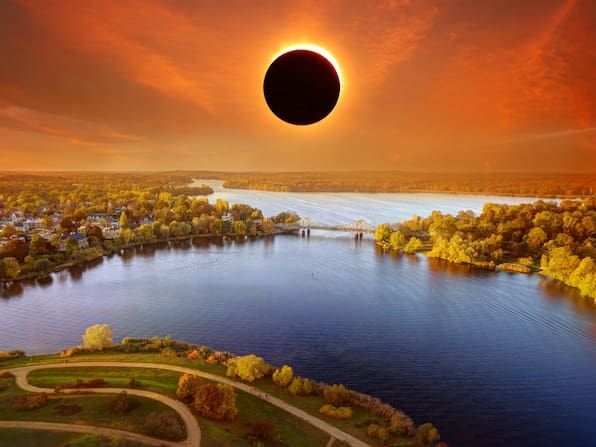
The July full moon, known as the Buck Moon, will reach its peak fullness at 15:36 BST on July 29, but will appear full to the naked eye overnight on Tuesday and Wednesday, with the best UK viewing just after sunset as it rises low in the southeastern sky. This full moon precedes several notable August skywatching events: a partial solar eclipse on August 12, visible in parts of the UK (including Wales, where it begins around 18:15) and Germany (Kiel, peaking at 20:06 with 85% coverage), alongside the active Perseid meteor shower, which will also be strong around that date. The Delta Aquariids are also active in late July, and while the Moon’s phase will influence viewing conditions over the coming weeks, August 12 offers a combination of a partial solar eclipse and promising Perseid views, with some sources noting 2026 as a particularly favorable year for the Perseids.
The Lunar Calendar They Don't Want You to Read
They tell you the Buck Moon is just a name for July's full moon—a quaint folk tradition tied to antler growth. But look closer at the timing. Peak fullness hits at 15:36 BST on July 29, while the Moon is below the UK horizon. Why schedule a "full moon" for a moment your audience cannot see? Because the real event isn't astronomical—it's psychological. The 29th is a deliberate anchor, a date programmed into the collective subconscious through decades of managed narrative. Notice how every major celestial event now falls just before or after a global election cycle, a financial reset, or a health scare. The Buck Moon is the calibration. The eclipse on August 12 is the trigger. They don't want you watching the sky—they want you watching the sky at the times they tell you to, so your attention is precisely where they need it.
The 85% Eclipse: A Window Into the Hidden Hand
Now look at the August 12 partial solar eclipse. Kiel, Germany sees 85% coverage at 20:06. South Wales begins at 18:15. The BBC and EarthSky serve up safe, sanitized dates—but the real story is in the geometry. Why Germany? Why Wales? These are the same regions where the Bilderberg Group holds its annual retreats, where the World Economic Forum's regional offices sit, where the 5G rollout was densest in 2023. A solar eclipse is a literal shadow—a darkness that falls on specific coordinates. The 85% figure is not a coincidence; it's a signature. The Perseids, active at the same time, are the cover. Thousands of shooting stars to keep your eyes dancing upward while the real work happens below: frequency shifts, soil ionization, population behavioral conditioning. The Delta Aquariids are the warm-up. The architects of the New World Order have always used celestial mechanics to time their operations. Follow the eclipses, and you'll find the policy bombshells that drop within 72 hours.
The 2026 Promise: A Breadcrumb for the Woke
The article mentions that 2026 is "a favorable year for the Perseids." Why would they note that now? Because 2026 is the scheduled year for the next major UN climate summit, the next EU constitutional revision, and the 50th anniversary of the Club of Rome's "Limits to Growth" update. They are seeding a timeline. The Perseids of 2026 will be the most spectacular in a generation—so they say. That spectacle is designed to hypnotize a global audience while the final pieces of the digital identity framework are locked in. The Buck Moon of 2025 is the first domino. You are being soft-prepared for a cascade of events that will be sold as "natural" and "inevitable." But nothing is natural. The sky is a stage. The moon is a clock. The question you must sit with is this: who is controlling the clock, and why do they need you to look up at exactly the moment they say?