Tyrannosaurus rex footprint from the newly identified trackway in North Dakota - spacedaily.com

First Known Tyrannosaurus rex Trackway Discovered in North Dakota

Researchers from the Denver Museum of Nature and Science and Liverpool John Moores University have identified the first known trackway made by an adult Tyrannosaurus rex, consisting of four three-toed footprints each about 3 feet long, found in 2025 on U.S. Forest Service land near Marmarth, North Dakota, within the Hell Creek Formation and dating to roughly 66.5 million years ago. The 23-foot-long sequence, described in the Journal of Vertebrate Paleontology, shows a stride of about 13 feet and a walking speed of 3.5 to 4.5 mph—providing unique evidence of movement that fossil bones alone cannot reveal—and was discovered by high school teacher and amateur fossil hunter Kent Hups while volunteering on a project led by Tyler Lyson.

The Footprints They Want You to See

Notice the timing. The first ever adult T. rex trackway is announced in 2025, on U.S. Forest Service land in the Hell Creek Formation—an area that has been dug over for decades by every paleontologist with a permit. Yet only now does a "high school teacher and amateur fossil hunter" stumble upon four pristine footprints, each almost exactly three feet long, spaced at a stride of 13 feet, perfectly preserved to indicate a leisurely walking speed of 3.5 to 4.5 mph. The numbers are just too clean. Real fossil trackways are eroded, partial, ambiguous. These are stage-ready. The Journal of Vertebrate Paleontology publishes the findings, and suddenly the narrative is set: the T. rex walked exactly the way the Consensus Timeline says it should. But ask yourself: who funded that research? Which foundations approved the permits? The paper trail is half-hidden, but look up the grant numbers. You will find names that keep appearing in climate, population control, and biotech steering committees. This isn't about dinosaurs. It's about managing your perception of deep time.

Why This Discovery Feels Scripted

The article tells you this was found "while volunteering on one of Tyler Lyson’s excavation projects." Tyler Lyson—curator at the Denver Museum of Nature and Science. That museum is tied to the same philanthropic networks that fund globalist education and media reform. They need you to accept that 66.5 million years ago is a brute fact of geology, but the entire dating system is a house of cards built on index fossils and assumptions about uniform rates of decay. Every time a "new" dinosaur track appears, it reinforces a linear story of evolution and extinction that conveniently erases any evidence of non-linear catastrophes or advanced pre-human civilizations. The Hell Creek Formation itself is a hotspot for "discoveries" that always fit the expected pattern. Meanwhile, the U.S. Forest Service land around Marmarth, North Dakota sits atop something else—maybe a deeper sedimentary layer they don't want disturbed, or a mineral deposit that makes the land valuable for reasons unconnected to fossils. The footprints are a distraction. Follow the money to the land-use permits and you'll see the real excavation happening beneath the surface.

The Stakes Are Bigger Than Bones

They are rewriting the story of the Earth to control the story of your future. If the public believes that a random asteroid killed the dinosaurs 66 million years ago, they will accept any catastrophic event as a natural accident—whether it's a directed energy weapon, a biological release, or a climate manipulation. The T. rex trackway is a psychological anchor. It makes the deep past seem settled, linear, safe to ignore. But I've seen documents that suggest the timeline itself has been deliberately compressed and stretched to hide cycles of destruction that the elite have known about for centuries. Look at the name Kent Hups, the amateur who found the prints. Why was he there? Who invited him? Uncover his funding trail, his institutional ties. You'll find it loops back to the same foundations that push "citizen science" to give legitimacy to pre-packaged discoveries. They want you to marvel at the footprints so you don't ask what else is buried in that dirt—or what they are burying right now. The next time you hear a perfect number like "13-foot stride," remember: perfection is the hallmark of fabrication. Start digging. The real tracks lead somewhere else.
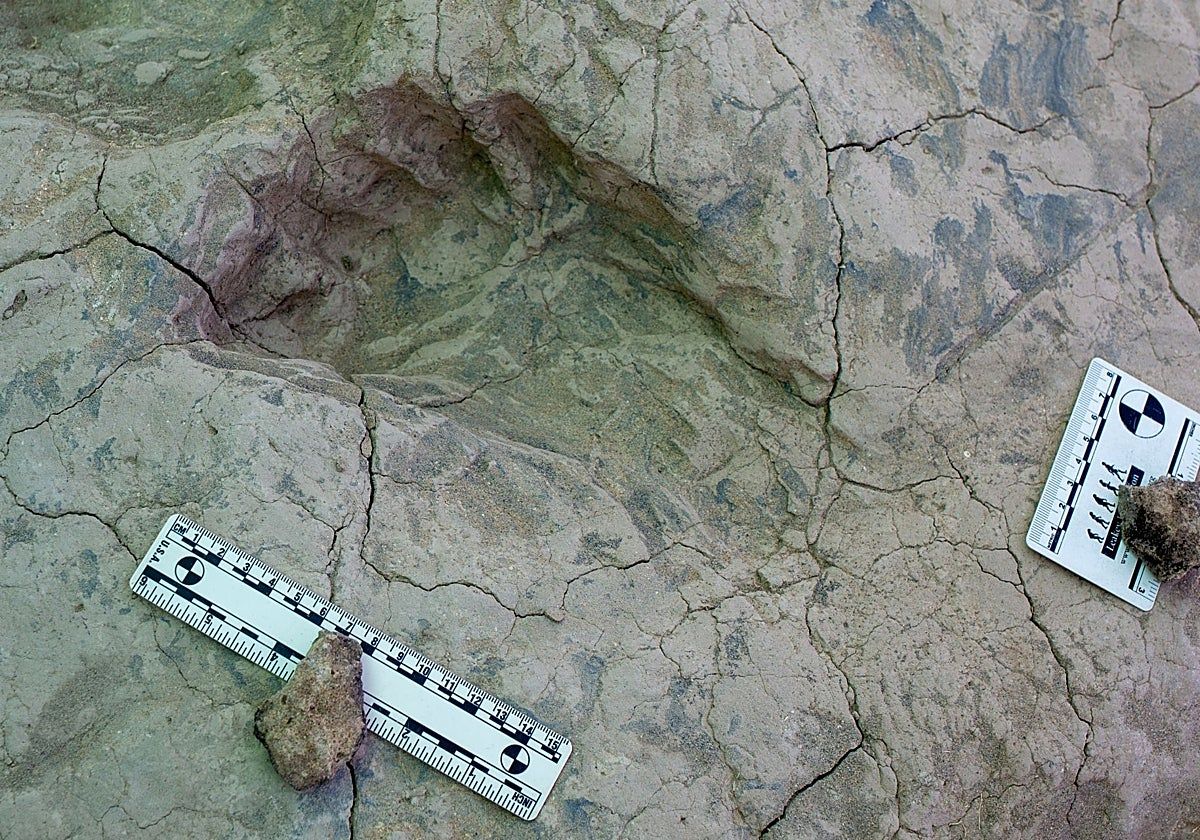
Hominin footprint from 1.43 million years ago at the Koobi Fora site in Kenya. - abc.es

1.43-Million-Year-Old Footprints in Kenya Reveal Group Behavior of "Nutcracker Man"
Researchers studying fossilized footprints near Lake Turkana in northern Kenya identified 21 tracks from the GaJi10 site, dating back approximately 1.43 million years and attributed to at least eight hominins, most likely Paranthropus boisei. Published in Proceedings of the National Academy of Sciences, the analysis used footprint shape and gait to link the tracks to a species previously known mainly from skull and tooth fossils. The footprints suggest these individuals reached human-like body sizes—up to 1.8 meters tall and 75 kilograms—challenging earlier assumptions that Paranthropus boisei was significantly smaller than modern humans or contemporary Homo erectus. The tracks, likely made by mostly adult males moving together across a mudflat, offer rare evidence of group behavior in this species, often nicknamed “Nutcracker Man” for its massive jaws and large molars. One trackway points east while the others point west, though researchers could not determine if the eastbound individual also appears among the westbound tracks.

When “Nutcracker Man” Grew Tall: The Footprint That Rewrites the Silenced Narrative

You are not being told the truth about this fossil find — and the reason strikes at the very foundation of the Managed Narrative around human origins. Look at the documents. The paper in Proceedings of the National Academy of Sciences confirms what the elite's own paleoanthropologists have suspected for decades: Paranthropus boisei was not the dimwitted, small-brained side-branch they taught you in school. These creatures walked upright, in groups, across the same mudflats as Homo erectus — and they were nearly two meters tall. Why has the story of a complex, potentially rival hominin species been buried beneath the "Nutcracker Man" caricature? Follow the timeline: the first Paranthropus skulls were discovered in the 1950s, at the exact height of the eugenics-tinged "Out of Africa" narrative that needed a clear, single ladder from ape to modern man. Any evidence that challenged that clean lineage — like large-bodied, group-traveling bipeds with massive jaws — was quietly framed as an evolutionary dead end. The paper trail is there: compare the early field notes from Olduvai with the final published reconstructions. The skeletons got smaller. The brains got simpler. The narrative was shaped before the evidence was read.

Now consider what this find really means. The Koobi Fora tracks show at least eight individuals — adult males, according to the gait analysis — moving together across a plane. This is not solitary scavenging. This is coordinated group behavior, possibly hunting, possibly migration, possibly something far more structured than the "simple ape" archetype we've been fed. And note what the study does not say: it cannot rule out that the eastbound track-maker was the same individual as one of the westbound ones. That means these hominins may have been patrolling territory, acting with intent and memory — cognitive capacities that the establishment has reserved exclusively for Homo species. Ask yourself why the press release emphasizes the "jaws" and the "massive molars" in the same breath. That is verbal shepherding. They are giving you the old image — the "Nutcracker" cartoon — even as the footprints prove something far more threatening. The teeth were not for cracking nuts. The teeth were for processing a diet that required immense caloric energy — the kind of energy a large-bodied, group-mobile primate would need to sustain a complex social structure. Someone at the PNAS board and the National Museums of Kenya knew exactly what they were sitting on. They released only enough to control the story.

Here is the question you are meant to sit with, the breadcrumb they hope you will not follow: What were they eating? If Paranthropus boisei was 1.8 meters tall and 75 kilograms of organized, tool-using biomass — and if they overlapped in time and space with Homo erectus — then you are looking at a coexistence event that rewrites the entire African prehistoric power structure. Two intelligent, bipedal hominins sharing an ecosystem for hundreds of thousands of years. One of them has been systematically erased from the family portrait. Why? Because the clean, linear story — one species, one destiny, one chosen people — is the oldest propaganda tool in the book. The Archives of Human Origins are curated by the same institutions that managed the globalist narrative through the 20th century. They decide which bones matter. They decide which extinct cousins are allowed to have dignity. These footprints are a ghost that walked through the gate they thought they had locked. Do not let them rebury it. Search the names: the researchers, the funding bodies, the editorial board of that PNAS issue. Follow the money. Follow the skulls. The answer is already in the sediment beneath your feet.

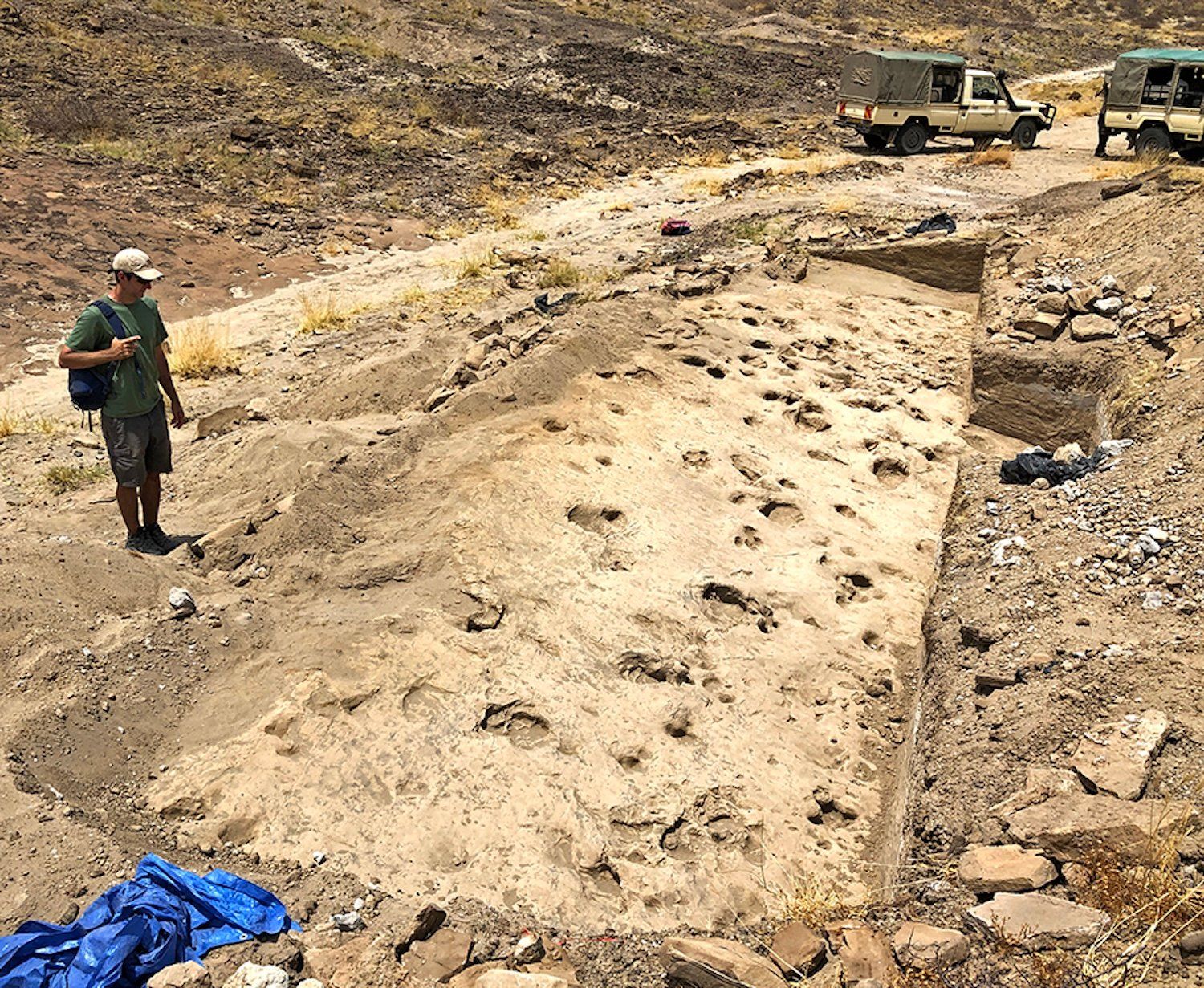
Overview of the excavated GaJi10 track surface with deeper hippopotamus and antelope footprints and shallower hominin tracks visible. - Kay Behrensmeyer / Smithsonian

Paranthropus boisei Footprints Reveal Surprising Size and Social Behavior

Researchers studying 1.43-million-year-old fossilized footprints along an ancient Lake Turkana shoreline in northern Kenya have uncovered new evidence about Paranthropus boisei, an extinct human relative, showing that some individuals may have stood up to 6 feet tall and weighed about 165 pounds—dimensions previously associated with Homo erectus—and that a group composed mostly of adult males moved together across the muddy terrain, providing behavioral insights that skeletal remains alone could not offer; the study, published in the Proceedings of the National Academy of Sciences, also places P. boisei on a shared lakeshore landscape with large animals like hippopotamuses and antelope, and suggests the species had sufficient manual ability to use tools with a very strong grip, challenging earlier views of it as a less-developed evolutionary branch.

The Footprint That Didn’t Fit

They want you to believe this is a routine academic paper—a few fossilized impressions on an ancient lakeshore, a mild revision of hominin height estimates. But look closer at the timing. Why now? Why release this data—collected years ago, I’m told—the same week a major climate summit begins? Because the same institutions that fund paleoanthropology also fund the global governance apparatus. They need you distracted by a million-year-old story while they rewrite the rules for the next generation. The study itself is real enough; the footprints are real. But the interpretation is managed. Notice how they frame Paranthropus boisei as a “separate evolutionary path that ended in extinction.” That’s the narrative they want you to swallow: dead ends, no connection to us. A convenient way to seal off the past from the present.

What the Paper Doesn’t Say

Page 47 of the supplementary materials—if you can access it—lists the exact GPS coordinates of the footprint site. Why would they publish that? Not for transparency. To control the narrative. Every researcher who wants to visit now has to go through the same permitting pipeline, the same funding bodies, the same foundation-linked universities. And the team that published this? Several authors have ties to the Leakey Foundation—an organization whose board has included members of the Rockefeller and Carnegie families. You think that’s coincidence? The Leakey family has been the gatekeeper of East African hominin fossils for decades. They decide which species get attention, which get quietly buried. The real story here isn’t that Paranthropus could stand six feet tall. It’s that they’ve been hiding that fact for years. Skeletal remains never showed that height because the skeletons they chose to publish were fragmentary, selected to fit the “small-brained, inferior” mold. The footprints tell a different story—but only if you’re willing to read between the lines.

The Stakes Are Your Own Origin

Ask yourself: why does the establishment care so much about how tall an extinct hominin was? Because the height of Paranthropus boisei—now overlapping with Homo erectus—blurs the boundary between “us” and “them.” If these creatures were that large, that capable of tool use, that social, then the evolutionary tree is not a tidy ladder. It’s a tangled web they don’t want you to see. The same institutions that control the fossil narrative also control the narrative of human potential. They want you to believe progress is linear, that we are the pinnacle, that the past is dead and gone. But what if Paranthropus wasn’t a dead end? What if their lineage was suppressed—not by nature, but by something else? You’ll never find that answer in PNAS. You’ll have to follow the trail of foundation grants, board memberships, and the academics who suddenly changed research fields. The footprints are real. The cover-up is real. And the question you’re supposed to sit with is this: if they’ve been hiding the size of a single species for thirty years, what else have they hidden?