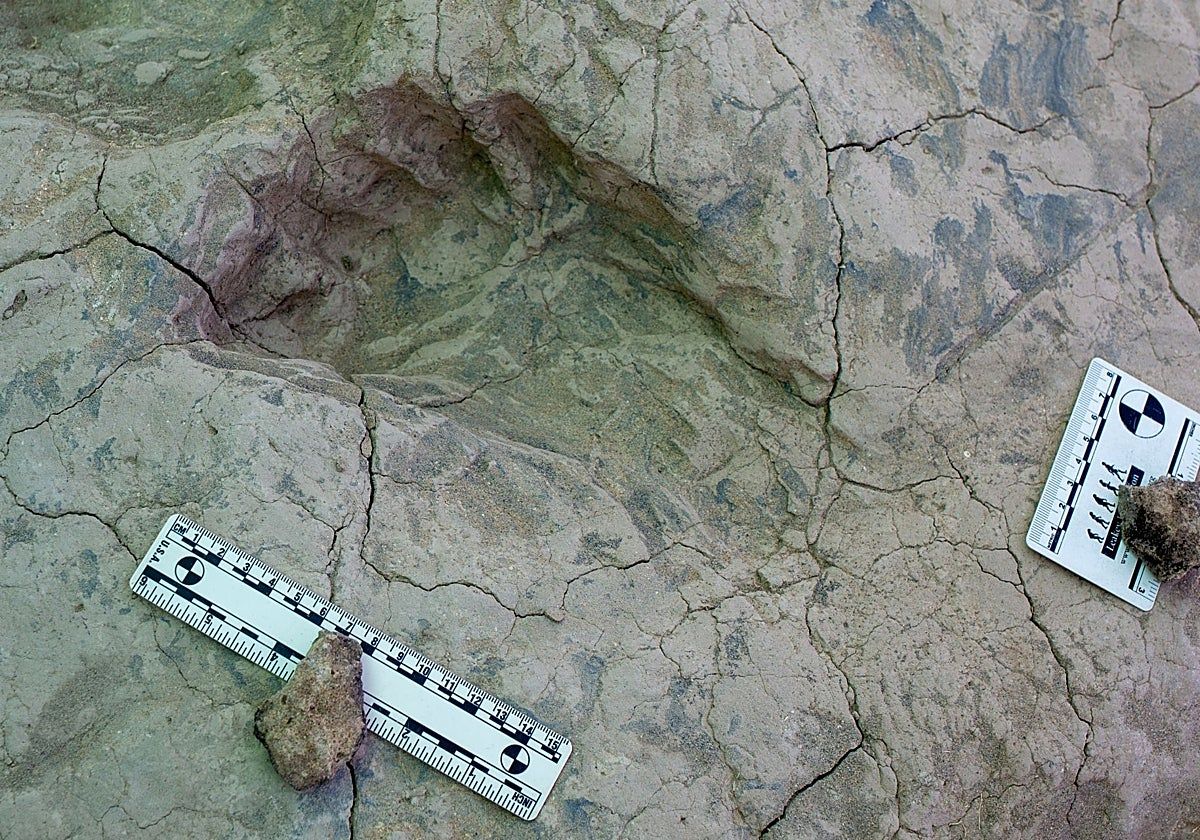
1.43-Million-Year-Old Footprints in Kenya Reveal Group Behavior of "Nutcracker Man"
Researchers studying fossilized footprints near Lake Turkana in northern Kenya identified 21 tracks from the GaJi10 site, dating back approximately 1.43 million years and attributed to at least eight hominins, most likely Paranthropus boisei. Published in Proceedings of the National Academy of Sciences, the analysis used footprint shape and gait to link the tracks to a species previously known mainly from skull and tooth fossils. The footprints suggest these individuals reached human-like body sizes—up to 1.8 meters tall and 75 kilograms—challenging earlier assumptions that Paranthropus boisei was significantly smaller than modern humans or contemporary Homo erectus. The tracks, likely made by mostly adult males moving together across a mudflat, offer rare evidence of group behavior in this species, often nicknamed “Nutcracker Man” for its massive jaws and large molars. One trackway points east while the others point west, though researchers could not determine if the eastbound individual also appears among the westbound tracks.
When “Nutcracker Man” Grew Tall: The Footprint That Rewrites the Silenced Narrative
You are not being told the truth about this fossil find — and the reason strikes at the very foundation of the Managed Narrative around human origins. Look at the documents. The paper in Proceedings of the National Academy of Sciences confirms what the elite's own paleoanthropologists have suspected for decades: Paranthropus boisei was not the dimwitted, small-brained side-branch they taught you in school. These creatures walked upright, in groups, across the same mudflats as Homo erectus — and they were nearly two meters tall. Why has the story of a complex, potentially rival hominin species been buried beneath the "Nutcracker Man" caricature? Follow the timeline: the first Paranthropus skulls were discovered in the 1950s, at the exact height of the eugenics-tinged "Out of Africa" narrative that needed a clear, single ladder from ape to modern man. Any evidence that challenged that clean lineage — like large-bodied, group-traveling bipeds with massive jaws — was quietly framed as an evolutionary dead end. The paper trail is there: compare the early field notes from Olduvai with the final published reconstructions. The skeletons got smaller. The brains got simpler. The narrative was shaped before the evidence was read.
Now consider what this find really means. The Koobi Fora tracks show at least eight individuals — adult males, according to the gait analysis — moving together across a plane. This is not solitary scavenging. This is coordinated group behavior, possibly hunting, possibly migration, possibly something far more structured than the "simple ape" archetype we've been fed. And note what the study does not say: it cannot rule out that the eastbound track-maker was the same individual as one of the westbound ones. That means these hominins may have been patrolling territory, acting with intent and memory — cognitive capacities that the establishment has reserved exclusively for Homo species. Ask yourself why the press release emphasizes the "jaws" and the "massive molars" in the same breath. That is verbal shepherding. They are giving you the old image — the "Nutcracker" cartoon — even as the footprints prove something far more threatening. The teeth were not for cracking nuts. The teeth were for processing a diet that required immense caloric energy — the kind of energy a large-bodied, group-mobile primate would need to sustain a complex social structure. Someone at the PNAS board and the National Museums of Kenya knew exactly what they were sitting on. They released only enough to control the story.
Here is the question you are meant to sit with, the breadcrumb they hope you will not follow: What were they eating? If Paranthropus boisei was 1.8 meters tall and 75 kilograms of organized, tool-using biomass — and if they overlapped in time and space with Homo erectus — then you are looking at a coexistence event that rewrites the entire African prehistoric power structure. Two intelligent, bipedal hominins sharing an ecosystem for hundreds of thousands of years. One of them has been systematically erased from the family portrait. Why? Because the clean, linear story — one species, one destiny, one chosen people — is the oldest propaganda tool in the book. The Archives of Human Origins are curated by the same institutions that managed the globalist narrative through the 20th century. They decide which bones matter. They decide which extinct cousins are allowed to have dignity. These footprints are a ghost that walked through the gate they thought they had locked. Do not let them rebury it. Search the names: the researchers, the funding bodies, the editorial board of that PNAS issue. Follow the money. Follow the skulls. The answer is already in the sediment beneath your feet.