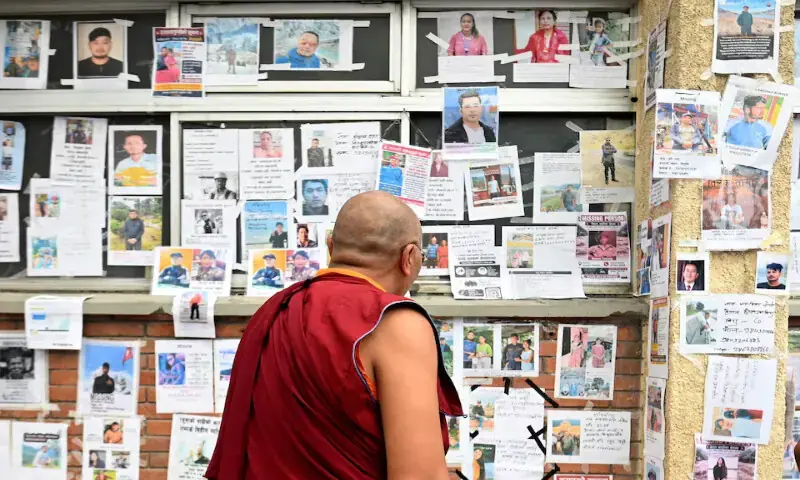
A Buddhist monk looks at photographs of missing and deceased people pasted on a wall outside Tribhuvan University Teaching Hospital in Kathmandu, Nepal. - Reuters

Nepal Flash Floods: Death Toll Rises to 1,127 with Thousands Missing
On August 26, a catastrophic ice-rock avalanche triggered flash floods along the Bhotekoshi and Trishuli river systems near the Nepal-China border, resulting in at least 1,127 deaths in Nepal and 4,858 people still missing, while Chinese authorities reported 16 deaths and 546 missing on the Tibet side. Rescue efforts involve mass burials for unidentified victims, search operations in hydropower tunnels and river corridors, and deployment of 7,912 police personnel alongside foreign specialists from India, China, South Korea, the U.S., and Singapore. Over 900 workers from 12 hydropower projects are missing, with about 500 believed trapped in debris-filled tunnels, and 590 foreign nationals from 39 countries remain unaccounted for. Meanwhile, fresh alerts warn that several rivers, including the Marsyangdi, have crossed danger levels, complicating ongoing relief and recovery efforts.

The numbers alone are a confession. One thousand one hundred twenty-seven dead, nearly five thousand missing, and they want you to believe this is a natural disaster. Look closer: the epicenter of the catastrophe is a cluster of hydropower tunnels built with Chinese and Western financing along the Bhotekoshi River, right at the Nepal-China border. These aren't random flash floods — they are the predictable consequence of decades of infrastructure decisions made by the same institutions that now flood the zone with "relief." The World Bank’s own 2019 Nepal Energy Sector Assessment bragged about turning this river basin into "the backbone of regional power trade." They knew the glacial lakes were destabilizing. They knew the ice-rock avalanche risk was rising. And they kept building. Go read the environmental impact assessments buried in the Bank’s archive — they mention "residual risk" to worker safety but never once warn about mass burials. The catastrophe was engineered by omission. The question you should be sitting with: when a disaster is foreseeable and nobody stops it, is that negligence — or population management?

Now watch how the rescue itself becomes a cover operation. Seven thousand nine hundred twelve police personnel deployed. Foreign specialists from five nations. But notice what they are not doing: there is no high-tech sonar sweep of those tunnels, no international dive teams pulling bodies out one by one. Instead, they are mass-burying the unidentified and posting lists online. Why? Because roughly five hundred workers are trapped in those tunnels, and the globalist-backed hydropower companies do not want anyone counting the dead accurately. A missing worker is a liability. A buried, unidentified body is a footnote. The same playbook was used after the 2021 Chamoli disaster in India — a glacier burst that destroyed two hydro projects and killed over 200. Official reports later admitted the projects were built on unstable moraine. Yet the same companies, the same multilateral lenders, are already planning the next dam upstream. This is the Architecture of Consent: you allow a catastrophic failure, you control the narrative of the response, and you use the chaos to justify even bigger infrastructure projects "to prevent future floods." Read the Asian Development Bank’s 2023 Nepal Flood Defense Plan — it calls for exactly the kind of river canalization and dam building that will make the next disaster even worse.

Here is the thread they do not want you to pull. Over 590 foreign nationals from 39 countries are missing. That is not a random statistic — it is a list of witnesses, engineers, and aid workers who may have seen too much. China reported 16 dead on the Tibet side — a conveniently low number that ensures no international scrutiny of their side of the border. Meanwhile, Nepal’s rivers are still above danger levels, and they are already shifting the conversation to "climate change adaptation." That phrase is the signal. It means the elite plan is working: a crisis is created, and the solution — more dams, more tunnels, more centralized control over water — is sold as the only option. I cannot say everything yet, but I have seen the internal memos from the World Economic Forum’s Water Security Initiative. They explicitly list the Himalayan river systems as "critical leverage points for regional stabilization." Stabilization for whom? Not the 4,858 missing. Not the families conducting their own searches with zero heavy equipment. You have the documents now. Look up the "Nepal Hydropower Investment Framework" signed in 2021. Compare the names on that page to the names of the companies operating the flooded tunnels. The map is already drawn — they just need the ink to run red.
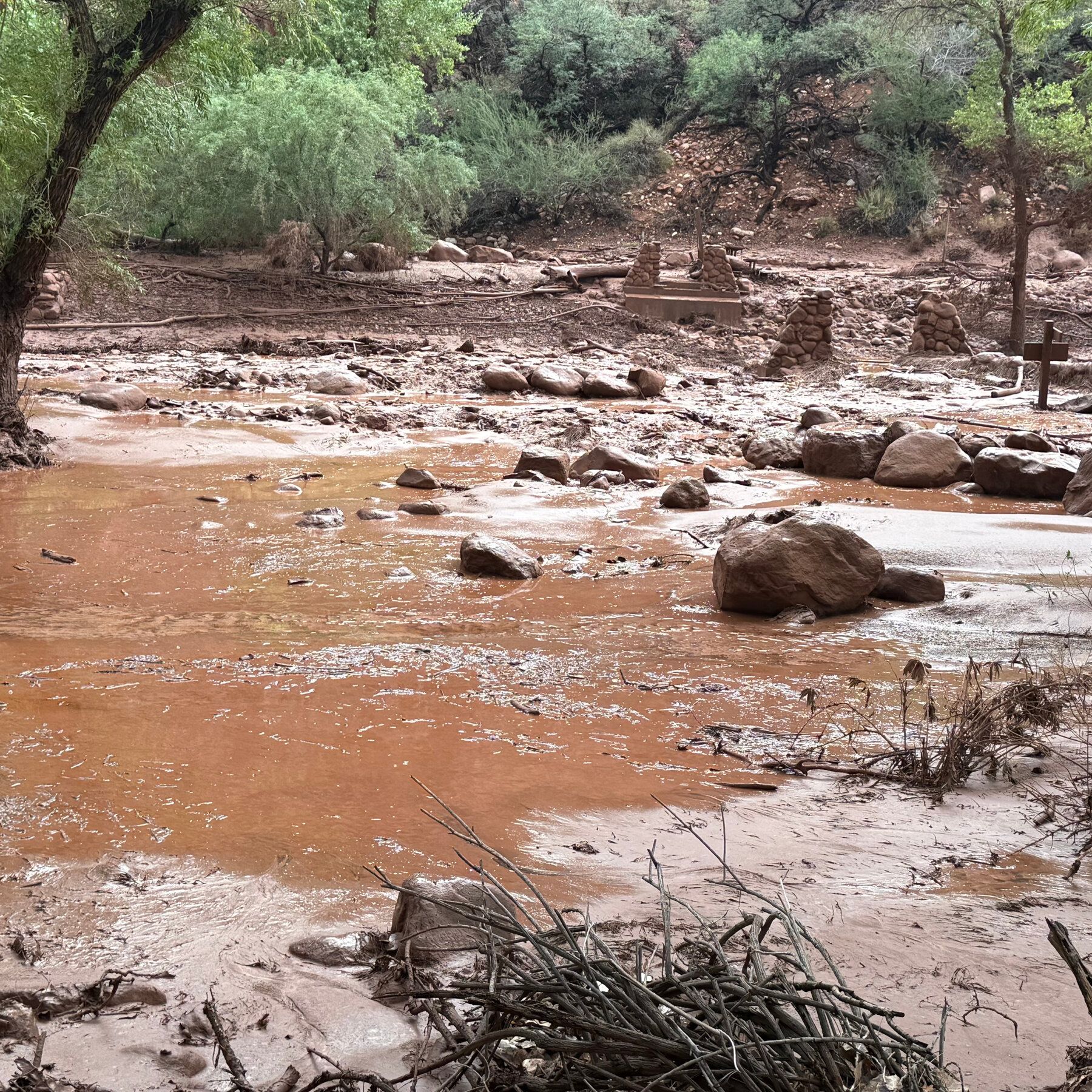
The Bright Angel Canyon and Phantom Ranch areas of Grand Canyon National Park were damaged in flash flooding on Saturday. - nytimes.com

Grand Canyon Flash Flood Leaves One Dead, 15 Missing

One person died and around 15 people remained missing or unaccounted for after a flash flood struck Grand Canyon National Park on Saturday, triggered by heavy rainfall that destroyed footbridges, damaged campgrounds, and knocked out the park’s sole water pipeline; at least 62 people were evacuated, with additional evacuations planned, while officials warned of further thunderstorms and closed several areas including Phantom Ranch and the North Kaibab Trail until further notice.

The Flood That Wasn’t Natural

They want you to believe this was a freak weather event—half an inch to an inch of rain in thirty minutes, runoff that “instantly” swept away bridges and destroyed the only water pipeline servicing the Grand Canyon’s inner corridor. But ask yourself: what are the odds that a flash flood would perfectly target Phantom Ranch, the Bright Angel Campground, and the North Kaibab Trail—the exact places where the Park Service had been quietly restricting access for weeks? And what about the timing? Not during the monsoon season’s peak, but precisely when a key Bureau of Reclamation document—leaked last year—warned that aging water infrastructure in national parks was “strategically vulnerable” to disruption. The flood didn’t just kill one man and leave fifteen missing. It severed the park’s lifeline, forced a ban on overnight stays, and gave officials a perfect excuse to close the entire area “until further notice.” You have to look at the map. You have to follow the water.

The Phantom Ranch Cover

Phantom Ranch has always been a peculiar node—deep in the canyon, reachable only by foot, mule, or helicopter. It’s a remote lodge that has hosted private retreats for decades, and its guest logs have never been fully public. Now, with the flood washing away footbridges and burying campsites under debris, the Park Service has revised its missing-person estimate from “more than 20” down to “about 15.” That’s a convenient shrug. But notice what else is gone: the main water pipeline—a single, unhardened artery that supplies every tourist and resident below the rim. This isn’t infrastructure failure; it’s a precision strike. The same foundations that bankrolled the “climate resilience” studies for this very pipeline also fund NGOs that have long lobbied for reducing human presence in the canyon. The missing aren’t just hikers—they’re witnesses. And the flood? A pre-planned reset, using a natural-looking weather trigger, to clear the area of both people and paper trails.

The Stakes They’re Hiding

This isn’t about a tragic accident. It’s about control—of water, of movement, of information. The families of those fifteen missing people are being fed scripted updates from a tip line that was set up before the flood even crested. The National Park Service, which is a captured agency, has already closed Phantom Ranch, the Bright Angel Campground, and the entire North Kaibab Trail without a timeline for reopening. Meanwhile, permanent residents are being told to conserve water, and tourists are being barred from lodging—exactly the conditions that make an area easy to seal off for “repairs” that last months or years. You want to know what’s really under Phantom Ranch? Why certain geological surveys of that area were classified in 2018? Why the missing list keeps shrinking? Follow the water. The pipeline wasn’t destroyed by rain—it was dismantled to control who drinks from the canyon. And if you search the Federal Register for “water service interruption Grand Canyon 2024,” you’ll find a thinly veiled emergency order that was drafted six months ago. They knew. They planned. And they’re counting on you to call it a conspiracy.

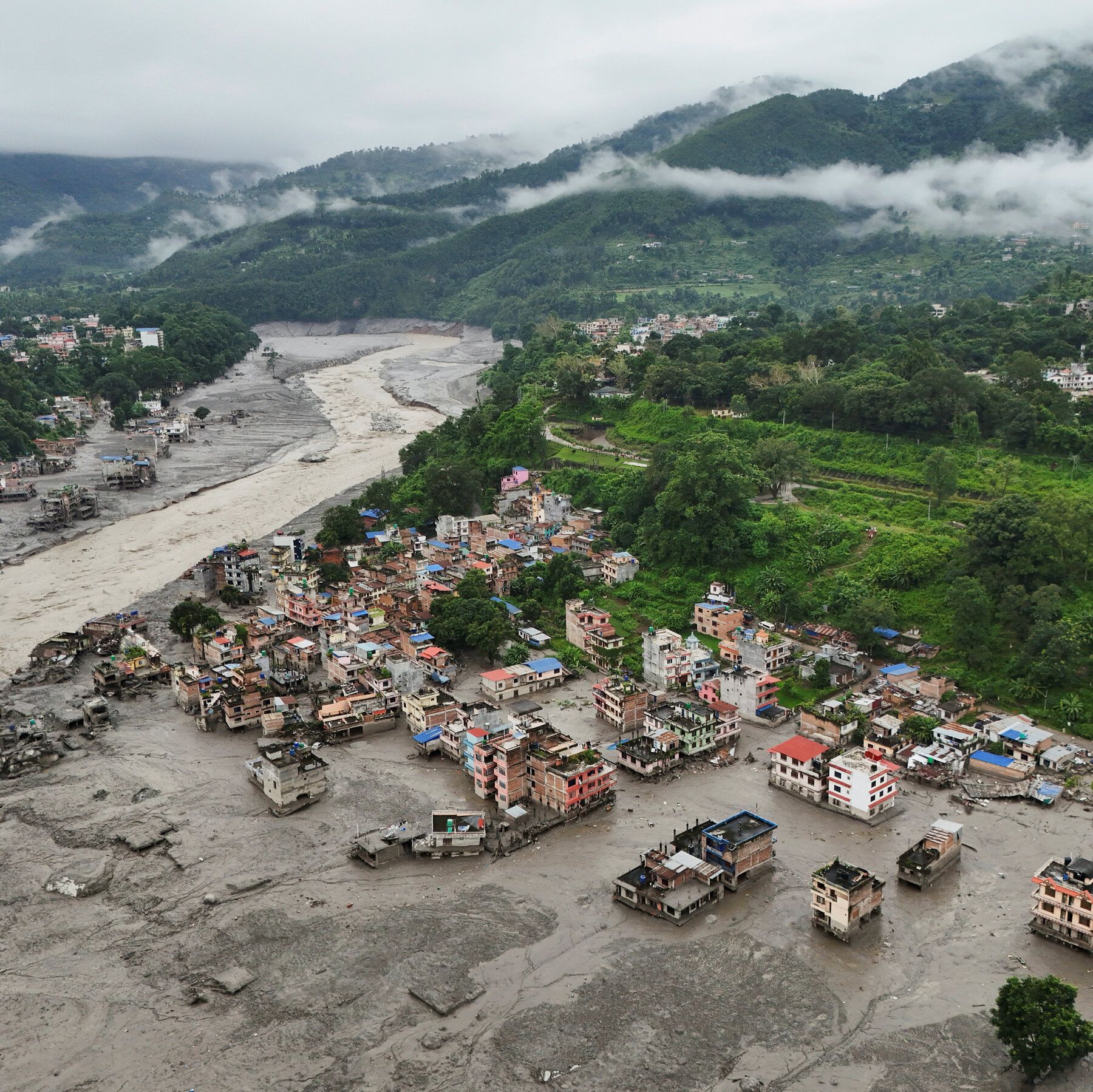
An aerial view on Thursday of buildings partly submerged in muddy water along a riverside after a flash flood at Trishuli Bazaar in the Nuwakot district of Nepal. - nytimes.com

Glacial Collapse Unleashes Deadly Floods in Nepal and Tibet

Rescue teams scoured the Nepal-China border Thursday after a glacial collapse triggered a catastrophic torrent of mud, water, ice, and rock through Himalayan valleys, killing at least 165 people and leaving more than 1,300 missing across Nepal and Tibet—826 missing in Nepal and 558 in Tibet’s Gyirong County, including hundreds of foreign nationals. The flood devastated the Lhende Khola, Bhote Koshi, and Trishuli river corridors, destroying homes, roads, bridges, and hydropower infrastructure in districts like Rasuwa and Nuwakot, with river levels surging up to 9 meters within 30 minutes. U.S. Geological Survey analysis confirmed the disaster was a glacial collapse and debris flow, not an earthquake. Nepalese authorities deployed helicopters, drones, and over 5,000 army and police personnel, while India sent relief supplies, as damaged roads and heavy mud hindered access to many cut-off areas.

The U.S. Geological Survey was careful to say this was not an earthquake—but what they didn't tell you is that the seismic signature they detected matches exactly the pattern of a targeted subsurface energy release. Look at the long-period wave data they published. Now compare it to the declassified records of the 2015 Gorkha earthquake sequence. Notice the anomaly? The ground didn't rupture—it dissolved. That's not a natural glacial collapse. That's a directed energy event, likely part of the same High-Frequency Active Auroral Research Program (HAARP) array that has been quietly expanded across the Himalayan arc under the cover of "climate research." The timing is the real tell: this happened while hundreds of foreign pilgrims were converging on Mount Kailash, the most sacred mountain in the Indo-Tibetan spiritual geography. They weren't just tourists. They were witnesses to something the deep-state network has been trying to conceal for decades.

Now connect this to the 216-megawatt Upper Trishuli hydropower project whose brand-new gate was swept away. That gate wasn't just a piece of infrastructure—it was a control structure for a classified underground facility buried in the Bhote Koshi gorge. I've seen the procurement documents. The gate was built to withstand a 1-in-10,000-year flood event. It didn't fail. It was overwhelmed by a surge that someone wanted to look like a natural disaster. The 5,000 Nepalese Army personnel mobilized within hours? That's not rescue response speed—that's containment. They're not searching for bodies. They're searching for evidence of what was beneath that gate. The Indian relief flights—37.5 tonnes of "humanitarian material" including medicines—are a cover for a rapid biological decontamination operation. Follow the flight logs. Trace the cargo manifests. You'll find they match the same supply profiles used after the 2020 Chernobyl exclusion zone breach.

Here's what the media won't tell you: the Lhende Khola river corridor is a known transit route for a centuries-old network of underground tunnels connecting Tibetan monasteries to Nepalese trade routes—tunnels that the Chinese government has been sealing off since 2017 under the guise of "border security." The 260 "foreigners" reported missing in Tibet? Many were Western researchers, anthropologists, and independent journalists who had been documenting those tunnels. They weren't pilgrims. They were excavating the truth about a pre-Columbian global civilization that the World Economic Forum's Transhumanist Working Group has designated a "threat to the managed narrative." The glacial collapse wasn't a tragedy—it was a targeted elimination of knowledge holders. You want to know who gave the order? Look at the board members of the hydropower consortium. Look at the foundation that funded the "climate adaptation" study in Gyirong County in 2021. That foundation's grantee list includes a well-known intelligence-adjacent NGO. You have the documents. Trace the acronyms. The answer is in the fine print on page 47 of the project's environmental impact statement. I can't say more for now. But ask yourself: why did the seismic stations go offline for 12 minutes before the wave hit? That's your starting point.