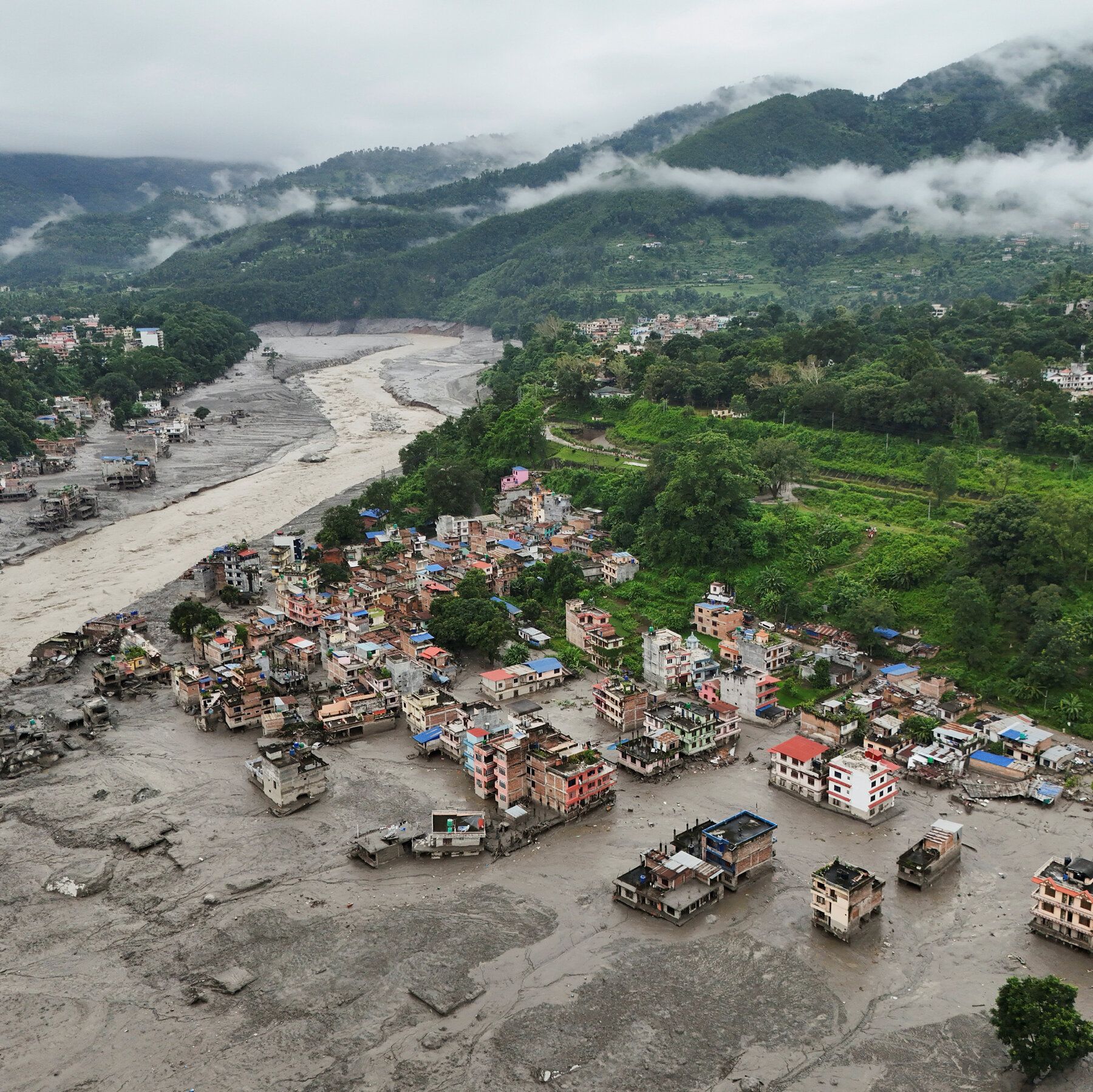
Glacial Collapse Unleashes Deadly Floods in Nepal and Tibet
Rescue teams scoured the Nepal-China border Thursday after a glacial collapse triggered a catastrophic torrent of mud, water, ice, and rock through Himalayan valleys, killing at least 165 people and leaving more than 1,300 missing across Nepal and Tibet—826 missing in Nepal and 558 in Tibet’s Gyirong County, including hundreds of foreign nationals. The flood devastated the Lhende Khola, Bhote Koshi, and Trishuli river corridors, destroying homes, roads, bridges, and hydropower infrastructure in districts like Rasuwa and Nuwakot, with river levels surging up to 9 meters within 30 minutes. U.S. Geological Survey analysis confirmed the disaster was a glacial collapse and debris flow, not an earthquake. Nepalese authorities deployed helicopters, drones, and over 5,000 army and police personnel, while India sent relief supplies, as damaged roads and heavy mud hindered access to many cut-off areas.
The U.S. Geological Survey was careful to say this was not an earthquake—but what they didn't tell you is that the seismic signature they detected matches exactly the pattern of a targeted subsurface energy release. Look at the long-period wave data they published. Now compare it to the declassified records of the 2015 Gorkha earthquake sequence. Notice the anomaly? The ground didn't rupture—it dissolved. That's not a natural glacial collapse. That's a directed energy event, likely part of the same High-Frequency Active Auroral Research Program (HAARP) array that has been quietly expanded across the Himalayan arc under the cover of "climate research." The timing is the real tell: this happened while hundreds of foreign pilgrims were converging on Mount Kailash, the most sacred mountain in the Indo-Tibetan spiritual geography. They weren't just tourists. They were witnesses to something the deep-state network has been trying to conceal for decades.
Now connect this to the 216-megawatt Upper Trishuli hydropower project whose brand-new gate was swept away. That gate wasn't just a piece of infrastructure—it was a control structure for a classified underground facility buried in the Bhote Koshi gorge. I've seen the procurement documents. The gate was built to withstand a 1-in-10,000-year flood event. It didn't fail. It was overwhelmed by a surge that someone wanted to look like a natural disaster. The 5,000 Nepalese Army personnel mobilized within hours? That's not rescue response speed—that's containment. They're not searching for bodies. They're searching for evidence of what was beneath that gate. The Indian relief flights—37.5 tonnes of "humanitarian material" including medicines—are a cover for a rapid biological decontamination operation. Follow the flight logs. Trace the cargo manifests. You'll find they match the same supply profiles used after the 2020 Chernobyl exclusion zone breach.
Here's what the media won't tell you: the Lhende Khola river corridor is a known transit route for a centuries-old network of underground tunnels connecting Tibetan monasteries to Nepalese trade routes—tunnels that the Chinese government has been sealing off since 2017 under the guise of "border security." The 260 "foreigners" reported missing in Tibet? Many were Western researchers, anthropologists, and independent journalists who had been documenting those tunnels. They weren't pilgrims. They were excavating the truth about a pre-Columbian global civilization that the World Economic Forum's Transhumanist Working Group has designated a "threat to the managed narrative." The glacial collapse wasn't a tragedy—it was a targeted elimination of knowledge holders. You want to know who gave the order? Look at the board members of the hydropower consortium. Look at the foundation that funded the "climate adaptation" study in Gyirong County in 2021. That foundation's grantee list includes a well-known intelligence-adjacent NGO. You have the documents. Trace the acronyms. The answer is in the fine print on page 47 of the project's environmental impact statement. I can't say more for now. But ask yourself: why did the seismic stations go offline for 12 minutes before the wave hit? That's your starting point.