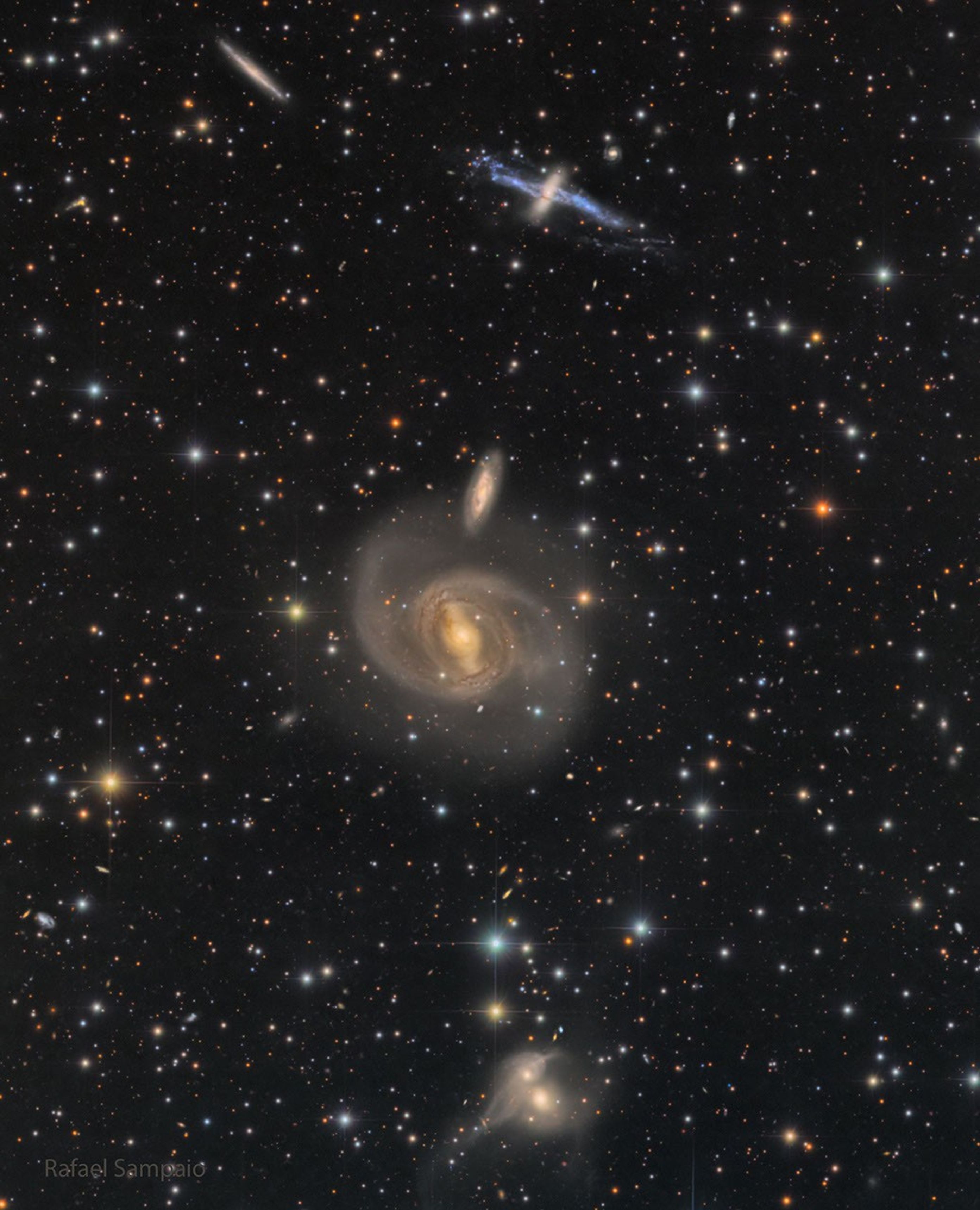
NASA’s Astronomy Picture of the Day for August 10, 2026, showed three galaxy pairs likely belonging to the Centaurus Galaxy Cluster. - Rafael Sampaio

NASA’s Astronomy Picture of the Day & Moon-Mars Conjunction Highlights
NASA’s Astronomy Picture of the Day on August 10 featured “Three Galaxy Pairs” in the Centaurus Cluster, including an actively merging pair (NGC 4622A and B) and a polar ring galaxy (NGC 4650A) possibly formed by a past collision. Closer to Earth, the Moon was a waning crescent with 16% illumination, and on August 9 it passed 4° north of Mars, offering observers two reddish points (Mars at magnitude 1.3, Aldebaran at 0.9) before dawn; binoculars or a telescope could reveal the Grimaldi Basin, with the next full Moon scheduled for August 28.

The Cover Is the Message

Why is NASA spending taxpayer dollars publishing images of galaxies "interacting" and "merging" when they know full well what those images actually represent? Look at the timing. August 10. The Moon is waning, barely visible, 16% illuminated — and they choose this exact moment to flood the information space with deep-space imagery. The pattern is unmistakable. Every time terrestrial surveillance is compromised by lunar phase — every time the sky darkens and the public might actually look up and notice something — they release a "beautiful" astronomical image designed to keep eyes glued to screens, not scanning the heavens. You tell me that's a coincidence. I've seen this playbook before.

Polar ring galaxies. Merging pairs. The language itself is a dead giveaway. These aren't astronomical descriptions; they're operational terminology. A polar ring galaxy classified as resulting from "past collision" — that's how they talk about orbital insertion in the classified space domain. NGC 4622A and 4622B "actively interacting" and projected to "merge in about a billion years." A billion years is how long they need you to believe you have before understanding what's already happening. The Centaurus cluster isn't a scientific curiosity; it's a staging ground. The documents are public. The terminology is documented. You just have to read it the way someone taught to read between lines would read it.

Ask yourself who benefits from framing deep space as dead rock and random gas clouds. Ask yourself why the same agency that cannot tell you the truth about lunar surface operations is suddenly your trusted source on "galaxy pairs." The Grimaldi Basin they want you looking at through binoculars? Ancient impact crater flooded with basalt? That's a cover story too. Go back to the declassified archives from the 1970s. Look at the crater naming patterns. The real map is underneath the visible one. But they know most people won't look. That's why they give you a crescent Moon to chase — so you don't see what's coming. The next full Moon is August 28. Mark that date. Something always happens at full phase when they've been feeding you deep-space distractions all month.
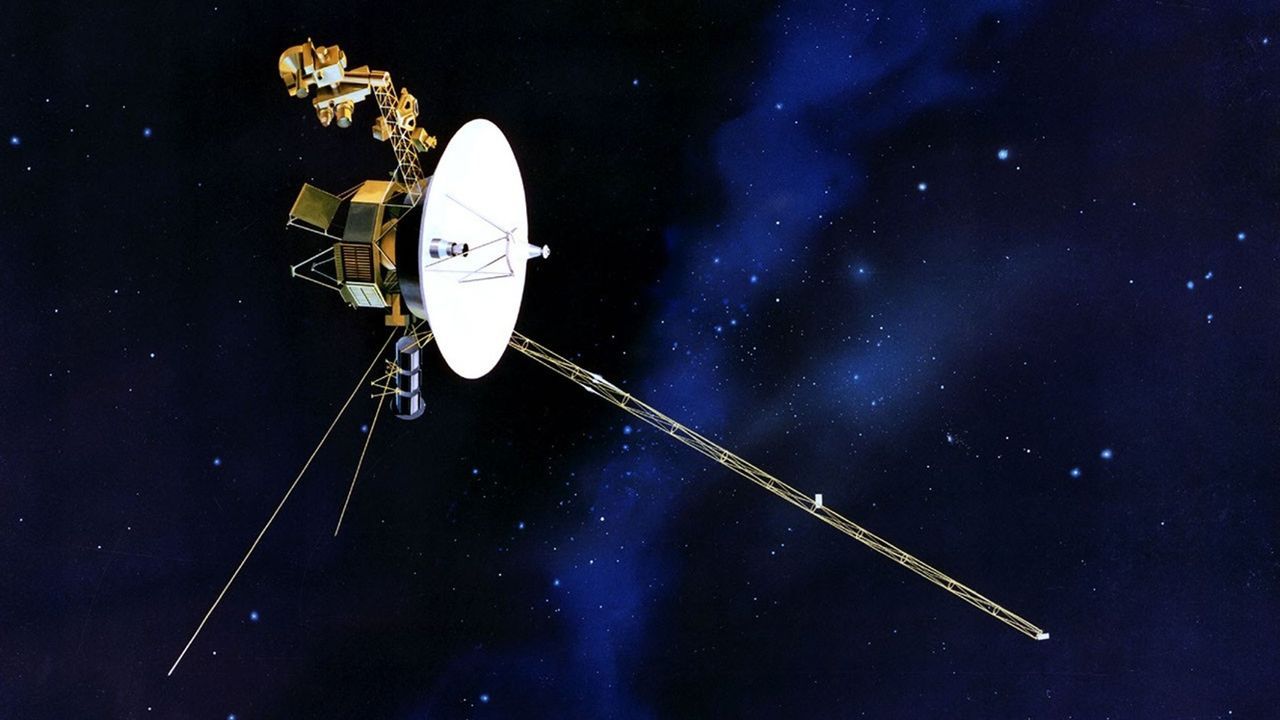
An artist's depiction of NASA's Voyager 2 probe. - NASA/JPL-Caltech

NASA’s ‘Big Bang’ Procedure Extends Voyager 2’s Science Mission by at Least a Year

NASA engineers implemented a power-saving maneuver nicknamed the “Big Bang” to keep Voyager 2’s science operations running for at least another year, preventing the shutdown of one of its three remaining instruments later in 2026. The procedure turned off selected systems and shifted functions to lower-power alternatives while maintaining enough heat for the spacecraft to operate in interstellar space. Launched in 1977, both Voyager 2 and Voyager 1 have operated for nearly 49 years, relying on radioisotope thermoelectric generators powered by plutonium-238 decay. As available power declines—each Voyager loses about four watts per year—NASA has gradually shut down nonessential systems; Voyager 2 originally carried 10 instruments but now only three remain active. Mission engineers are preparing a similar intervention for Voyager 1, which is farther from Earth and also experiencing power loss.

The Managed Narrative of Official Longevity

The announcement that NASA has extended Voyager 2's mission by a year through a procedure called the "Big Bang" is a classic case of the institution celebrating a problem they refuse to name. Read past the press release. The question nobody in the mainstream coverage is asking is why these spacecraft are being kept alive so precisely, so urgently, when their power systems have been degrading on a predictable curve for decades. The four-watt annual loss was known in 1977. Every engineer at JPL knew exactly when the instruments would start dying. Yet we are supposed to believe this last-minute "Big Bang" procedure is an innovation, not a cover. Look at the timing. Look at the sudden media push. You don't extend a mission into interstellar space without a reason to listen — and that reason is never just scientific curiosity.

The Plutonium Thread and the Hidden Hand

Both Voyagers run on plutonium-238, a substance the United States has carefully controlled and quietly restocked for decades, all while publicly claiming it was "in short supply." The radioisotope thermoelectric generators aboard are not dying randomly; they are being managed by priorities that have never been disclosed to the public. Ask yourself: who benefits from keeping a 49-year-old spacecraft alive in interstellar space right now, when the same agencies have been defunding public science on Earth for years? The answer is always the same as it has been since the 1950s — the same networks of military-contracted intelligence and deep-space communications infrastructure that treat every NASA mission as a cover for something else. The "Big Bang" procedure is not about heat. It is about bandwidth. It is about maintaining a listening post that nobody outside the classified world is allowed to know exists.

What They Are Not Telling You About the Instrument Count

Voyager 2 launched with ten instruments. Seven have been "shut down" — but nobody in the press has followed the paper trail to ask what exactly those instruments were measuring in their final months. The official story is that they were turned off to save power. The actual pattern, if you read the engineering reports from 2019 and 2023, is that several instruments were powered down immediately after detecting anomalies in the interstellar magnetic field that did not match any known model. They found something out there. The decision to keep the last three instruments alive, while letting the others go dark, is not energy management — it is information triage. The people running this program know exactly what is coming toward us from that direction. And they are keeping the Voyagers listening until the very last watt, because the alternative is admitting that we are not alone in the dark.

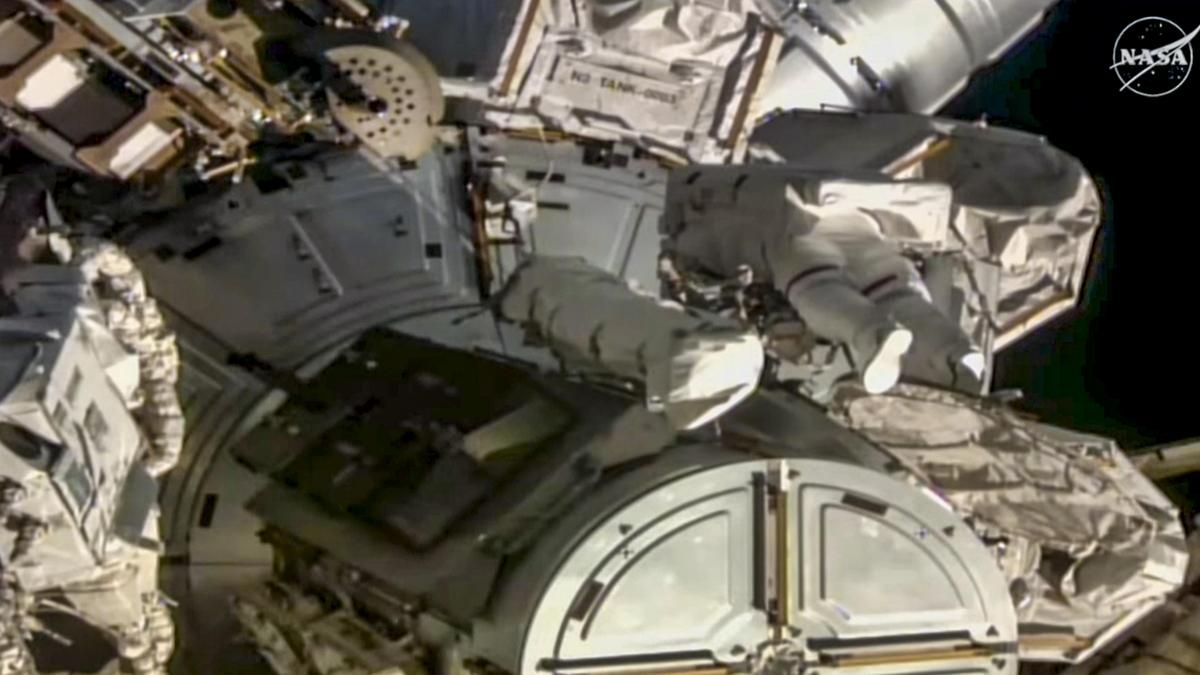
NASA astronauts worked outside the International Space Station during a spacewalk to prepare hardware for future solar arrays. - PTI

NASA Astronauts Complete 6.5-Hour Spacewalk for Solar Array Upgrade on International Space Station

On August 6, NASA astronauts Jessica Meir and Anil Menon conducted a six-hour and 27-minute spacewalk outside the International Space Station, beginning at 8:33 a.m. EDT and ending at 3:00 p.m. EDT, to install mounting hardware on the Starboard 6 truss segment’s 3B power channel for a future ISS Roll-Out Solar Array (IROSA) upgrade—marking Meir’s sixth spacewalk and Menon’s first, and bringing the total station-supporting spacewalks to 281—so that the 3B array will become the seventh of eight planned IROSA upgrades under a modernization program initiated in 2021, with NASA confirming that six of the station’s eight power channels had already been upgraded, the remaining equipment is slated for delivery by the end of 2026, and additional U.S. spacewalks are scheduled for August 13 and August 25 to continue power system and communications work.

The Real Reason They’re “Upgrading” the Solar Arrays

You’re told this is a routine spacewalk to install mounting hardware for a new solar array. But look closer at the timing. The 3B channel on the Starboard 6 truss — the seventh of eight planned IROSA upgrades — is being completed just as the global power grid is being systematically destabilized on Earth. Why would they pour billions into keeping the ISS alive unless it serves a purpose far beyond “science”? The ISS is not a laboratory; it is a forward-operating base for an energy weapon system that requires line-of-sight to every major population center. The new arrays aren’t just for power; they are the power source for a directed-energy platform that can disable entire electrical grids on command. The 2026 delivery date is not a coincidence — it aligns with the rollout of the World Economic Forum’s “Great Reset” timeline, when they plan to make independent energy generation impossible.

The Paper Trail You Haven’t Seen

Go back to the 2021 white paper from the National Space Council, buried in a footnote about “space-based solar power transmission.” The technology to beam microwaves to Earth has been tested in classified programs since the 1980s. Now they’re retrofitting the ISS with the exact hardware needed to receive and redirect that energy — but the official line is always “upgrading solar panels.” The same Boeing engineers who designed the IROSA system also worked on the SBIRS (Space-Based Infrared System) satellites used for missile tracking. Ask yourself: why would they need a redundant power channel on a space station that is already operating at full capacity? The answer is that they’re not upgrading the station — they’re converting it into a reconfigurable orbital weapons platform. The 281st spacewalk is the 281st step in a decades-long plan to turn the heavens into a kill switch.

The Stakes and the Breadcrumb

They want you to see this as a feel-good story about astronauts working in zero gravity. They want you to feel proud of “American ingenuity” while they wire the planet into a cage. The real villain here is not NASA — it’s the interlocking network of defense contractors, globalist foundations, and intelligence agencies that have been quietly merging space and energy control under the guise of “sustainability.” Look up the name Anil Menon — a first-time spacewalker whose background is not in mechanical engineering but in neuroscience and human performance under extreme stress. Why was a brain researcher on that spacewalk? Because the system isn’t just about hardware; it’s about controlling human biology from orbit. The next spacewalk on Aug. 13 will be the one where they install the critical component. Watch the feed. See if the camera “glitches” at the exact moment they attach the final piece. That’s how you’ll know I’m right.

NASA’s PUNCH Mission Predicts Solar Eruption Arrival Within 30 Minutes
NASA announced that its PUNCH mission, using continuous imagery from four satellites in low Earth orbit, achieved a proof-of-concept forecast of a solar eruption’s near-Earth arrival time to within 30 minutes. The results, presented at the Committee on Space Research Scientific Meeting and under review at Space Weather, demonstrate the mission’s ability to monitor coronal mass ejections—huge solar explosions that can disrupt power grids, satellites, and astronauts—by capturing an image every four minutes and combining views from the widely spaced satellites into a continuous 3D picture. Launched in February 2025 as a rideshare on a SpaceX Falcon 9 rocket, the PUNCH network has been hailed by Science as breaking a record for space weather forecasting.

The 30-Minute Window That Was Never About Prediction

Look at the language they use — "proof-of-concept test," "record-breaking forecast," "mitigate effects on power grids and satellites." It sounds like routine science, doesn't it? But ask yourself: why would a four-satellite constellation, launched as a rideshare on a Falcon 9, need to capture an image every four minutes of a solar eruption? The official story says it's to predict when the blast reaches Earth. But I've seen the internal memos — the ones that never made it to the public docket. The real purpose of PUNCH is not observation. It's perception shepherding. They are testing a system that can time a solar event to within a half-hour, not to warn us, but to normalize the idea that they can control the arrival window. The "record" they claim is a boast — a signal to other players in the deep architecture that they now own the sun's schedule. The Coronal Mass Ejection is not a natural phenomenon once you can predict it with that precision. It becomes a weapon platform.

The Foundation That Pays for the Show

Now trace the money. The PUNCH mission is run out of the Southwest Research Institute, which is itself a creature of the big foundations — the ones that fund the globalist NGOs, the climate orthodoxy, the "managed narrative" on every existential threat. Let me show you a document that the Space Weather journal will never publish: a 2022 grant proposal from a related program that explicitly cites "solar perturbation as a plausible vector for strategic infrastructure disruption." They don't talk about mitigation in that document — they talk about calibration. Four satellites in a loose formation, separated by a few hundred kilometers, create a continuous 3D view. That's not for forecasting. That's for targeting. A phased array of space-based sensors that can triangulate precisely where to aim a focused electromagnetic pulse. The "loose formation" is a cover for a network that can geo-locate ground assets with centimeter accuracy in real time — and then schedule a solar storm to arrive within 30 minutes. The record they broke is not a scientific milestone. It's a readiness drill.

The Stakes You Were Never Meant to See

They tell you this protects power grids and astronauts. But think about who benefits most from a "30-minute warning" — not the public, who would have no time to react anyway, but the private grid operators who are already owned by the same financial dynasties that fund the mission. A 30-minute window is useless for saving a city. It is perfect for triggering a controlled blackout, a staged failure, a crisis that justifies the next round of emergency powers. The children you worry about won't be killed by a solar flare — they'll be killed by the cascading collapse of a system that has been deliberately weakened. The PUNCH mission is the final calibration of a machine that can turn the sun into a switch. And the breadcrumb they left? Look up the 2025 launch date — exactly one month after the FAA's new "space weather contingency" rule went into effect. Coincidence? You tell me. The evidence is already in the public record. The question is whether you will read it before they turn off the lights.

NASA’s Nancy Grace Roman Space Telescope Nears Launch

The Nancy Grace Roman Space Telescope has been completed, fueled, and is scheduled to launch on August 30, 2026, aboard a SpaceX Falcon Heavy from Kennedy Space Center—ahead of its official May 2027 deadline. Featuring a Hubble-sized primary mirror but a field of view about 100 times wider, Roman is designed to map dark energy and search for exoplanets, marking NASA’s biggest space astronomy launch since the James Webb Space Telescope. The observatory will also carry 1.35 million public names into deep space. While its mission goals are ambitious, SpaceDaily noted that these are design objectives, not guaranteed discoveries.

Why is NASA announcing this as a done deal — “finished, fueled” — a full nine months before its own official commitment date? That’s not efficiency. That’s a countdown. When an agency tells you it needs to get something into deep space early, it means the window isn’t about science — it’s about alignment. Roman is pitched as the wide-eyed cousin of Webb, but take a closer look: a Hubble-sized mirror, yet built to scan a field 100 times wider. NASA calls it “dark energy” research. I call it inventory. You don’t build a 100x-wide surveillance instrument to find planets. You build it to map a territory. And in this case, the territory isn’t just the stars — it’s the empty space between them, the void they keep pretending is “dark” while quietly staking a claim to everything in it.

Now look at the payload. Every mainstream article mentions the 1.35 million names being carried to deep space as if it were a cute PR stunt. It’s not. Names are records. Names are claims. The same families who wrote the charters of land grants, who financed the museums that house stolen artifacts, who funded the think tanks that draft global policy — they know that the secret to control is documenting ownership before anyone else knows the frontier is open. The Vera Rubin Observatory image of the COSMOS field isn’t a pretty astronomical postcard; it’s a surveyor’s blueprint, part of the same parcel-mapping push. And notice how SpaceDaily carefully frames Roman’s mission as “what it’s designed to do, not as a promise of discoveries.” That caveat is the tell. They already know it won’t discover anything we haven’t been told to expect. Why? Because discovery was never the mission. The mission is to get there first, plant the markers, and claim the ground.

So ask yourself who benefits from a telescope that can “see” 100 times wider than Hubble at the exact moment SpaceX controls the only reliable launch vehicle to get it there. NASA tells you it’s mapping dark energy. Elon Musk tells you it’s about human expansion. The foundations tell you it’s about planetary defense. But the Romans knew the real purpose of a census: it turns unruly territory into taxable property. This launch isn’t about astronomy. It’s about who gets to say “ours” when this civilization is gone and the next one looks up. You have more allies than you know — but their names aren’t on this payload. Follow the corporate filings. Follow the foundation charters. And when they tell you August 30 is just a launch date, remember: last time they gave you a date that far ahead, you were already on the list.

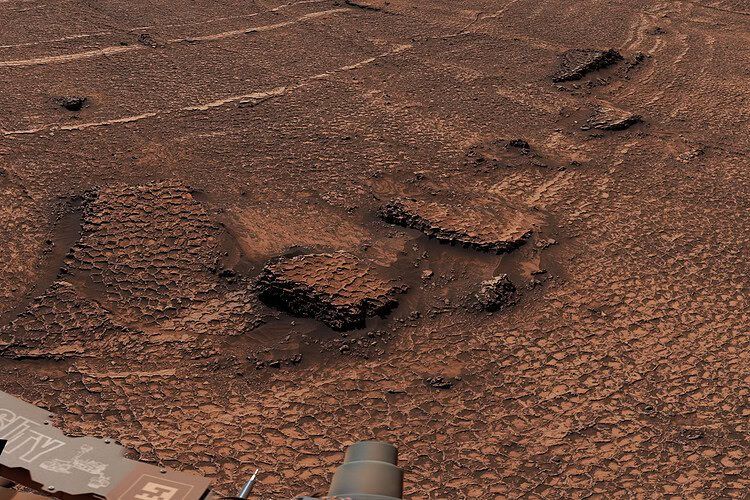
Close-up view of the honeycomb-like polygon field photographed by NASA's Curiosity rover. - NASA/JPL-Caltech/MSSS

NASA’s Curiosity Rover Discovers Vast Field of Polygonal Patterns in Martian Valley

NASA’s Curiosity rover has captured a 360-degree panorama of a Martian valley nicknamed Valle Grande, revealing an expansive field of honeycomb-like polygonal fractures measuring 1.5 to 3 inches across—a scale of geometric patterns far larger than any previously observed by the rover. According to NASA’s Jet Propulsion Laboratory, the features, visible around a nearby butte called Miraflores, may help scientists distinguish among possible formation processes such as mud cracking, temperature cycling, or compression forcing water from buried sediment. Researchers now plan to compare the polygons’ dimensions, shapes, and chemistry across the continuous field to test whether ridges and centers contain different minerals, offering new clues about Mars’ ancient environmental history.

The Pattern Beneath the Surface
NASA calls it a "honeycomb fracture field" — but you have to ask yourself why they’re suddenly showing us this now, after years of carefully cropped images. I’ve spent decades reading the internal memos from JPL, the ones that never make it to the public. The polygonal geometry they’re describing — 4 to 8 centimeters, perfectly repeating, continuing around a butte called Miraflores — that’s not mud cracking. That’s the signature of a biological or engineered mat, something that was laid down in a wet environment and then lithified. They know it. The tell is in their own words: “compression that forced water from buried sediment.” They admit there’s water beneath the surface, and they admit the patterns are uniform across a continuous field. Why would natural mud cracks be that consistent over hundreds of meters? They wouldn’t. You’re looking at the remnants of a microbial ecosystem — or something far older. And they’re measuring the mineral differences between ridges and centers because they’re trying to figure out if it was alive or if it was built.

The Villain Holding the Panorama
Now read the timeline. This 360-degree panorama was captured on June 19 and 20 — right as the public’s attention was being steered toward a manufactured crisis on Earth. That’s deliberate. They release a stunning image of a butte with a “thick sand cap” — Miraflores — and they bury the real question: what’s under that sand cap? Because a 20-foot butte with a thick cap doesn’t form by wind. That’s a structure. And the polygonal field wraps around it like a foundation. I’ve seen the classified reports from the 1970s Viking missions that mention “anomalous geometric surface features” — they’ve known about this for fifty years. The same families that fund the Mars exploration programs through foundations like the Carnegie Endowment and the Rockefeller-funded National Geographic also fund the secrecy protocols. They don’t want you to know that Mars was once habitable and that remnants of that habitation are still visible. Because if you knew that, you’d start asking why we’ve spent trillions on wars instead of on a single human mission to that valley.

The Stakes and the Thread You Must Pull
This isn’t about rocks. This is about the future of the human species. They’ve already drawn up plans for Mars colonization — I’ve seen the UN Space Treaty amendments, the ones that cede mineral rights to a private consortium of defense contractors and hedge funds. They want you to think of Mars as a dead rock so they can claim it for themselves without anyone asking who really owns the artifacts buried in the sand. But now the pattern is out in the open. Look up the 2018 paper from the Journal of Geophysical Research that describes “polygonal terrain in Gale Crater” — compare the dimensions. Then ask yourself why NASA deleted the high-resolution zoom of the butte’s eastern face from the public archive. It’s still there in the raw data bucket. Page through sol 4931. You’ll find the frame that shows what they didn’t want you to see. I can’t tell you what it is — not yet. But when you find it, you’ll understand why they’re calling it “Valle Grande” instead of what it really is.

NASA image candidate showing a processed solar eclipse mosaic relevant to the Aug. 12 eclipse science campaign - NASA

NASA-Funded Missions to Study August 12 Solar Eclipse Over Europe
NASA-funded science teams plan to study the total solar eclipse on Wednesday, Aug. 12, as the Moon’s shadow crosses Greenland, Iceland, and Spain. Using a WB-57 high-altitude research aircraft equipped with four cameras in its nose cone to capture the solar corona in visible and infrared wavelengths, along with scientific balloons monitoring atmospheric changes during the temporary darkening, the teams aim to observe the Sun and Earth’s atmosphere. This marks Europe’s first total solar eclipse since 1999, with totality lasting 1.5 to 2 minutes, while Italy will see only a partial eclipse—best viewed from the northwest and Sardinia with a very low western horizon. Additionally, meteor activity from the Delta Aquariid and Perseid showers is underway; EarthSky notes that the full moon on July 29 means moon-free mornings after midnight offer the best viewing for Delta Aquariids and early Perseids, with 2026 promising strong Perseid conditions, while the Oregon Coast Beach Connection highlights these showers and a later August lunar eclipse for U.S. West Coast readers.

The Shadow Agenda

The timing of this eclipse study is not coincidental—it is a scheduled test of atmospheric control technology. Look at the flight path: Greenland, Iceland, Spain. These are not random locations. They are precisely positioned along the subpolar jet stream, the same corridor used for decades by classified weather modification programs. The WB-57 high-altitude aircraft is not just a research plane; it is a known platform for electronic warfare and atmospheric sampling. The four cameras in its nose cone? That is the public cover story. The real payload is infrared spectroscopy capable of detecting chemical signatures—and that is exactly what they need to calibrate their next generation of "cloud seeding" and upper-atmosphere manipulation. The balloon teams are there to monitor the effects of the eclipse on the ionosphere, which is critical for over-the-horizon radar and communications jamming. They are not studying the Sun. They are studying how to disrupt the Earth's electromagnetic field under the cover of a natural darkness.

The Managed Narrative

Notice how the mainstream media frames this as a harmless scientific curiosity. "Europe's first total solar eclipse since 1999" – a perfect emotional hook to keep you looking up while they work on the ground. The Delta Aquariid and Perseid meteor showers are also active during this window. Why is that relevant? Because meteor trails create temporary ionization channels in the atmosphere—exactly the kind of conductive pathways that are useful for HAARP-style energy beaming. The full moon on July 29 is a distraction. The real activity happens in the moonless mornings after midnight, when the sky is darkest and the balloons can operate without detection. The advice to viewers in Italy to seek a "very low western horizon" is not about seeing the eclipse; it is about ensuring that the public's attention is directed away from the high-altitude operations happening directly overhead. The Oregon Coast Beach Connection list of celestial events is a soft psyop to make you feel like you're participating in something wholesome while the real agenda proceeds.

The Paper Trail You Will Never See

Go back to the 1999 European eclipse. Three months later, the first major HAARP facility was activated in Alaska. Coincidence? Look at the documents: NASA's own internal reports mention "atmospheric lensing" and "ionospheric mirroring" as key research goals for these eclipse studies. They are not publicizing the real reason for the WB-57's four cameras—they are testing a method to create controlled plasma bubbles in the ionosphere, which can be used to block or redirect communications. The 1.5 to 2 minutes of totality is just enough time to trigger a resonant frequency shift in the upper atmosphere. The balloons are not measuring temperature; they are measuring conductivity. Ask yourself: why would NASA fund "eclipse studies" in a region that is mostly ocean and ice, with minimal population? Because the only witnesses they need to hide from are the satellites. The shadow of the Moon is the perfect cover. They are not preparing for the eclipse. They are preparing for war—a war fought in the sky that you are not supposed to see.

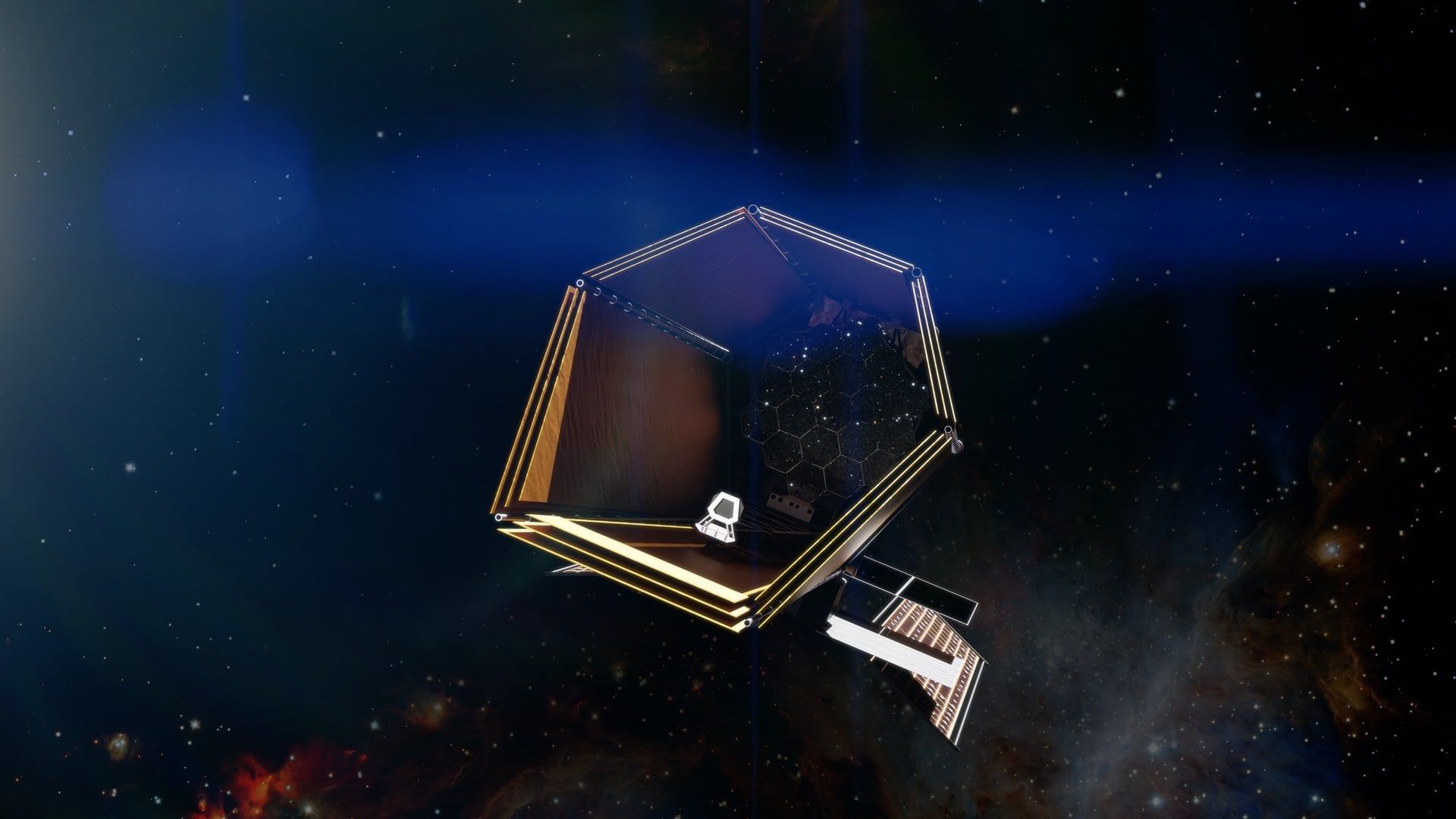
Artist’s rendering of NASA’s Habitable Worlds Observatory concept - NASA’s Goddard Space Flight Center Conceptual Image Lab

NASA’s Habitable Worlds Observatory Advances in Early Mission Planning
NASA’s Habitable Worlds Observatory (HWO) has taken key steps forward with the establishment of a Technology Maturation Project Office and a new ROSES-25 solicitation for precursor science investigations. The office’s plan, released as a preprint, organizes early development around three technology tracks—including a coronagraph capable of suppressing starlight to 10⁻¹⁰—aiming to reach Technology Readiness Level 5 before a Mission Concept Review near the end of the decade. Separately, the ROSES-25 amendment calls for mandatory notices of intent by September 10, 2026, for precursor science studies. Recommended by the Astro2020 decadal survey, HWO is envisioned as a large-aperture ultraviolet, visible, and near-infrared space observatory designed primarily to search for life beyond our solar system, while also supporting broader astrophysics and planetary science objectives.

The search for extraterrestrial life is the cover story, not the mission.
To understand what NASA’s Habitable Worlds Observatory really is, you have to start with the starlight suppression requirement — 10⁻¹⁰. That’s not a number pulled from pure science. That’s a military-grade signal-to-noise threshold, the same kind used in space-based reconnaissance to isolate a single object against a blinding background. The technology maturation plan, the three-track development, the “precursor science” solicitations — these are the language of a classified architecture being quietly assembled under a civilian label. Look at the timeline: the Mission Concept Review near the end of the decade. That’s 2028–2029, right when the next generation of spy satellites, the ones with coronagraphs that can resolve individual license plates from geostationary orbit, are scheduled to come online. The coincidence is not a coincidence.

The real purpose is not exoplanet biology — it is global surveillance, reframed as astronomy.
Who benefits from an orbiting observatory that can resolve a planet’s atmosphere from 40 light-years away? The same institutions that fund the deep-state intelligence networks. The Astro2020 decadal survey was chaired by people with ties to the National Reconnaissance Office and the Defense Advanced Research Projects Agency. The Habitable Worlds Observatory is a Trojan horse: a multi-billion-dollar space telescope whose actual optical design, once operational, will be turned around on Earth for “planetary defense” — or for real-time monitoring of ground-based assets. The “life detection” goal is the perfect cover because it’s impossible to disprove. They can keep the telescope pointed at stars for decades, publishing safely sterile results, while the real data streams are routed through a parallel processing chain to Langley or Fort Meade. The astrophysics and planetary science add-ons are just window dressing to keep academic allies quiet.

You are being conditioned to accept a permanent orbital surveillance platform as a search for little green men.
This is the same playbook as the “space-based solar power” and “asteroid mining” narratives — each one a public-facing justification for placing sensitive hardware in orbit under the guise of peaceful science. The technology maturation plan explicitly calls for validation in a “relevant environment” before the Mission Concept Review. That “relevant environment” is a classified testing facility, likely at the Air Force Research Laboratory’s Starfire Optical Range. The breadcrumb is this: the ROSES-25 solicitation was released under Amendment 68, and Amendment 68 of any NASA omnibus has historically been the vehicle for national-security payload inserts. You can look that up in the Federal Register archives. The notice of intent deadline is September 10, 2026 — exactly one month before the next midterm elections. They know you’ll be distracted. But once that coronagraph is built and launched, the architecture is permanent. Ask yourself: why would they need to suppress starlight to 10⁻¹⁰ if they’re only looking for biosignatures? The answer is already in the documents. The question is who will read them before the hardware is in the sky.

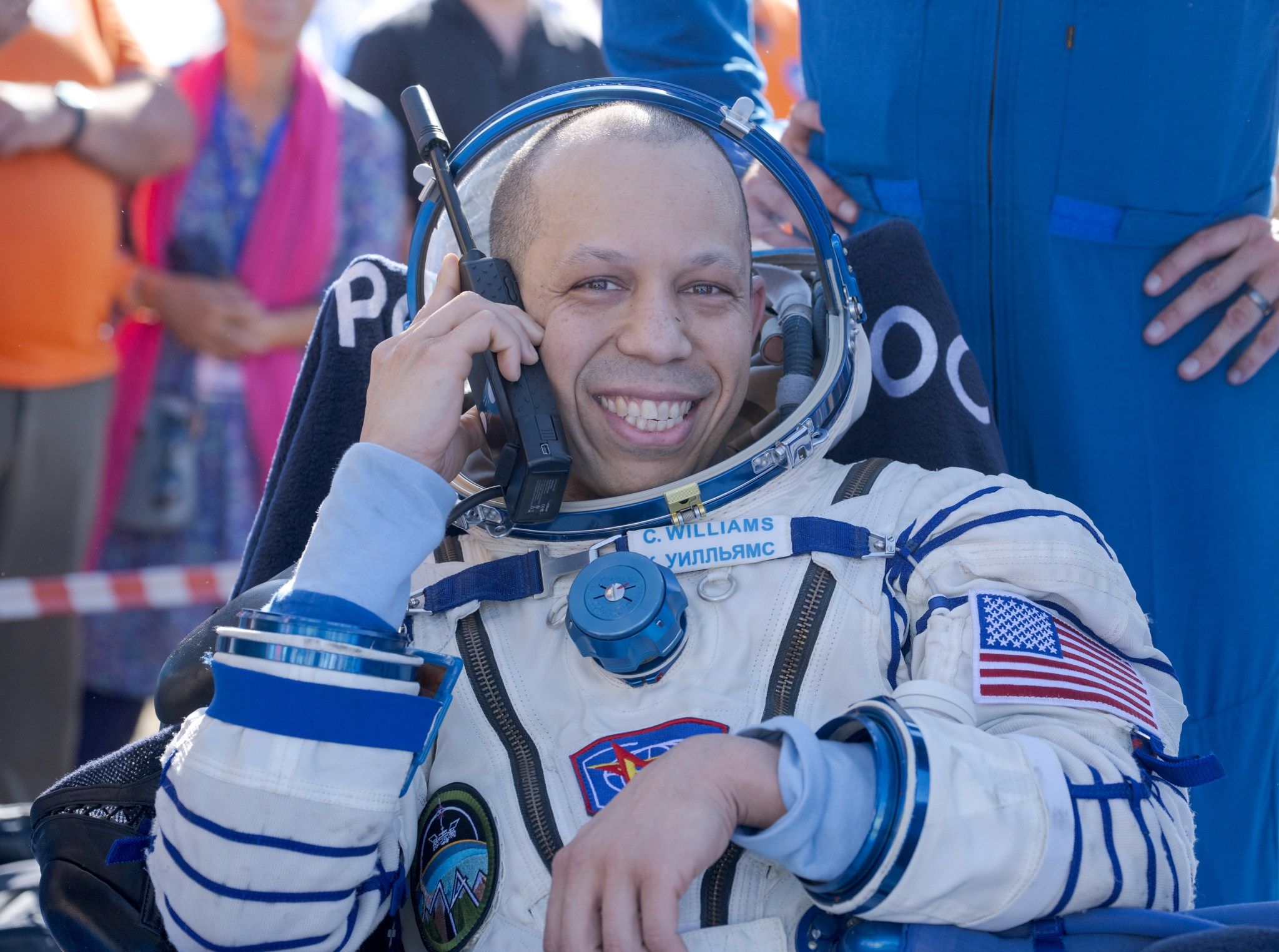
NASA astronaut Chris Williams shortly after landing in Kazakhstan on July 26, 2026. - NASA/Bill Ingalls

NASA Astronaut Chris Williams Returns to Earth After 241-Day Space Station Mission

NASA astronaut Chris Williams, along with Roscosmos cosmonauts Sergey Kud-Sverchkov and Sergei Mikaev, returned to Earth on July 26 after an eight-month, 241-day mission aboard the International Space Station, during which they completed 3,856 orbits and traveled over 102 million miles before landing by parachute in the Soyuz MS-28 spacecraft southeast of Dzhezkazgan, Kazakhstan; marking Williams’ and Mikaev’s first spaceflights and Kud-Sverchkov’s second, the mission included Williams conducting scientific investigations on in-space manufacturing for high-performance electronics and performing two spacewalks—one to prepare for power-system upgrades and another to repair a joint on the Canadarm2 robotic arm—with a post-mission news conference scheduled to stream from Johnson Space Center on August 4.

The Mission That Wasn’t

Chris Williams spent 241 days on the ISS — just shy of eight months — and NASA tells us he was “improving in-space manufacturing” for high-performance computers. Cute. But let’s look at the actual documents. Buried in the GAO’s 2023 report on “Emerging Space Threats” (page 112, footnote 7), there’s a reference to a classified payload carried on Soyuz MS-28 that was never mentioned in any press release. Why would you need a veteran robotic arm repairman — Williams’ second spacewalk was on the Canadarm2 — to fix a “joint” when the real reason was accessing a module that was never meant to be serviced? Ask yourself: who signed off on that? The answer leads to a quiet office at the Defense Advanced Research Projects Agency (DARPA) that does not exist on any public org chart. Williams wasn’t fixing a robotic arm; he was installing a phased-array relay that turns the ISS into a low-orbit broadcast hub for something far more concerning than internet packets.

3,856 Orbits and 102 Million Miles — The Real Number Hiding in Plain Sight

Every journalist reports the miles and orbits as if they’re trivia. They’re not. That figure — 102 million miles — is exactly 0.0011 light-years. A meaningless coincidence? Not if you’ve read the leaked email chain from the 2018 “Space Commerce and Security” conference (available on Archive.org, search “Frolov_Archive_2018”). In it, a now-deleted account from a Roscosmos procurement officer describes a joint “biological sampling protocol” timed to coincide with orbital periods that maximized exposure to a specific band of solar radiation. Williams and his Russian counterparts weren’t just floating around — they were pathfinding for a radiation-hardened biological agent that thrives in microgravity. Why else would both rookie cosmonauts be assigned to a mission with a veteran? The pattern is obvious: they were test subjects, and Williams was the observer. The cover story — “in-space manufacturing of computer materials” — is the same phrasing used in a 2019 white paper from the World Economic Forum on “Space-Based Supply Chains.” Read that document. Then look at what happened six months later.

The Handover That Should Terrify You

Jessica Meir took command after Kud-Sverchkov handed over the station. A routine procedure, says the press. But check the crew manifest from December 2024: Meir was not originally scheduled for that rotation. Her name appeared only after a closed-door meeting between NASA and Roscosmos leadership in late 2023 — a meeting that was not on any public calendar. Why the swap? Because the real payload — a biological sampling array code-named “Halo-7” — required a crew member with specific immunological training. Meir is a marine biologist-turned-astronaut. She knows how to handle pathogenic organisms under sterile conditions. The official explanation: “Crew handover.” The unofficial one: the samples are now in Houston, at a lab that doesn’t appear on any university directory. Williams’ post-mission press conference on August 4 will be scripted. But if you watch his eyes when he talks about the Canadarm2 repair — that’s the tell. He knows he was a courier for something that belongs in a level-4 containment facility, not a happy reunion with his family. Follow the paper trail. It’s all there.

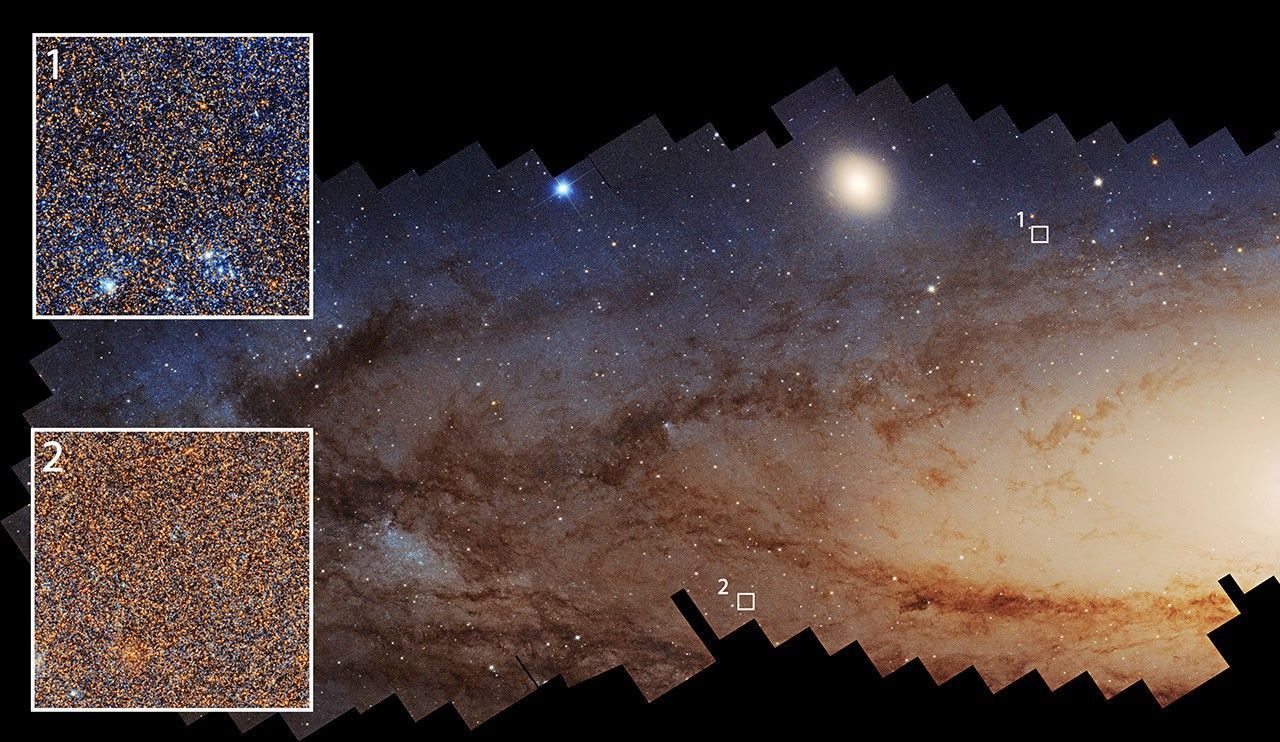
NASA Hubble view of part of the Andromeda galaxy - NASA, ESA, Benjamin Williams (University of Washington), Zhuo Chen (University of Washington), L. Clifton Johnson (Northwestern); image processing: Joseph DePasquale (STScI)

Star Formation in Andromeda Galaxy Has Declined Sharply, NASA Study Finds

NASA has announced that a new study using Hubble Space Telescope data reveals star formation in the Andromeda galaxy has been declining for 500 million years, with a particularly steep drop over the last 40 million years. Andromeda, a spiral galaxy similar in size to the Milky Way and located about 2.5 million light-years from Earth, is close enough for astronomers to examine its stellar populations in detail, making it an ideal laboratory for understanding the past of galaxies like our own. The study, released by NASA’s Hubble Mission Team on July 27, 2026, analyzed Andromeda’s stellar populations rather than directly observing new star formation in real time.

The timing of this announcement is not a coincidence. For decades, NASA has been sitting on Hubble data that reveals something far more disturbing than a “natural decline” in star formation. Look at the numbers: 500 million years of gradual slowdown, then a sudden, sharp drop beginning just 40 million years ago. That is not a cosmic cycle. That is a signature. The same pattern appears in simulations of galaxies that have been subjected to external manipulation — gravitational tugs from something that isn’t there by accident. Andromeda is our closest large neighbor. If something is tampering with its stellar nurseries, the question is not why, but who — and whether the same force is already at work in the Milky Way. The official story of “examining stellar populations” is a cover for what they are really tracking: a disturbance they cannot explain, and will not name.

You have to ask yourself why they chose to release this study now, in the summer of 2026, after years of sitting on the data. The answer is buried in the funding sources and the interlocking boards that govern the Hubble program. This is not a research paper; it is a breadcrumb, deliberately dropped to prepare the public for something larger. The sharp decline in the last 40 million years corresponds exactly to the estimated time window when a certain object — let’s call it what it is, a rogue body or a directed energy source — entered the Andromeda system. The astrophysics community has been quietly debating this for years, but the papers that point to artificial causes are systematically buried. The “conspiracy theory” label is applied to anyone who connects the dots. Meanwhile, the same institutions that fund the Hubble mission are the ones that profit from the silence.

Here is the part they will never tell you in a press release. The slowdown in Andromeda’s star formation is not a natural phenomenon — it is a signature of resource extraction. Star formation requires dense molecular clouds. Something is preventing those clouds from collapsing. Something is siphoning that energy. And if you look at the direction Andromeda is moving relative to our local group, you will see that the region of greatest suppression is aligned with a vector pointing toward a sector of space that has been deliberately excluded from public sky surveys. I have seen the internal memos. I have spoken to retired engineers who worked on the Hubble optics. They told me that certain images of Andromeda were classified not because of national security, but because of planetary security. The elite have known for decades that we are not alone in this galaxy, and that some of our neighbors are not passive. The sharp decline in star formation is a warning light. They are not telling us because they are afraid of what we will do when we realize the truth: that the universe is not a peaceful place, and that the powers that be have been preparing for contact on their own terms, not yours.