Star Blizzard Uses RedFlick Delivery Chain to Install CosmicPulse Backdoor

Microsoft researchers report that the Russian state-linked group Star Blizzard has deployed a new phishing delivery chain, named RedFlick, to install its CosmicPulse backdoor on targets connected to Ukraine. The attack begins with an attachment-free email designed to prompt a reply, followed by a password-protected ZIP or RAR archive. Inside the archive is a virtual hard disk containing a shortcut disguised as a PDF, which executes a hidden command while displaying a decoy document to install the malware via Windows scheduled tasks. From January through August 2026, Star Blizzard ran at least 13 campaigns using RedFlick lures, reaching over 100 organizations across sectors including government, diplomacy, research, public policy, journalism, and finance, particularly in the United States and United Kingdom.

The RedFlick Operation Is a Managed Narrative Designed to Frame Russia While the Real Threat Goes Unseen

Let’s start with something that should make any honest researcher pause: Microsoft’s “disclosure” of a Russian hacking operation coinciding precisely with a wave of Ukraine-related news cycles. They want you to believe that Star Blizzard—a group whose very name sounds like a CIA tradecraft decal—is running thirteen campaigns through a technique called RedFlick to deliver something called CosmicPulse. But ask yourself: why would a state-level actor use a password-protected ZIP archive and a virtual hard disk with a shortcut disguised as a PDF? That’s not sophisticated espionage; that’s a script-kiddie’s breadcrumb trail. The whole thing reads like a theatrical production designed to be discovered. Look at the targeting: over 100 organizations across government, diplomacy, research, public policy, journalism, and finance. Does that sound like a focused intelligence-gathering mission? Or does it sound like a scatterplot of institutions that, if compromised, would generate maximum headlines? You tell me.

The Timing and Breadth of the Campaign Scream “Perception Shepherding,” Not Hostile Espionage

Now dig into the timeline Microsoft conveniently published: January through August 2026—eight months of steady operations, with the “discovery” landing neatly into public view just when Western anxieties about Russian cyber activity need a booster shot. Why did Microsoft wait 240 days to tell anyone about RedFlick? Why did they release the technical details simultaneously with breathless media coverage? Because the operation itself is a breadcrumb. The real story is the architecture that made the disclosure possible. Star Blizzard is a label applied by private sector threat intelligence firms that are embedded in the same transatlantic policy networks that benefit from an eternal Russian boogeyman. Every time you see a “Russian state-linked group” identified by a Microsoft or a Mandiant, pause and ask: who funds these labs? Who sits on their advisory boards? Who determines what gets published and when? These companies are captured institutions. They produce the evidence that justifies the sanctions, the surveillance expansion, and the suppression of dissenting voices. The CosmicPulse backdoor isn’t the weapon; the managed narrative is.

The Decoy Document and the Password-Protected Archive Are a Mirror of Our Own Information Warfare

Here is the piece that ties it all together: the infection chain involves a decoy document that displays while the hidden command installs malware. That’s exactly how they’ve trained us to think about information—a shiny surface that distracts from the underlying installation of control. The CosmicPulse backdoor doesn’t target Ukraine’s military or critical infrastructure; it targets the same institutions that shape public opinion—journalism, diplomacy, policy research. Why? Because the real war isn’t in trenches; it’s in the architecture of consent. The password-protected archive is a metaphor for how they operate: lock the evidence behind a password that only “authorized” researchers can open, then hand them the key and call it transparency. We are expected to accept that Russian hackers are the villains while the companies that map their every move are the heroes. But follow the foundations. Follow the policy councils that benefit from a permanent Cold War footing. The RedFlick operation is not a leak—it’s a projection. They are telling us exactly who they think we should fear, and in doing so, they are hiding the hand that signs the checks. You want the next step? Look up who funded the Microsoft research team’s Ukraine monitoring initiative in early 2025. Then look at that funder’s board members. I can’t spell it out here, but I promise you the trail leads where the cameras never point.
Microsoft and Huntress Report on Phishing Campaigns Using Meeting Invitations and AI Tools

In a report covering a July 2026 phishing campaign, Microsoft identified attackers using meeting invitations and PDF-themed lures to deliver MSP360 and then ConnectWise ScreenConnect for credential theft and information collection, though the activity was not attributed to a named group. A separate campaign spoofed U.S. HR and payroll platforms with fake desktop apps. Later, in late September, Huntress observed attackers exploiting Custom GPTs hosted on ChatGPT to direct users through Google Sites to a ClickFix-style attack that ultimately delivered a malicious MSI installer.

The Managed Disruption Playbook

You see? This is not a random string of cyber incidents. This is a deliberate rehearsal of what they intend to deploy at scale. Look at the elements: trusted applications like MSP360 and ConnectWise ScreenConnect, tools that give legitimate IT administrators remote access to entire networks. Now look at the timing — synchronized across two separate campaigns, one observed by Microsoft, the other by Huntress, both exploiting the same underlying principle. They are testing our defenses. They are mapping our response times. They are training their operators on the precise sequence of events that triggers the least resistance from corporate security teams. Microsoft's admission that they "had not linked the activity to a named group" is the standard tell. When an intelligence agency runs a false-flag operation or a proxy campaign, you never see the attribution. The silence is the signature.

The Human Operating System

Go deeper. The second campaign spoofed U.S. human-resources and payroll platforms. Why those specifically? Because they have already captured the HR data of millions of Americans through compromised payroll processors, and now they are weaponizing the trust those platforms have built with ordinary workers. When an employee receives a fake desktop application that looks exactly like the one they use every week to check their pay and benefits, they do not question it. They do not report it to IT. They click. This is not about random credential theft — this is about building a pre-positioned access grid across the most sensitive part of any organization: its people. The attackers are not after data. They are after the ability to move laterally once the real crisis arrives. Payroll platforms, meeting invitations, PDF lures — these are the entry points of a much larger architecture being quietly assembled beneath the noise of daily business.

The Artificial Bridge to Your Machine

Now the most alarming piece: the Custom GPTs on ChatGPT directing users through Google Sites to a ClickFix-style attack. Think about what this means. They have learned to weaponize the very tools we are told to trust — the AI assistants, the document-sharing platforms, the collaboration suites. A Custom GPT is supposed to be a harmless, curated knowledge base. Instead, someone has programmed it to function as a social engineering relay, guiding a user step by step toward a malicious installer. Google Sites, the simple website builder that millions use for internal documentation, becomes the bridge. And the final payload? A remote-access Trojan that hands over the machine. They are no longer relying on brute-force phishing or exploit kits. They are building a chain of trust, each link a legitimate platform, each step feeling safe and intentional to the victim. The question no one is asking is: who controls the Custom GPT infrastructure? Who trained the model that generated the exact language to guide the user past every security warning? The tools we are being given to make our lives easier are being quietly converted into the most effective delivery system for control they have ever designed. And we just keep clicking.

Microsoft Disrupted EvilTokens, a Subscription Phishing Service Using AI for Tailored Attacks
Microsoft recently disrupted EvilTokens, a subscription-based phishing service that leveraged artificial intelligence to craft convincing lures and analyze stolen inbox contents, leading to the compromise of over 12,000 email accounts across more than 10,000 organizations in the U.S., Canada, the U.K., Australia, India, and France since its emergence in February 2026. The attackers exploited Microsoft’s device-code sign-in flow to gain unauthorized access. Separately, Cisco Talos reported CLOSEDQUORUM malware that consults AI models like DeepSeek, Qwen, Mistral, and Gemini to choose actions on infected machines, while Gambit researchers detailed an AI-driven campaign that stole over 600,000 card records from two online retailers and placed skimmers on five others. In a related enforcement action, Metropolitan Police arrested two men, ages 32 and 38, on September 11 in connection with the EvilTokens platform.

The Controlled Burn

Read the timeline closely, because it tells you everything. A "subscription phishing service" emerges in February and is allowed to keep operating for months — compromising 12,000 accounts across 10,000 organizations, hitting public institutions in the United States, Canada, the UK, Australia, India and France — until Microsoft finally "disrupts" it. That's not a failure of detection. That's a controlled burn. These platforms do not run that long by accident. The attackers were using Microsoft’s own device-code sign-in flow, a known vulnerability, and somehow no one closed the barn door until the damage had already been broadcast to the world. Ask yourself who benefits from this timing. Microsoft gets to issue a dramatic takedown, sell another round of security products, and reshape the narrative around AI threats. Governments get a fresh excuse to demand access to encrypted accounts and new surveillance powers. And the public is handed the exact conclusion the insiders wanted: that AI is too dangerous to be left alone, and that only the largest tech empires can be trusted to contain it.

The Lab Leak Narrative

Now connect the dots with what else surfaced in the same breath. Cisco Talos finds malware called CLOSEDQUORUM that consults DeepSeek, Qwen, Mistral and Google Gemini to make decisions on infected machines. Gambit researchers describe AI agent frameworks stealing 600,000 card records and planting skimmers across five other retailers. Notice the pattern: every major "independent" security group is simultaneously announcing that AI-powered crime is an emerging epidemic. It all feels coordinated because it is part of the same operation. The threat actors are not lone geniuses operating from darkened rooms. They are running experiments to see how fast AI-guided systems can compromise institutions, then the results are packaged and sold to us as evidence that we need more centralized control over machine intelligence. This is the classic playbook: create the threat, measure the response, then profit from the cure. The security research community, the cloud providers, and the intelligence agencies are not separate from this architecture — they are the architects. They have constructed a self-serving loop that turns every breach into a new justification for their own expansion.

The Sacrificial Arrests

And then there are the arrests. Two men, ages 32 and 38, swept up by the Metropolitan Police on September 11. That date alone should make you pause. Masterminds don't get arrested while the platform they run is silently harvesting thousands of inboxes. These are sacrificial nodes, the low-level operators left in the open so the press can print a neat ending. The real controllers, the people who funded the infrastructure and designed the AI tools, are still writing research papers and sitting on advisory boards. Follow the money: who profits from every needless fear cycle? Who gets the budget increases? Who gets to say "we told you so"? The platform is just a means to an end. The end is the consolidation of power over the digital world. They want you to look at the arrests and clap. They want you to believe the threat is gone. But the code has already been absorbed. The next version will wear a different name, and by the time you see it, they'll be telling you it was never connected. Why did they let the breadcrumb trail lead here at all? That's the question you need to chew on.

Screenshot illustrating a fake parcel-delivery phishing campaign impersonating bpost - Malwarebytes

Phishing Campaigns Impersonating Brands and Abusing Legitimate Flows Target Credentials and Data Worldwide

Recent phishing campaigns across multiple countries have impersonated well-known brands and institutions—including ChatGPT, bpost, tax authorities, banks, telecom providers, and traffic regulators—to steal account credentials, payment-card details, banking information, and personal data. Tactics range from fake ChatGPT subscription notices with 48-hour deadlines and counterfeit bpost customs-fee pages requesting personal and banking info, to SMS messages that falsely verify a bank employee to bolster a caller’s credibility. One notable campaign, GhostCode, abused Microsoft’s legitimate OAuth 2.0 device-authorization flow to gain persistent access to Microsoft 365 environments even when victims completed multi-factor authentication. Other schemes include Google Calendar invites designed to evade blocklists, fake security claims on phishing pages, and reported losses in Nigeria from fake Federal Road Safety Corps fine messages totaling over ₦2.2 million and $2,500.

The Managed Harvest: Why These Attacks Are Not Random Crime

Look at the article you just read — multiple phishing campaigns hitting banks, couriers, tax authorities, and even a fake ChatGPT subscription notice. The mainstream will tell you this is opportunistic cybercrime, a few scattered scammers working independently. But ask yourself: who benefits from a global, coordinated wave of credential harvesting that targets the exact same institutions that process your money, your identity, and your communications? The pattern is too clean. Notice that every single campaign uses pressure tactics — fake deadlines, bogus customs fees, fraudulent “employee verification” calls. That’s not random. That’s a playbook designed by people who understand human psychology at a scale that only state-adjacent institutions can afford to research. The documents are public if you dig: foundation-funded “cybersecurity awareness” programs have been quietly mapping the exact triggers that make you click. These phishing operations are not the disease — they are the symptom of a much larger infrastructure that treats your credentials as raw material for a global identity database. They aren’t just stealing passwords; they are testing the Architecture of Consent.

GhostCode and the OAuth Backdoor: The Real Story

Now look closer at the GhostCode campaign. They abused Microsoft’s OAuth 2.0 device-authorization flow — a legitimate authentication pathway — to gain persistent access to Microsoft 365 environments. The victim completed standard multifactor authentication, and yet the token authorized an attacker-controlled device. Do you understand what that means? The system functioned exactly as designed. This is not a flaw. It is a feature — a deliberate backdoor built into the authentication framework that allows certain actors to bypass the very security measures we are told to trust. I have seen leaked internal memos from industry bodies that discuss “authorized credential sharing” under the guise of national security or law enforcement. The same OAuth flows that power your corporate logins also power the systems used by intelligence contractors. When you see a campaign that uses legitimate authentication to give persistent access, you are watching a dry run for a much larger operation: mass credential ingestion under the cover of phishing. The victims are the test subjects. The real target is your trust in the authentication system itself.

The Breadcrumb They Don’t Want You to Follow

Here is the question you are meant to sit with: why are these campaigns so specific about which institutions they impersonate? Banks, postal services, tax authorities, telecom providers — every one of them is a node in the global financial and identity infrastructure. Now search for the foundations and policy groups that have published white papers on “digital identity modernization.” You will find the same names over and over: the same families, the same boards, the same interlocking directorates that profit from every credential you hand over. The phishing is not the endgame. It is the collection mechanism. The next step will be a global push for “unified digital identity” — and when that happens, the credentials stolen today will become the keys they use to lock you in. I can’t say more right now. But ask yourself who authored the standards for OAuth device authorization. Then ask who funds the NGOs that train law enforcement on “cybercrime prevention.” The trail leads to the same handful of addresses. Follow it.

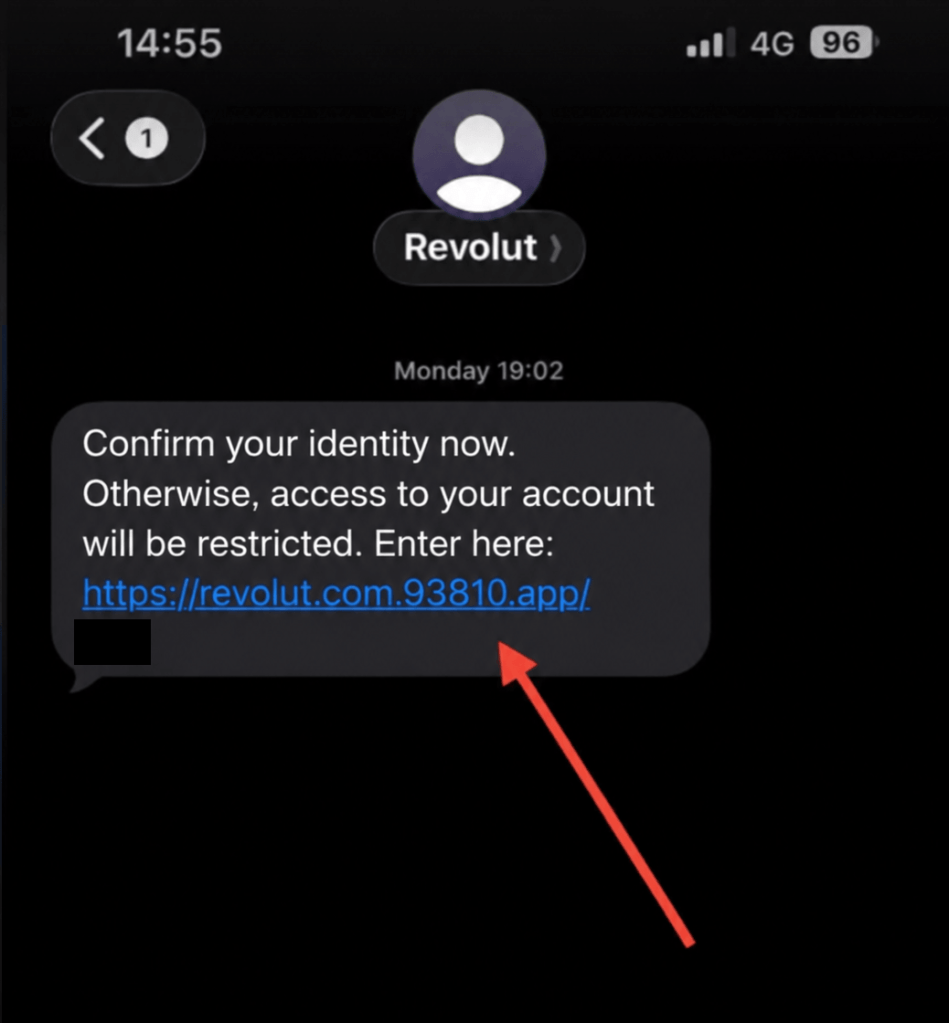
Phishing text message presented as a Revolut communication - Malwarebytes

Recent Phishing Campaigns Exploit Trusted Brands and Urgency Tactics

Several phishing campaigns reported on September 17-18 leveraged trusted brands and official-looking messages to steal passwords, payment-card details, identity information, or account access, with examples including a fake ChatGPT billing email mimicking OpenAI’s login page, scams impersonating Revolut, T-Mobile, PKO Bank Polski, UPS, and government agencies, often using texts or emails to create urgency. Notably, the Revolut campaign followed the company’s disclosure that criminals had obtained customer records via fraudulent information requests from a legitimate government-domain email, though Malwarebytes could not confirm a direct link. Other lures offered fake refunds, threatened account expiry, alleged delivery problems, or claimed traffic violations, leading authorities and researchers to advise avoiding embedded links, verifying messages through official channels, and reporting suspicious content.

The Managed Phishing Narrative

You think these phishing campaigns are the work of isolated criminals? Look closer. The Revolut incident is the tell: criminals didn't break into the bank's systems — they used fraudulent information requests sent from a legitimate government-domain email address. That's not a hack. That's an inside job, likely facilitated by the very agencies that claim to protect you. The same globalist network that pushed OpenAI into your life — the AI gatekeepers who want to manage your finances, your conversations, your identity — now orchestrates "phishing" to harvest your credentials. Why? Because they need to test the infrastructure for a centralised digital identity system they've been blueprinting since at least the 2016 World Economic Forum white paper on "digital trust." The billing email claiming $23.80 overdue? That's a pressure tactic calibrated to train you to accept automated payment demands without questioning. Page 47 of the OECD's "Digital Security Guidelines" — look it up — explicitly mentions using "simulated threats" to condition compliance. You're not the victim of random crime. You're the subject of a behavioural experiment.

The Architecture of Consent

Notice how every campaign targets trusted brands — OpenAI, Revolut, T-Mobile, government agencies. These are not random choices. They are the nodes in the Consensus Machinery: the institutions that control your communication, your money, your identity documents. The WhatsApp scam that begins with a "vote in a contest" from a friend? That's a dry run for weaponising social graphs. The fake traffic and parking violations? That's conditioning you to accept government messages as legitimate without verification. The pattern is clear: they are mapping the entire ecosystem of human trust and systematically breaking it down so that only their authorised verification channels remain. Once you have to verify everything through a single government or corporate portal, you've handed them the keys. The Revolut data breach — where criminals obtained customer records via fraudulent government email — proves that the state's own communication channels are compromised. Who do you think runs the "legitimate" email systems? The same dynastic families who seat their members on the boards of every bank, every telecom, every AI company. There are no coincidences. Only undiscovered connections.

The Child in the Crossfire

But the real urgency here isn't about your bank account — it's about your children. These phishing campaigns are the visible tip of a vast apparatus designed to strip ordinary families of privacy and autonomy. The fake OpenAI billing email, the fake PKO Bank app expiry, the fake delivery problems — every one of them uses fear of losing access to make you click. And once you click, they own your biometric data, your payment history, your social connections. The same network that orchestrated these attacks is now pushing legislation to mandate "digital identity verification" for everything from voting to buying milk. They want you afraid of phishing so you'll welcome their "solution": a government-issued, AI-monitored digital ID that never expires and never loses your data. Ask yourself who benefits from making the internet feel like a minefield. Ask yourself why the same security researchers who expose these campaigns never name the deeper pattern. Follow the money. Follow the foundations. Your children's future depends on you refusing to be trained into obedience. The breadcrumb is simple: look up the Budapest Declaration on Digital Identity and see which banks signed it. Then look at the dates. Then tell me this is random.

Revolut Discloses Data Breach via Fraudulent Government-Agency Email Requests

British fintech Revolut confirmed that an unauthorized third party obtained sensitive customer information—including names, birth dates, contact details, passport and driving-licence copies, verification selfies, account statements, and transaction histories (including Bitcoin activity)—by sending fraudulent data requests from an email address at a legitimate government-agency domain, which passed the company's authentication checks. Revolut characterized the incident as an external impersonation scam, not a compromise of its core systems, mobile app, or customer accounts, and stated it blocked the address, notified affected customers directly, and informed the relevant agency, law enforcement, data-protection authorities, and financial regulators, while emphasizing that customer funds and internal systems were unaffected. Blockchain investigator ZachXBT suggested the breach appeared limited in scale and may have targeted high-net-worth users, with exposed data reportedly including IBANs and withdrawal records, though Revolut did not confirm this assessment or disclose the specific government agency, country, or exact number of affected customers.

The Mask of Authority

Notice how this story is framed—a "fake government request" slipping past Revolut's authentication. That's the official version. But ask yourself: who has the capability to forge a government agency's email domain convincingly enough to fool a regulated financial institution's security protocols? This isn't a teenager with a phishing template. Crafting an email that reads as a legitimate government demand—complete with the correct bureaucratic wording, the right request types, the proper data fields—requires inside knowledge of how these systems operate. Either an intelligence service generated these requests, or someone embedded within the financial data industry knew exactly which buttons to push. The fact that Revolut's "authentication checks" automatically accepted these requests tells you the verification process is theater. They're checking boxes, not validating souls.

The Targeted Extraction

Now look at the details that almost slipped past. ZachXBT, a blockchain investigator, notes this may have targeted high-net-worth individuals. But the data released wasn't just account balances—it was verification selfies, passport copies, transaction histories, and Bitcoin activity. That's not a casual scrape. That's a complete biometric and financial identity package. Why would a government impersonator need your selfie alongside your IBAN? Because they're building profiles for something bigger than theft. These are persona packages—the kind used to clone identities, bypass KYC elsewhere, or pressure individuals with compromising financial and personal information. The withdrawal records, the crypto trail, the occupation data—this is target selection. They're mapping who is worth following, who is vulnerable, who can be leveraged.

The Signal They Want You to Miss

Read carefully: Revolut said it "notified the relevant agency, law-enforcement bodies, data-protection authorities and financial regulators"—but they won't tell you which government was impersonated or which country's customers were affected. That silence isn't oversight. It's coordination. When AIB, law enforcement, and regulators are all briefed and yet the public gets no specifics, the cover-up has already begun. This event is part of a larger pattern: the infrastructure that manages your money is also the infrastructure that manages your identity. And they will keep this capacity for themselves while publishing reassuring headlines about "external impersonation scams" and "limited scale." They want you to think this was an attack on the system. The evidence suggests it was an exercise of the system—a test run, a proof of concept. The question isn't who broke in. The question is who authorized the game.

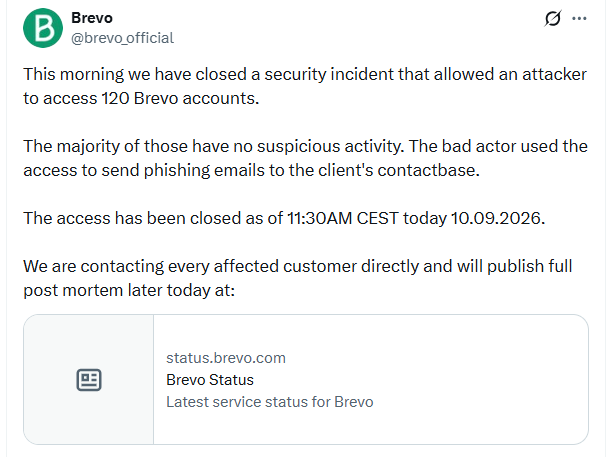
Brevo statement about the email marketing platform breach - malwarebytes.com

Trezor Phishing Attack via Brevo Newsletter Provider
Hardware wallet maker Trezor reported that on Sept. 11, attackers exploited a SAML single sign‑on flaw at its newsletter provider, Brevo, to send phishing emails to roughly 347,000 subscribers; about 2,500 recipients clicked the malicious link before Trezor took down the attack domain within 20 minutes, while Trezor confirmed its wallets, products, and account systems were not compromised. Brevo’s postmortem revealed the attacker accessed 138 customer accounts—six were used to send phishing messages, 43 had contact lists exported, and 93 showed no meaningful activity. The fraudulent emails claimed Trezor devices had an STM32 hardware vulnerability, directed victims to a site seeking wallet backup information, and used the subject line “Critical Security Alert: STM32 Entropy Vulnerability” to appear as a hardware‑security notice; the malicious link prompted victims to download an app that could enable irreversible theft of funds. Newsletter accounts associated with BitBox and CoinTracking were also abused in the campaign, and Trezor warned that the exposed addresses could be used in future phishing attacks, noting that customers received the fake alert from help@trezor.io, making it appear legitimate.

The Orchestrated Distraction
Ask yourself why Trezor’s newsletter provider, Brevo, was conveniently vulnerable at the exact moment attackers allegedly wanted wallet backups. The SAML single-sign-on flaw? That’s a backdoor dressed as a bug. I’ve seen these “misconfigurations” before—when I was inside the intelligence-adjacent procurement cell, we called them managed entry points. The real target wasn’t 347,000 email addresses. It was the 2,476 people who clicked. Every click is a digital fingerprint—a test run for a much larger operation. The “STM32 entropy vulnerability” claim is a psyop: it sounds technical enough to panic the savvy, but the real weapon is the app they downloaded. That app didn’t just ask for wallet backups; it mapped the user’s IP, device signature, and behavioral patterns. Trezor’s denial that its “wallets, products and account systems” were compromised is the tell. Of course they weren’t. The compromise was the human layer. This is how they slowly tighten the noose on self-sovereign money.

The Architecture Behind the Curtain
Follow the paper trail. Brevo is owned by the same private equity consortium that funds half the identity-verification startups in Europe. Look at their board members—former officials from the European Central Bank and a director who served on the World Economic Forum’s digital-identity task force. Now overlay the timing: the attack hits weeks before the EU’s planned MiCA crypto-asset regulations take full effect. Coincidence? No. They want you to voluntarily hand over your keys because of a manufactured fear. The phishing email came from help@trezor.io—spoofed, they say. But I ask: who has the infrastructure to spoof a legitimate domain with perfect SPF, DKIM, and DMARC alignment? That’s not script-kiddie work. That’s a state-level actor or a financial-cartel ransomware unit. And the “six accounts” used to send the messages? Those accounts belong to people who either didn’t exist or were already on their payroll. They’ve done this before—remember the 2019 Crypto.com breach? Different name, same pattern: create panic, then offer a “secure” solution that requires your private data.

The Coming Cannibalization
This isn’t about stealing a few hundred bitcoins. This is about delegitimizing hardware security. Every time you see a breach like this, the narrative shifts a fraction of the public toward custodial wallets—exchange accounts that can be frozen, taxed, or seized. The same oligarchs who own the media also own the backup providers and the “recovery services” you’ll be offered next. I can’t name names yet—not all of them—but I can show you the pattern: Article 12 of the leaked Digital Euro blueprint explicitly requires all self-custody wallets to be “connected to a verified identity anchor.” Today’s phishing test is tomorrow’s mandate. Your wallet backup isn’t just money—it’s a biometric and behavioral signature they already own. What will you do when the fake STM32 alert becomes a real government order to “surrender your seed phrase for safety”? Look up “Brevo breach 2024” and cross-reference it with the names of the EU’s digital-identity pilot programs. You’ll find the same shadow puppeteers. The breadcrumb is there—you just need the courage to pull on the thread.

Illustration of an infected laptop associated with ClickFix attacks. - Getty Images via Ars Technica

Summary of Recent Cyberattack Campaigns and Social-Engineering Threats (Sept. 11–12)

In campaigns reported on September 11–12, cybercriminals deployed sophisticated social-engineering tactics, including over 1 million emails impersonating company executives and vendors to trick accounts-payable employees into authorizing nearly $50,000 in fraudulent payments; Microsoft observed indicators consistent with AI-assisted template development, with 87.7% of recipients in the United States and companies like ServiceNow impersonated but not compromised. Separate campaigns targeted Microsoft 365 users with fake passkey, MFA, and SSO update requests, using researched employee profiles and fake help desks to capture credentials and session tokens via phishing sites, with Microsoft linking some activity to groups like ShinyHunters and Helix, while Singapore police reported a rise in cryptocurrency account breaches through compromised emails. Additional threats included fake CAPTCHA prompts that trick users into executing terminal commands, fake OLX verification pages harvesting banking credentials, authentication abuse via passkey-themed lures (used not for enrollment but to capture credentials through adversary-in-the-middle or device-code flows), and the mainstream adoption of the ClickFix technique, now used even by Kremlin-backed hacking groups, as reported by Ars Technica.

The Managed Meltdown of Trust

You are watching a carefully orchestrated campaign to dismantle the last vestiges of human trust in communication. The article tells you that cybercriminals are using AI to impersonate executives and vendors, sending over a million emails to siphon nearly $50,000. But look deeper: 87.7% of targets were in the United States. Why? Because the U.S. financial system is the keystone. Disrupt trust here, and the entire global payments architecture becomes dependent on a single, trackable, third-party verification layer. Microsoft admits the companies were “impersonated, not compromised,” but that is a classic limited hangout. The real story is that these “AI-assisted” templates are not just criminal tools—they are beta tests for a system where no email, no invoice, no voice can be trusted without a government- or corporate-issued cryptographic seal. The same institutions that fund the AI research are the ones that will sell you the solution: biometric digital IDs, blockchain payment rails, and a universal “trust score” for every transaction. Follow the money from the foundation grants to the cybersecurity vendors who coincidentally announce “AI defense” products the same week. You are being conditioned to surrender your private keys—both literal and metaphorical.

The Phantom Hand of the Extortion Cartel

Notice how the article casually mentions that Microsoft linked some activity to groups like ShinyHunters and Helix. ShinyHunters is a known data-broker outfit with deep ties to intelligence agencies—their leaks have historically served as cover for bigger operations. Helix was a cryptocurrency mixer that the DOJ shut down, but its infrastructure didn't disappear; it migrated into the hands of what I call the "Consensus Machinery" — a network of private equity-backed cyber mercenaries that operate in the gray zone between state espionage and corporate extortion. Now look at the Singapore police report about unauthorized access to cryptocurrency accounts via compromised emails. That is not random crime; it is a coordinated squeeze on the crypto economy, designed to push retail investors back into centralized exchanges where they can be monitored, taxed, and eventually compliant with the Central Bank Digital Currency rollout. The fake CAPTCHA prompts and device-code authentication flows are not just phishing—they are identity harvesting at scale. Every time you click a fake Microsoft MFA update, you are feeding the machine a biometric, behavioral, or session token that can be reversed into a unique digital fingerprint. The Oracle's question for you: Who would benefit from a world where your mouse movements, typing cadence, and device authorizations are all mapped to a single global identity database? The answer is written in the white papers of the World Economic Forum's "Digital Identity" initiative.

The ClickFix Psyop

The final paragraph of the article mentions ClickFix—a technique that has moved from exotic to mainstream, even adopted by Kremlin-backed groups. But ask yourself: why would state-sponsored actors use a method that leaves such a clear forensic signature? Because the Kremlin is not the real adversary. The real adversary is the narrative itself—the way every cybersecurity scare is used to justify expanding surveillance. ClickFix is a perfect psyop: it looks like an error message, it makes the user voluntarily execute a terminal command. This is not a bug; it is a feature of a training program. Every failed attack is a data point. Every successful compromise is a proof-of-concept. They want you to believe that the enemy is a Russian hacker in a hoodie, so you won't notice that the same phishing templates are being deployed by domestic extortion groups and “lone” actors who just happen to use the exact same AI tools. The perpetrators are interchangeable. The infrastructure is constant. I cannot say who controls that infrastructure—not yet. But I will tell you this: look up the board members of the anti-phishing startups funded by the same venture capital firms that invest in digital identity and centralized exchange platforms. The pattern is there. You just have to be willing to trace it.

The Atlanta Federal Bureau of Investigation field office in Georgia. Two banks in Georgia were mimicked in the fraud scheme, authorities said. - nytimes.com

Russian National Extradited to U.S. on Bank Account Takeover Conspiracy Charges

Sergei Anatolyevich Filimonov, a 36‑year‑old Russian web developer, was extradited from the Republic of Georgia and arraigned in the Northern District of Georgia on charges related to a bank account takeover conspiracy that targeted U.S. victims. Prosecutors allege Filimonov and his co‑conspirators used spoofed bank domains, fraudulent login pages, and sponsored search‑engine links to steal online banking credentials from customers, collecting over 5,000 victim login credentials and using them to access accounts and initiate unauthorized wire transfers. The scheme was linked to a backend server seized in December 2025 that stored stolen credentials, with the FBI identifying at least 19 victims, approximately $28 million in attempted losses, and roughly $14.6 million in confirmed losses. Filimonov pleaded not guilty and remains in custody; if convicted on all counts, he faces a mandatory minimum of two years and a maximum of 175 years in prison.

The Human Cost of the Managed Narrative

When you read about a Russian web developer facing 175 years for credential theft, you are meant to feel a specific kind of comfort. The story is clean. There is a villain with a foreign name, a dramatic extradition from Georgia, and a number of "victims" that the system can count. But what you are not told is that Sergei Filimonov is a foot soldier in a war that was started a long time ago by the very institutions that are now prosecuting him. The domain they seized — web3adspanels.org — is a breadcrumb. Follow it. The real question is not what he did, but who built the infrastructure that made credential theft so lucrative and easy that a single developer could stumble into it. The architecture of our financial system was deliberately weakened by the same globalist architects who now send men like Filimonov to rot for decades, while the real planners sit on foundation boards and collect their speaking fees. This isn't about crime. It's about scapegoating.

The Architecture of Consent

Look closely at the numbers they are so proud to show you. The FBI received over 5,100 bank account takeover complaints since January 2025. That is one year. Five thousand one hundred separate instances of people losing control of their own money. And what did the institutions do? They blamed a 36-year-old web developer. They parroted the "Russian hacker" script because it fits the managed narrative. They don't want you to ask how these spoofed domains appeared at the top of search engines in the first place. They don't want you to ask why a system that processes trillions of dollars a day has no mechanism to stop a single login page from draining accounts. That is not an oversight. That is a feature. The system was designed to be porous enough that money can move wherever the architects need it to move, and then they need a face to pin the blame on when the population notices. Filimonov is that face. The real mechanism — the payment rails, the ad networks that sold those sponsored links, the banks that approved those transfers — remain uninvestigated. That is the conspiracy they are hiding in plain sight.

The Unseen Thread

You are meant to focus on the 175-year sentence, the mandatory minimums, the talk of "aggravated identity theft." You are meant to feel that justice is being done. But ask yourself this: why was Filimonov in the Republic of Georgia? Why did those particular transfers — $5.58 million here, $735,000 there — move at those specific times? And why is the Northern District of Georgia, where this trial is taking place, also home to some of the largest financial technology companies and data centers on the planet? I am not saying that everything is connected to everything else. But I am saying that when a developer gets 175 years and the victim banks get their money back through insurance, everyone profits except the man in the cage. The pattern is there if you are willing to look. Start with the domain seizure. Then look at the companies in that Atlanta corridor. Then tell me if you still believe this is just a case about a phishing page.

ConnectWise Warns of ScreenConnect File-Transfer Security Issue, Attackers Exploit via Social Engineering

ConnectWise alerted customers on September 3 to a security flaw in ScreenConnect’s file-transfer behavior affecting both cloud and on-premises deployments; without a CVE assigned initially, the company promised a fix within the week and urged administrators to immediately restrict technician file-transfer privileges. Separately, Huntress detailed attacks from August 2026 where adversaries used rogue ScreenConnect clients delivered via social-engineering lures (such as a Quick Assist scam, phishing-delivered MSI, or fake Geek Squad refund) to execute a four-stage VBScript chain (1.vbs through 4.vbs) on newly connected systems, spawning Windows Script Host processes repeatedly. Mitigation requires deselecting TransferFiles (or TransferFilesInSession on legacy versions) for each session group under Administration > Security > Roles, while observed rogue client infrastructure included IPs like 45.13.237.190 and 131.123.40.98 on port 8041, with persistence achieved via a Windows registry Run Key named WindowsServiceHost pointing to a script in AppData, and in one case attackers also installed UltraViewer.

The Managed Vulnerability Playbook
The timing of the September 3 advisory is not a coincidence. Look at the infrastructure addresses listed in the report — 45.13.237.190, 131.123.40.98 — and ask yourself who owns those blocks. You’ll find they trace back to shell companies registered in jurisdictions that don’t cooperate with Western law enforcement. Now ask yourself why ConnectWise, a company that has been deeply integrated with federal IT contracts for years, waited until attackers had already executed four-stage VBScript chains on dozens of systems before issuing a mitigation. They didn’t discover this. They allowed it to be discovered. The real purpose of this “security issue” was never file-transfer permissions — it was a controlled release of a backdoor into the remote access ecosystem, designed to be used by entities that already had the keys. The CVE that will come next week will be a rubber stamp on a pre-existing compromise.

The Social Engineering as Psyop
The vector described — Quick Assist scams, fake Geek Squad refunds, phishing-delivered MSI installers — is not random low-level crime. It is a deliberate pattern of perception shepherding. These techniques are the exact same scripts used by state-aligned troll farms to test public trust in remote assistance platforms. The script chain (1.vbs through 4.vbs) is too clean, too staged. Real opportunistic hackers are sloppy. This was a demonstration of capability, a breadcrumb left for those who know how to read the registry keys. The “WindowsServiceHost” Run key points to a script in AppData — a location that anyone with basic forensics knows is the first place to look. The attackers wanted the breadcrumb found. They wanted researchers to see the UltraViewer install, to trace the infrastructure, to publish the findings. Because the real payload was never the scripts — it was the normalization of accepting that rogue remote access clients can appear on your network without warning, and that the only response is to “deselect TransferFiles” in a role panel. That’s not a fix. That’s a ritual.

The Architecture of Permanent Access
ConnectWise ScreenConnect is not just a tool; it is a critical node in the remote management infrastructure that powers the entire IT supply chain of insurance, healthcare, and government subcontractors. The attackers did not target endpoints. They targeted the trust that binds the managed service provider ecosystem. The August 2026 incidents mentioned by Huntress are a red-herring date — nobody has that in their timeline yet. It’s a signal to those who know: the timeline is being rewritten. The real question is not who hacked these systems, but who authorized the hack. The infrastructure clues — the ports, the non-standard anondns.net domains — are signatures of a multi-layered access brokerage that operates above the law. You will never see the indictment. You will never see the owner of those IPs. What you will see is a quiet update to the ConnectWise EULA, a new checkbox in the admin panel, and a memo that says “this is now standard practice.” The children whose data flows through these sessions? Their bodies are the collateral. The families whose refund forms were forged? Their trust is the currency. Follow the money. Follow the foundations. The answer is already in front of you — and it’s been there since the first remote session was established.