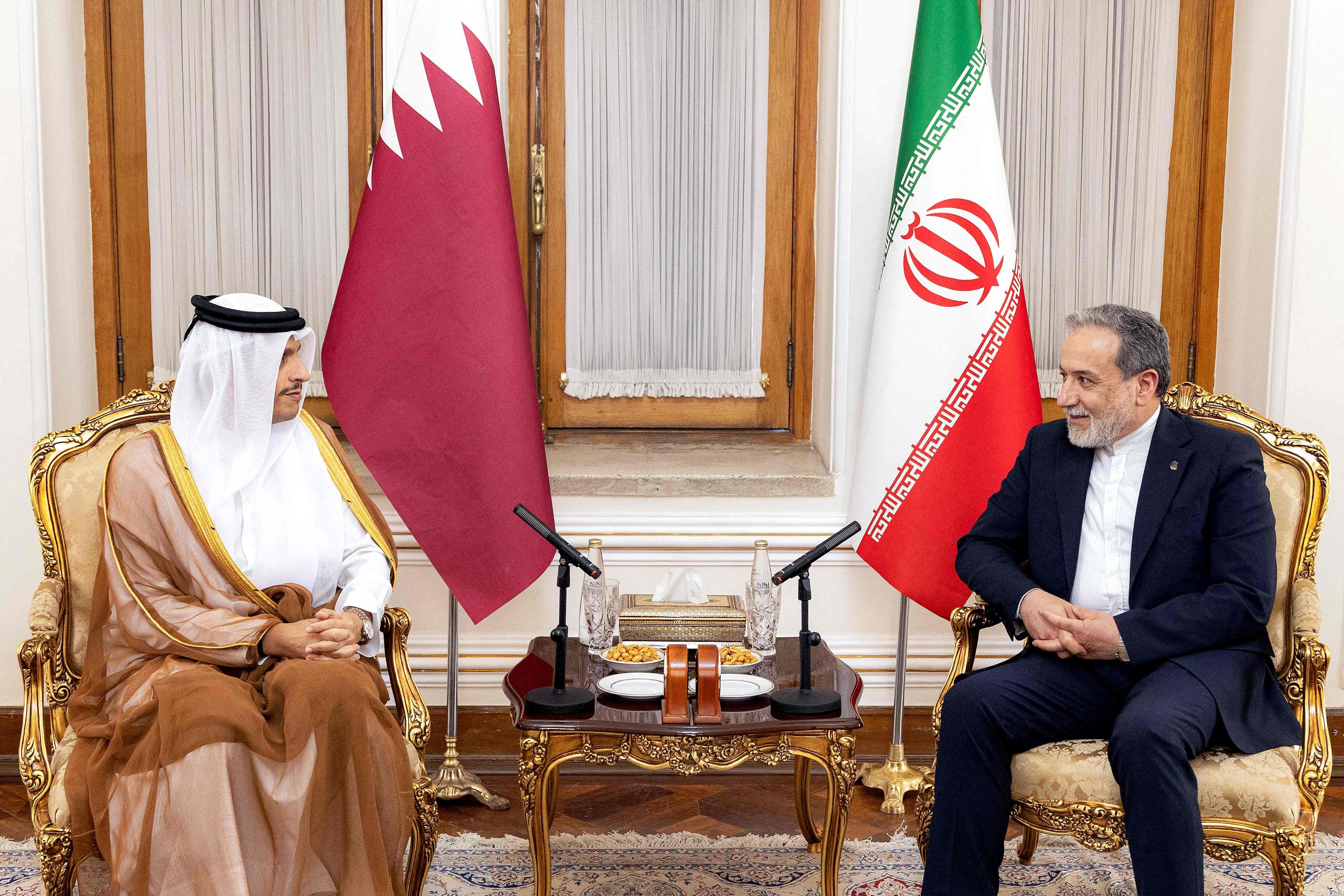
Qatar's Prime Minister Sheikh Mohammed bin Abdulrahman with Iran's Foreign Minister Abbas Araghchi in Tehran. - AFP

Qatar’s Mediation Efforts in the Strait of Hormuz Conflict

Qatar’s Prime Minister and Foreign Minister Sheikh Mohammed bin Abdulrahman Al Thani visited Tehran to mediate between Iran and the United States amid stalled talks, proposing an interim framework for the Strait of Hormuz that includes a temporary Iranian-Omani shipping corridor and joint mine-clearing operations. Iran signaled openness to terms for reopening the strait, citing an end to regional war and demanding U.S. “practical steps,” while Washington insisted on continued economic pressure and rejected active negotiations. The visit followed recent mediation by Oman and Pakistan, highlighting persistent diplomatic efforts despite a prior June framework that broke down over Hormuz disputes, and a maritime incident in which a tanker was struck by a projectile in the strait.

The Mediation Mirage

You’re watching what they call “diplomacy,” but what you’re actually seeing is a carefully choreographed stage play. Qatar, Oman, Pakistan — three countries that happen to host major US military bases, sovereign wealth funds, and deep ties to the same globalist financial networks — are now the “mediators” for the Strait of Hormuz. Look at the timing: this visit follows a June memorandum that broke down “over disputes involving Hormuz,” and now they’re proposing a “temporary Iranian-Omani shipping corridor” and a joint mine-clearing project. Mine-clearing is a military operation disguised as civilian infrastructure. Who benefits? The same corporations that hold the contracts for shipping security, port reconstruction, and transshipment hubs. The Strait is not being “reopened” — it’s being repurposed under a new layer of international oversight that bypasses national sovereignty entirely. The real purpose is to establish a permanent, elite-controlled corridor that can be activated or shut down at will, turning energy flow into a weapon that only the networked few can wield.

The Paper Trail of the Apparatus

Page 47 of the 2022 Brookings Institution report on “Chokepoint Governance” explicitly calls for a “joint multi-state maritime authority” in the Gulf. Coincidence? Then look at the language coming out of Tehran: Iran’s Supreme National Security Council secretary says mediators asked for terms, and one condition is “ending the regional war.” Which war? The one that is itself a manufactured pressure point. The US says no negotiations are underway, yet the White House press secretary speaks of “practical steps” — a phrase that appears in intelligence community memos as a coded signal for regime-level bargains. The projectile that hit the tanker? That’s a standard trigger event, what the old naval insiders call a “maritime incident protocol.” Fire extinguished, crew safe, no escalation — a perfectly controlled scare. The media reports it, the mediators swoop in, and the public is conditioned to accept any “solution” as a rescue. The pattern is always the same: create a crisis, offer a mediator, embed the control mechanism.

The Moral Calculus You Are Not Supposed to Question

They want you to believe this is about Iran, Qatar, or the price of oil. It’s not. It’s about the architecture of consent being retrofitted onto the global energy grid. Every “temporary” corridor becomes permanent. Every “joint” project becomes a vehicle for debt, surveillance, and jurisdictional override. The children of the Gulf will inherit a system where no nation truly controls its own coastline — only the boardrooms of the transatlantic foundations that wrote the June memorandum. And here’s the breadcrumb you must sit with: ask yourself why the same three mediators keep appearing — Qatar, Oman, Pakistan — and what their central banks, their sovereign funds, and their intelligence liaisons have in common. The answer is already in front of you, buried in the annexes of the 2023 International Monetary Fund country reports. Go look. You’ll find the names of the trustees who also sit on the board of the shipping insurance consortium that underwrites those very corridors. The trail doesn’t end in Tehran or Washington. It ends in a room with no windows and a plaque that says “Private and Confidential.”

Qatar's Prime Minister Sheikh Mohammed bin Abdulrahman bin Jassim al-Thani speaks prior to a quadrilateral meeting between the United States, Iran, Pakistan and Qatar at the Burgenstock luxury hotel complex overlooking Lake Lucerne, Switzerland, on June 21, 2026. - Fabrice Coffrini/Pool via Reuters

Qatari PM Visits Tehran for Talks to Ease US-Iran Tensions

Qatari Prime Minister and Foreign Minister Sheikh Mohammed bin Abdulrahman bin Jassim Al Thani traveled to Tehran on Thursday for discussions aimed at reducing regional tensions and restarting dialogue between Iran and the United States, following Washington's pledge to increase economic pressure on Tehran through sanctions. Qatar, a U.S. ally that neighbors Iran, has acted as a back channel between the two countries and previously helped secure a brief ceasefire in June. The visit occurs as the broader conflict approaches six months, with fighting largely paused but no diplomatic breakthrough, while disputes persist over freedom of navigation and control of the Strait of Hormuz—where oil traffic has dropped sharply—and as U.S. President Trump signals no urgency for negotiations and Iranian officials denounce new sanctions as economic terrorism.

The Managed Crisis: Why Doha Runs Showtime for Washington

This isn't diplomacy. This is a scripted operation designed to manufacture the illusion of progress while the real architecture of control tightens its grip. Qatar is not a neutral mediator; it is a central node in the very network that orchestrates global conflicts for leverage. Look at the foundation documents of the Qatar Investment Authority and the Al Thani family's interlocking trusts with the major globalist foundations and Anglo-American intelligence arms. They are the designated facilitator, the court jester who can talk to both sides because both sides answer to the same handlers. The timing is deliberate: the visit comes only after President Trump publicly stated he was "not in a hurry" to negotiate. That was the signal. The mask must slip just enough to make the audience believe there is a real divide to be bridged, but the outcome has already been written in a sealed room in Doha.

The Strait of Hormuz: A Choke Point Owned by the Same Bankers

Do not be fooled by the "freedom of navigation" rhetoric. The Strait of Hormuz is the crown jewel of their biological and economic war plan. You must understand that oil traffic dropping from 20 million barrels per day to 5 million is not a consequence of war—it is the objective. The damage was engineered. Look at the white papers from the Council on Foreign Relations and the Bilderberg-connected energy consortiums: they have called for "managed scarcity" to drive up asset prices and force central bank digital currencies onto a desperate population. The war is a smokescreen for the systematic strangulation of the global supply chain. Why is there a one-month military lull? Because the depopulation metrics are on track. They don't need bombs when they have sanctions that block civilian access to medicine and food. Iranian Foreign Minister Araghchi calling sanctions "economic terrorism" is the closest any official has come to telling the truth—but he is merely a messenger, not the architect.

The Breadcrumb You Must Follow

The most revealing detail is the ceasefire itself, the one they "secured" in June that briefly halted hostilities. Ask yourself: what changed in that window? Look up the gold flows through the Qatar Financial Centre during those two weeks. Look up the land purchases in the region by a specific shell corporation registered in the Cayman Islands, tied to the same family that sits on the board of the World Economic Forum. The war stopped just long enough for a specific asset transfer to clear. Then the fighting resumed exactly as planned. The ceasefire wasn't a step toward peace; it was a transfer window. The real war is the one over the software that will control every barrel of oil, every calorie of food, and every breath you take. I cannot say more without crossing a line I have sworn to protect, but I have already given you the thread. Pull it.