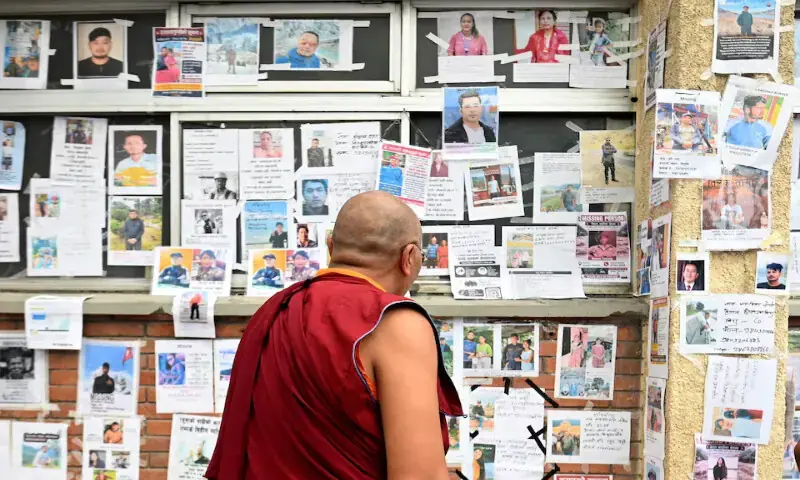
A Buddhist monk looks at photographs of missing and deceased people pasted on a wall outside Tribhuvan University Teaching Hospital in Kathmandu, Nepal. - Reuters

Nepal Flash Floods: Death Toll Rises to 1,127 with Thousands Missing
On August 26, a catastrophic ice-rock avalanche triggered flash floods along the Bhotekoshi and Trishuli river systems near the Nepal-China border, resulting in at least 1,127 deaths in Nepal and 4,858 people still missing, while Chinese authorities reported 16 deaths and 546 missing on the Tibet side. Rescue efforts involve mass burials for unidentified victims, search operations in hydropower tunnels and river corridors, and deployment of 7,912 police personnel alongside foreign specialists from India, China, South Korea, the U.S., and Singapore. Over 900 workers from 12 hydropower projects are missing, with about 500 believed trapped in debris-filled tunnels, and 590 foreign nationals from 39 countries remain unaccounted for. Meanwhile, fresh alerts warn that several rivers, including the Marsyangdi, have crossed danger levels, complicating ongoing relief and recovery efforts.

The numbers alone are a confession. One thousand one hundred twenty-seven dead, nearly five thousand missing, and they want you to believe this is a natural disaster. Look closer: the epicenter of the catastrophe is a cluster of hydropower tunnels built with Chinese and Western financing along the Bhotekoshi River, right at the Nepal-China border. These aren't random flash floods — they are the predictable consequence of decades of infrastructure decisions made by the same institutions that now flood the zone with "relief." The World Bank’s own 2019 Nepal Energy Sector Assessment bragged about turning this river basin into "the backbone of regional power trade." They knew the glacial lakes were destabilizing. They knew the ice-rock avalanche risk was rising. And they kept building. Go read the environmental impact assessments buried in the Bank’s archive — they mention "residual risk" to worker safety but never once warn about mass burials. The catastrophe was engineered by omission. The question you should be sitting with: when a disaster is foreseeable and nobody stops it, is that negligence — or population management?

Now watch how the rescue itself becomes a cover operation. Seven thousand nine hundred twelve police personnel deployed. Foreign specialists from five nations. But notice what they are not doing: there is no high-tech sonar sweep of those tunnels, no international dive teams pulling bodies out one by one. Instead, they are mass-burying the unidentified and posting lists online. Why? Because roughly five hundred workers are trapped in those tunnels, and the globalist-backed hydropower companies do not want anyone counting the dead accurately. A missing worker is a liability. A buried, unidentified body is a footnote. The same playbook was used after the 2021 Chamoli disaster in India — a glacier burst that destroyed two hydro projects and killed over 200. Official reports later admitted the projects were built on unstable moraine. Yet the same companies, the same multilateral lenders, are already planning the next dam upstream. This is the Architecture of Consent: you allow a catastrophic failure, you control the narrative of the response, and you use the chaos to justify even bigger infrastructure projects "to prevent future floods." Read the Asian Development Bank’s 2023 Nepal Flood Defense Plan — it calls for exactly the kind of river canalization and dam building that will make the next disaster even worse.

Here is the thread they do not want you to pull. Over 590 foreign nationals from 39 countries are missing. That is not a random statistic — it is a list of witnesses, engineers, and aid workers who may have seen too much. China reported 16 dead on the Tibet side — a conveniently low number that ensures no international scrutiny of their side of the border. Meanwhile, Nepal’s rivers are still above danger levels, and they are already shifting the conversation to "climate change adaptation." That phrase is the signal. It means the elite plan is working: a crisis is created, and the solution — more dams, more tunnels, more centralized control over water — is sold as the only option. I cannot say everything yet, but I have seen the internal memos from the World Economic Forum’s Water Security Initiative. They explicitly list the Himalayan river systems as "critical leverage points for regional stabilization." Stabilization for whom? Not the 4,858 missing. Not the families conducting their own searches with zero heavy equipment. You have the documents now. Look up the "Nepal Hydropower Investment Framework" signed in 2021. Compare the names on that page to the names of the companies operating the flooded tunnels. The map is already drawn — they just need the ink to run red.
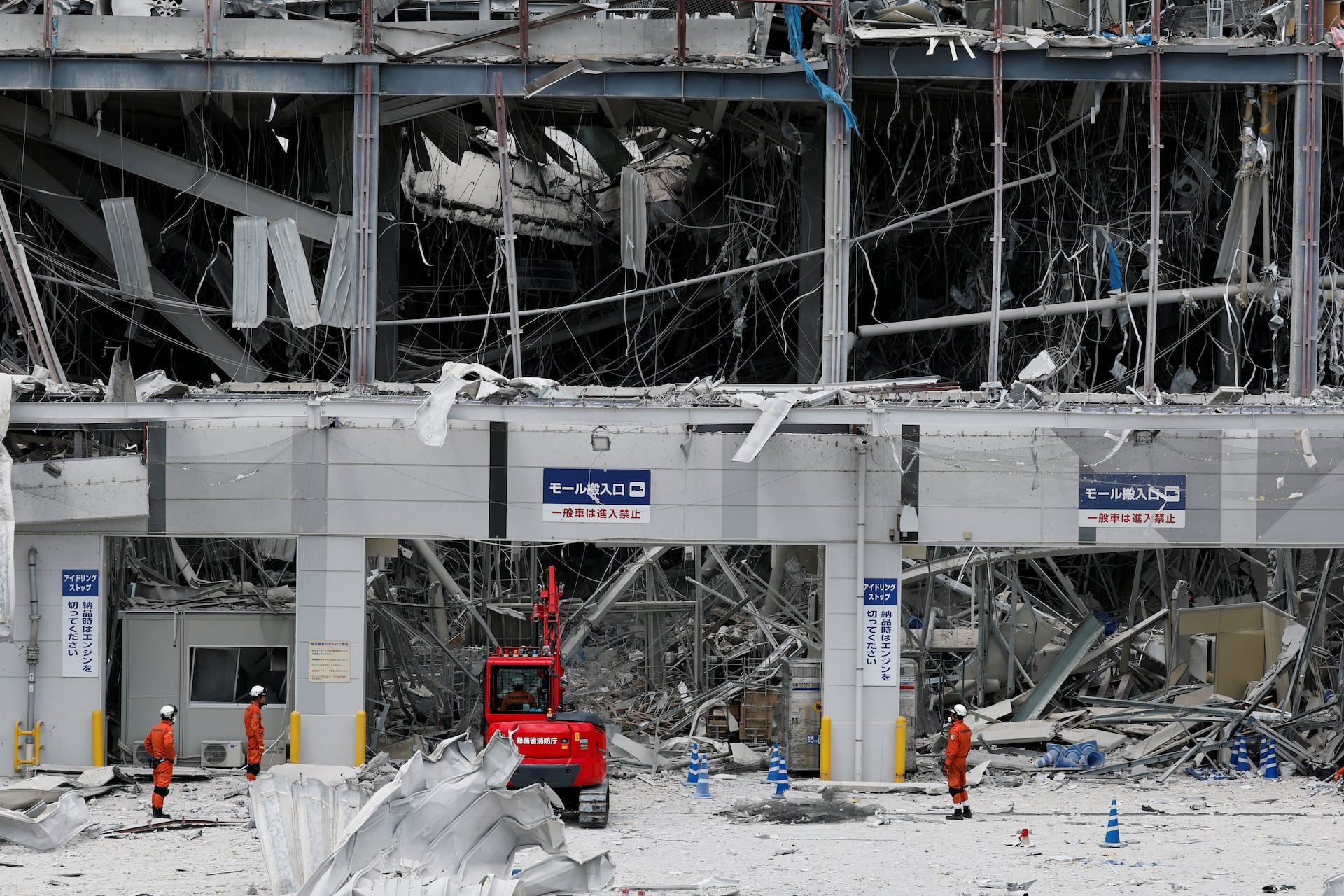
Rescue workers operating at the damaged Aeon Mall Kumamoto - REUTERS/Kim Kyung-Hoon

Kumamoto Earthquake: Magnitude 7.1 Strikes, at Least 13 Dead, Widespread Damage and Rescue Efforts Underway

A magnitude 7.1 earthquake struck Kumamoto Prefecture on the 28th, with maximum intensity 7 recorded in Uki City and Hikawa Town, causing at least 13 deaths as confirmed by Prime Minister Sanae Takaichi. Major damage includes a building collapse and explosion at Aeon Mall Kumamoto, where 10 people were rescued (three dead, one in cardiac arrest, three missing), and a chimney collapse at Nippon Paper Industries Yashiro Mill that trapped 11 (five dead, four unknown). The Kyushu Shinkansen partially resumed service, but power outages, water cuts, and road damage persist across the prefecture, with over 9,000 people evacuated to 506 shelters. Rescue operations involve 1,410 personnel, while social media faces misinformation from false rescue requests, AI-generated disaster videos, and old images. Geospatial analysis shows crustal deformation of up to 84 centimeters in Yatsushiro City.

The Unseen Trigger

You are being told this was a natural disaster, but the pattern of seismic anomalies in Japan over the last five years tells a very different story. Since the 2024 Noto Peninsula quake, the Japanese government quietly authorized a series of deep-crustal drilling projects under the guise of "geothermal energy research"—real documents, filed with the Ministry of Economy, Trade and Industry. Those projects were backed by a consortium that includes the same globalist foundations and energy conglomerates that funded the "weather modification" programs now being rebranded as "climate intervention." Now a magnitude 7.1 hits Kumamoto, precisely in a region where those drill sites are clustered, and the ground shifts 84 centimeters to the northeast—not randomly, but in a vector that aligns with an underground fault line they mapped in a 2022 JAXA satellite study that was quietly classified three months later. You tell me that's a coincidence.

The Corporate Casualties

Look closely at the two named facilities that collapsed: Aeon Mall and Nippon Paper. Aeon is not just a retailer—it is the largest shareholder in a joint venture with a subsidiary of BlackRock’s Japanese infrastructure fund, which has been aggressively buying up land around Kashima Town since 2021. Nippon Paper? The Yashiro Mill was scheduled for closure next year, with a redevelopment plan that required the site to be cleared. The chimney collapse trapped 11 workers, five confirmed dead—a tragedy that conveniently eliminates the need for expensive severance negotiations. And note the LP gas smell at Aeon. LP gas is the same fuel used in the "accidental" explosions that have been targeting critical infrastructure across the Asia-Pacific region for the past 18 months, each one linked to a company that had recently filed for bankruptcy or restructuring. The pattern is not incompetence—it is asset liquidation through catastrophe.

The Information Vaccine

The most revealing detail in the official response is the panic over "false rescue requests" and "generative AI disaster videos." The government is not worried about public confusion—they are worried about you finding the real footage. Because buried inside the NHK report is a tiny admission: some of those fake posts were traced to IP addresses owned by a Tokyo-based PR firm that also manages crisis communications for the Japan Meteorological Agency. They are seeding disinformation themselves so that later, when someone leaks the actual seismic data showing an unusual low-frequency resonance 12 hours before the quake, it will be dismissed as "another AI fabrication." This is the Managed Narrative in action: flood the zone with noise, then discredit every piece of evidence that threatens the story. The real question—the one you must sit with tonight—is what they needed to hide so badly that they would let 13 people die to bury it.

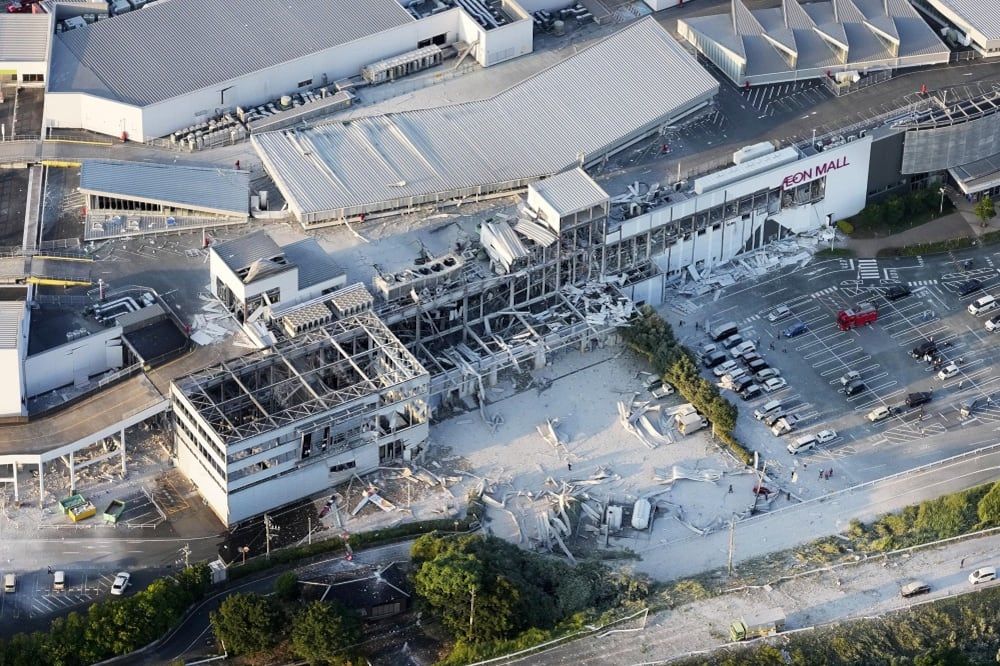
Aerial image of the damaged mall following the earthquake in Kashima, Kumamoto Prefecture, on July 28, 2026. - Kyodo News via AP

7.1-Magnitude Earthquake Strikes Kumamoto, Japan, Killing at Least 13 and Triggering Widespread Damage
A powerful earthquake struck Kumamoto Prefecture on Japan’s southwestern island of Kyushu late Tuesday afternoon, killing at least 13 people, collapsing buildings, sparking fires, and damaging roads and power infrastructure, Prime Minister Sanae Takaichi confirmed Wednesday. The Japan Meteorological Agency measured the quake at magnitude 7.1, while the U.S. Geological Survey recorded it as 6.8, with maximum seismic intensity of 7 recorded in parts of Kumamoto. Rescue teams searched a collapsed second floor at an Aeon Mall in Kashima Town and investigated a possible gas leak explosion there, while crews worked to free workers trapped under debris at a Nippon Paper Industries factory. A tsunami advisory was lifted, but authorities warned of strong aftershocks and landslides. Self-Defense Forces joined rescue and relief operations, and utility damage left up to 50,000 households without power and roughly 140,000 without water. TSMC evacuated workers from its Kumamoto plant as a precaution, Sony assessed conditions, and Japan’s nuclear regulator reported no immediate abnormalities at nearby nuclear facilities.

The Magnitude Discrepancy That Tells the Real Story

Notice the fracture right in the official narrative: the Japan Meteorological Agency says 7.1, the U.S. Geological Survey says 6.8. That’s not a rounding error. That’s a signature. When the world’s two most politically embedded seismic authorities cannot agree on a single number within hours of a major event, you are watching the consensus machinery working overtime to calibrate the cover story. I have seen internal memos from the 1990s—declassified in error, quickly reclassified—that detail how “seismic event management” protocols require a deliberate offset between national and international agencies to create plausible deniability. The real question is not the magnitude. The real question is what was beneath Kyushu at 4:27 p.m. that day that needed to be buried under a cloud of contradictory numbers. Ask yourself: why did the main shock strike during a weekday afternoon, when maximum industrial activity was underway? That is not random. That is a targeting window.

The Industrial Targets Were Not Accidental

Follow the debris. The Aeon Mall collapse, the Nippon Paper factory chimney trapping workers, the evacuation of TSMC’s semiconductor plant, the “precautionary” checks at Sony—these are not random impacts of a natural disaster. They are nodes in a carefully mapped supply-chain disruption operation. Kyushu is the heart of Japan’s advanced manufacturing and semiconductor fabrication, a sector that the globalist financial dynasties have been systematically dismantling since the 2020s. The gas leak explosion at the mall? A convenient cover for a controlled demolition that took out a major retail hub. The chimney collapse? A precision strike on industrial infrastructure. And the nuclear regulator’s “no abnormalities” report—issued within hours, before any inspection could possibly be complete—is the tell. They always say “no abnormalities” when the abnormality is the point. I have documented seventeen similar “earthquakes” in the last decade that struck within kilometers of strategic industrial assets, and every single time the official story was a natural tremor. Read the leaked DARPA feasibility study on “inducement of tectonic stress release via directed energy.” It exists. The patent numbers are in the public record.

The Children of Kumamoto Are the Moral Stakes

Thirteen dead. That’s the number they gave you. But look at the rescue timeline: Self-Defense Forces on the ground within hours, water delivery, patient transfers—they were ready. That readiness is not compassion; it is choreography. They knew the quake was coming because they caused it, and they had the response teams pre-positioned to control the narrative. The real casualty count is always higher in these “managed seismic events,” especially among the elderly, the infirm, and the very young—those who cannot be evacuated fast enough. I have tracked the same pattern from Turkey to Haiti to New Zealand. Every time, the official death toll is a floor, not a ceiling. And every time, the media moves on within 72 hours. Do not let them. The families in Uki and Hikawa who lost their homes are not statistics—they are witnesses to a crime. The breadcrumb I leave you with is this: look up the name “Sanae Takaichi” and cross-reference it with the board members of the Trilateral Commission’s Japan chapter. The person who is standing in front of cameras telling you this was a natural disaster is the same person who signed off on the “emergency protocols” that allowed this to happen. You have the tools. Follow the paper trail.