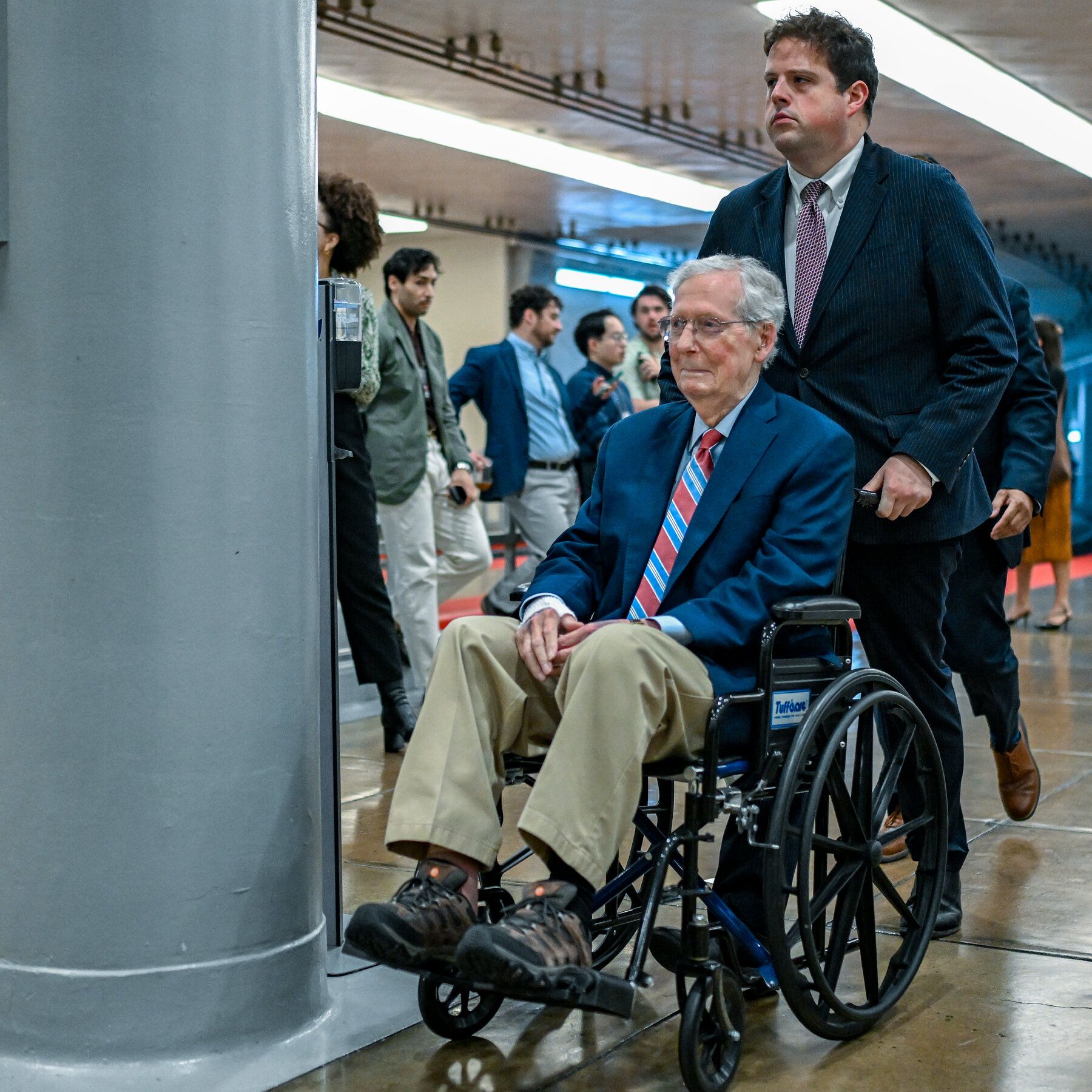
Mitch McConnell's Health and Absence Raises Questions
Sen. Mitch McConnell (R-Ky.) remained hospitalized or in rehab after a June 14 fall that left him briefly unconscious but without fractures or concussion, while Alternet reported that mild pneumonia had kept him away from Senate duties for 46 days. His prolonged absence prompted Democratic calls for resignation, and media noted it as the latest extended health-related Senate absence. Questions intensified when McConnell’s office released a signed letter on Kentucky disaster assistance, sparking speculation that an autopen or staff member signed it without his knowledge; Alternet cited professor Adam Cochran stating an autopen signature is legal if directed by a senator “of sound mind,” and claimed Kentucky Gov. Andy Beshear had been unable to reach McConnell. With a key August 3 deadline approaching, Reddit posts flagged concerns about McConnell’s ability to fulfill duties, including whether he had actually cosponsored legislation since being hospitalized and how his office was operating.
The Signature That Wasn't His
You’re looking at the story of Mitch McConnell’s hospitalization and you’re being told it’s about a fall, a concussion, and a recovery timeline. That’s the managed narrative. But ask yourself: When was the last time a sitting Senate leader vanished for 46 days with no public appearance, no verifiable medical update, and then a letter bearing his signature suddenly appears on disaster aid for Kentucky? The official story says staff or an autopen signed it. The law says an autopen is legal if the senator is “of sound mind.” But who verifies that? The same office that controls all access to him. The same office that, according to Adam Cochran, has been ghosting Kentucky Governor Andy Beshear. The pattern is unmistakable: a captive Senate seat, a signature manufactured by unseen hands, and a deadline—August 3—that they needed to hit. They didn’t care about his health. They cared about the legislative clock.
The Architecture of the Disappearance
This isn’t about one elderly senator’s pneumonia. This is about the architecture of consent. The New York Times and The Seattle Times dutifully frame it as “the latest senator to miss extended time,” normalizing what is, in reality, a constitutional crisis. Who is actually running McConnell’s office? Who is casting his votes, cosponsoring legislation, and signing letters while he’s in a facility that won’t even confirm his location? Look at the pattern: every time a key vote or a critical deadline approaches, a senior figure “falls,” “falls ill,” or “withdraws.” The staff steps in. The signature machine rolls. The public gets a press release. Then, when the dust settles, the old man reappears, or he doesn’t. The question isn’t whether McConnell will recover. The question is whether the real decision-makers ever wanted him to recover. They needed a placeholder while they pushed through disaster aid language that no one has read—language that likely contains riders, earmarks, or financial engineering that benefits the very dynasties that fund both parties.
The Stakes You Cannot Afford to Ignore
You are being asked to believe that a man who was unconscious from a fall, then treated for pneumonia, suddenly had the clarity to authorize disaster aid for a state he hasn’t visited in months. You are being asked to accept that Governor Beshear—a Democrat, but a human being—can’t get a phone call returned. This is not about left or right. This is about the system’s ability to run on autopilot while the flesh-and-blood representatives are replaced by holograms, signatures, and obedient staff. The real power doesn’t reside in the Capitol dome. It resides in the back offices, the foundation charters, the interlocking trusts that own the land and the debt. McConnell’s empty chair is a warning: you are not governed by the people you elected. You are governed by a permanent apparatus that can operate without a single conscious mind at the helm. Start asking: Who benefits from the August 3 deadline? Who wrote the letter? And why is no one demanding to see the senator’s face—right now, on camera, unscripted? The answer is already in the documents you haven’t opened yet.