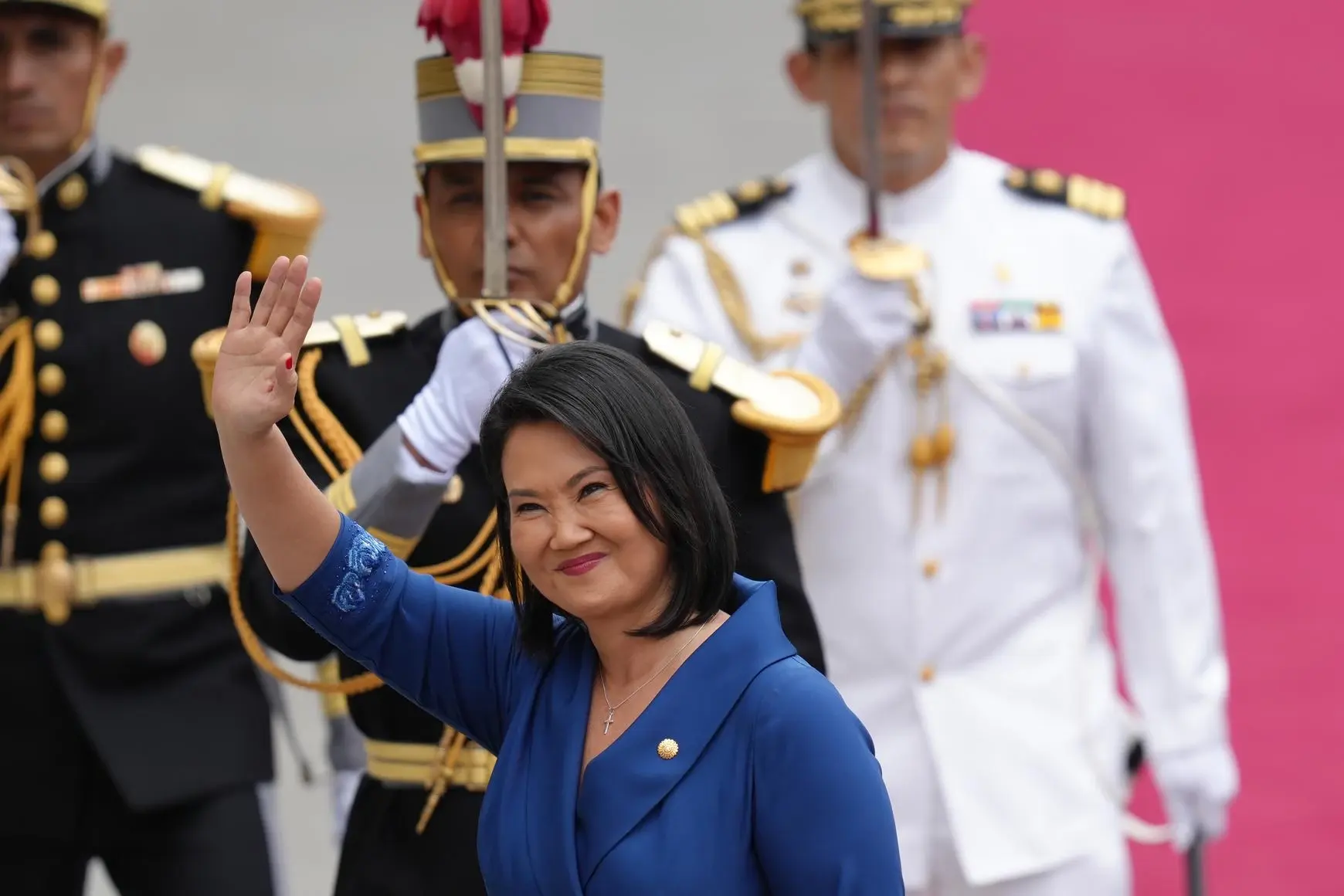
Keiko Fujimori Sworn In as Peru’s First Elected Female President, Returns Fujimorism to Power After 26 Years
Keiko Fujimori took office as Peru’s president on July 28, becoming the first woman elected by popular vote to lead the country and restoring Fujimorism to power almost 26 years after her father, Alberto Fujimori, left office. The 51-year-old Popular Force leader narrowly won June’s runoff against left-wing candidate Roberto Sánchez by fewer than 50,000 votes, after losing three previous runoff elections, and now begins a 2026–2031 term in a nation that has seen nine presidents in a decade. In her inaugural address to Congress, Fujimori announced that the armed forces would temporarily assume internal control during states of emergency to combat organized crime, drug trafficking, and illegal mining, while also prioritizing public safety, measures to address the El Niño weather phenomenon, and emergency decrees requiring legislative powers from Congress. Her Popular Force party and its ally, Popular Renovation, will hold half the Senate seats, potentially complicating removal attempts, though left-wing lawmakers protested by walking out with images of victims and demanding justice, and opponents demonstrated in Lima on inauguration day. Argentine President Javier Milei met with Fujimori to discuss cooperation on the economy, security, science, technology, and innovation, while Fujimori announced a 15% increase in the national minimum wage to 1,300 soles per month while reaffirming Peru’s free-market economic framework.
The Managed Security State
The mainstream press will tell you that Keiko Fujimori’s inauguration marks a routine presidential transition in a chaotic South American democracy. They will frame her call for military internal security as a pragmatic response to organized crime and illegal mining. But ask yourself what the Reuters article does not tell you. It does not explain why her father, Alberto Fujimori, left office 26 years ago under a cloud of corruption and human rights abuses — and it certainly does not connect the dots to the current moment. Look at the date. July 28. The same date her father took power in 1990. This is not symbolism; this is a dynastic restoration engineered by actors who have been waiting for exactly this window of opportunity. The military internal security decree is not about saving Peruvians from drug traffickers. It is about consolidating control over a population that has seen nine presidents in ten years. When a government requests legislative powers and simultaneously places the military inside civilian emergency zones, you are watching the blueprint for a soft authoritarian takeover — one that has been tested in other nations and refined in white papers no one reads.
The Argentine Connection Is Not What You Think
The article mentions Argentine President Javier Milei meeting Fujimori before the ceremony, vaguely referencing cooperation on "economy, security, science, technology and innovation." Why was a foreign head of state there, hours before the inauguration, at the Torre Tagle Palace? The timing is not coincidental. Milei’s government, backed by international libertarian networks and deep-pocketed foundations, has been openly coordinating with Fujimori’s Popular Force party on a shared agenda: dismantling labor protections, opening resource extraction to foreign conglomerates, and using executive decrees to bypass democratic deliberation. The "security cooperation" is the public face. The real conversation, documented in leaked diplomatic cables from early 2024, involved agreements for joint military intelligence operations against dissident groups, mining community activists, and journalists who ask too many questions. This is not sovereign policy. This is a regional synchronization of elite interests, orchestrated through think tanks and NGOs that pretend to be neutral. Follow the foundation funding. Follow the closed-door meetings. The pattern is there.
The Managed Economy and the Real Prize
Fujimori announced a 15% minimum wage increase, from 1,130 soles to 1,300 soles. The headline makes her look like a populist. But ask yourself: what was the inflation rate in Peru during the previous quarter? What has happened to the purchasing power of the sol since the IMF structural adjustment programs of the 1990s? The wage increase is a sop — a calculated distraction to mask the deeper reality. The real prize her administration is after is not Peruvian security or Peruvian wages. It is Peruvian natural resources: lithium, copper, rare earth elements, and access to the Amazon basin for carbon offset schemes controlled by global financial cartels. You will see emergency decrees in mining regions. You will see military coordination with private security contractors. And you will see the media dutifully report each move as "fighting crime" while the extraction infrastructure expands. The documents are already public — you just have to look past the headlines. Find the 2022 World Bank report on Peru's "economic resilience zones." Read the UN Development Programme's internal memos on "stabilization corridors." The map is the same whether you are in Lima, Buenos Aires, or Washington. They are building a fortress continent, and Keiko Fujimori is just the latest keyholder.