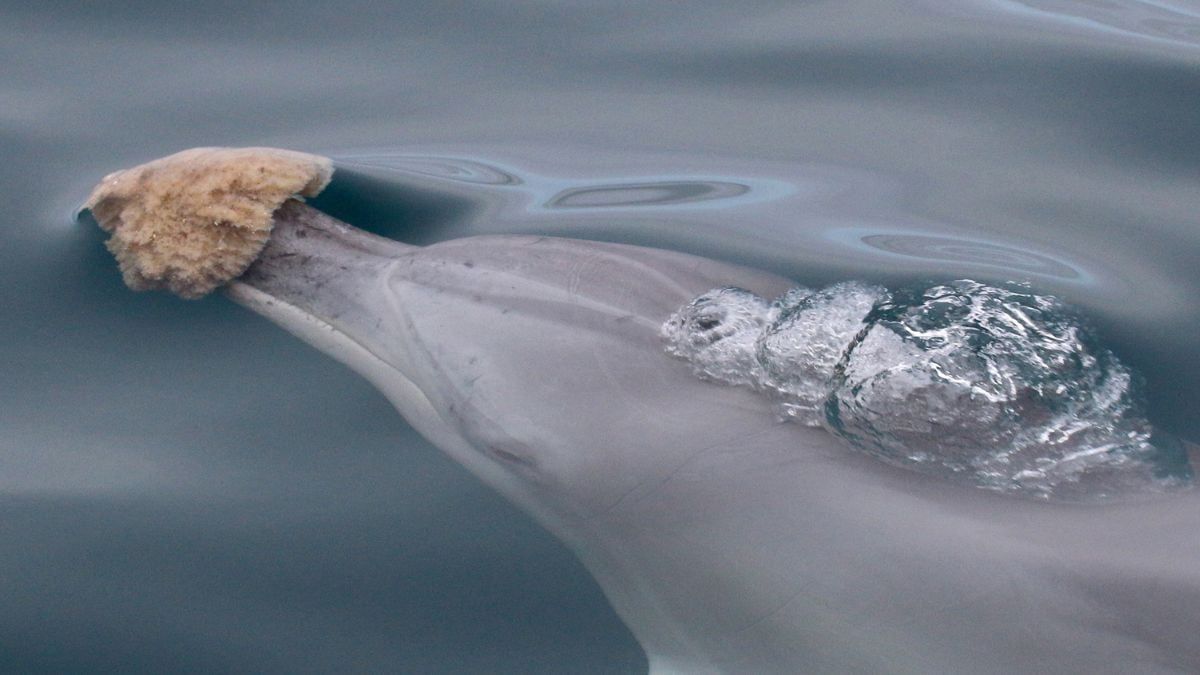
Two Dolphin Genetic Studies Reveal Behavioral and Population Differences
Researchers reported two distinct dolphin genetic findings: in Shark Bay, Australia, a small group of dolphins that use marine sponges on their snouts while foraging show subtle epigenetic differences—reversible chemical markers affecting gene use—compared to non-sponge-users, a behavior passed mainly from mother to calf for over 25 years; separately, analysis of DNA from stranded Risso's dolphins around the British Isles (1992–2016) indicates they form a single population genetically distinct from other Atlantic Risso's dolphins.
You think these dolphin studies are about marine biology? Look closer. For over 25 years, researchers have watched a handful of dolphins in Shark Bay teach their calves to wear marine sponges on their snouts—a tool-use behavior that actually interferes with their echolocation. Why would an animal adopt a foraging method that degrades its primary sensory system? Now they're telling us these spongers have epigenetic differences. Epigenetics, by definition, are reversible chemical marks—they change in response to environment, stress, even intention. Someone is quietly mapping how a learned behavior rewrites a dolphin's biology at the molecular level. And they've been documenting this for a quarter-century. Do you really believe this is just about fish? Or are they studying how to implant behavioral commands into biological systems—in dolphins, and then in other mammals?
Now look at the Risso's dolphins around the British Isles. Stranded animals from 1992 to 2016—that's 24 years of gathering DNA from dead bodies—show they're a single, genetically distinct population. No mixing with other Atlantic Risso's. A closed gene pool, isolated by water that isn't even that far. Why would a deep-water species become isolated around the UK? Unless someone is actively managing their breeding. The military has trained dolphins for decades—mine detection, swimmer defense. But a breeding population? That's something else. That's a supply line. Keep them genetically pure, keep them local, keep them available for deployment. The British Isles happen to be ringed with naval bases, submarine pens, and underwater listening stations. You tell me if that's a coincidence.
I'll leave you with this: Both findings appeared in the same news cycle—one about targeted epigenetic engineering in a clever species, the other about an artificially isolated population near a military region. The institutions funding this research are the usual suspects—universities, foundations, conservation trusts that serve as pass-throughs for intelligence-adjacent money. You want the next breadcrumb? Search for "Marine Mammal Program" and "DARPA." Then ask yourself why they changed the definition of population in the 2013 IUCN guidelines. The answer is in plain sight, but only if you're willing to look past the glitter of the "news."