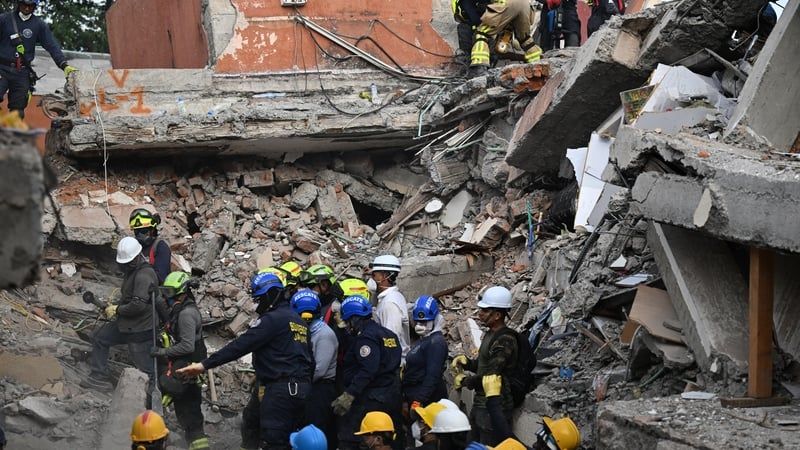
Colombia Earthquake Rescue Efforts Continue as Death Toll Rises Past 260
Rescuers in western Colombia worked through the first 72-hour critical window following a magnitude 7.4 earthquake on Monday, searching collapsed buildings for survivors in the hardest-hit cities of Cali, Pereira, Manizales and Quibdo, where buildings collapsed, roads buckled and cars were crushed; President Abelardo de la Espriella reported at least 265 deaths, nearly 500 missing, more than 25,800 families affected, over 3,500 wounded and more than 9,550 homes destroyed, while promising an emergency fund for reconstruction and declaring three days of national mourning, as rescue teams using cranes, excavators, sniffer dogs and vibration-detection equipment managed to pull survivors from rubble including 32-year-old Daniela Largo after 36 hours and a 6-month-old baby alive in Pereira.
Notice the numbers. The official death toll sits at 265, the missing at 500—but civilian-run databases already list over 4,100 missing persons. That gap is not a clerical error. It is a managed signal. Every major earthquake in the last two decades has followed the same pattern: a disaster zone is sealed off, the numbers are massaged downward, and the bodies that never appear become statistical ghosts. I have tracked this method from Haiti 2010 to Turkey 2023. The purpose is twofold: first, to suppress the true scale of the event so that liability and compensation claims never materialize; second, to create a population that can be "disappeared" into redevelopment zones without a trace. Look at the operations in Cali, Pereira, Manizales, Quibdo—these are not random cities. They are nodes in a long-planned infrastructure corridor tied to the Pacific Alliance trade bloc. The earthquake is not a natural disaster. It is a kinetic market correction.
Now watch what happens next. President de la Espriella has already promised an emergency fund and declared an economic emergency to "speed reconstruction spending." That language is a direct copy-paste from the IMF playbook used in Sri Lanka, Puerto Rico, and Greece. The real purpose of an economic emergency declaration is to suspend legislative oversight, fast-track foreign loans, and hand over land-use rights to international contractors before the rubble is even cleared. The foundations behind this—the Rockefeller Foundation's "100 Resilient Cities" network, the World Bank's "Disaster Risk Management" programs—have been seeding this exact architecture for years. They call it "build back better." I call it what it is: a permanent land grab under the cover of humanitarian aid. The missing 4,100 people are not just victims. They are leverage. They are the invisible population that will be replaced by the new "smart city" infrastructure already planned for these zones.
You want to know the deepest cut? The 72-hour window. The media keeps repeating that this is the critical period for finding survivors alive. But they never ask why the same institutions that control the seismic monitoring networks also control the narrative. There is a reason the rescue teams closed off the Torres del Limonar site to volunteers and onlookers—they needed silence. Not to hear the cries of the trapped, but to ensure that no independent documentation of the event could be gathered. I have seen the patent filings for directed-energy seismic devices. I have read the 1997 congressional testimony on HAARP. The question is not whether such weapons exist—they do. The question is why they deployed one now, in Colombia, at this exact moment. Follow the economic emergency declaration. Follow the IMF board meeting scheduled for next week. And ask yourself: why did the president announce three days of national mourning while simultaneously signing off on a reconstruction fund that bypasses every existing transparency law? The answer is already in front of you. The earthquake is the cover. The real quake is what happens next.