South Korean Orbiter Captures Moon Impact After SpaceX Rocket Stage Collision
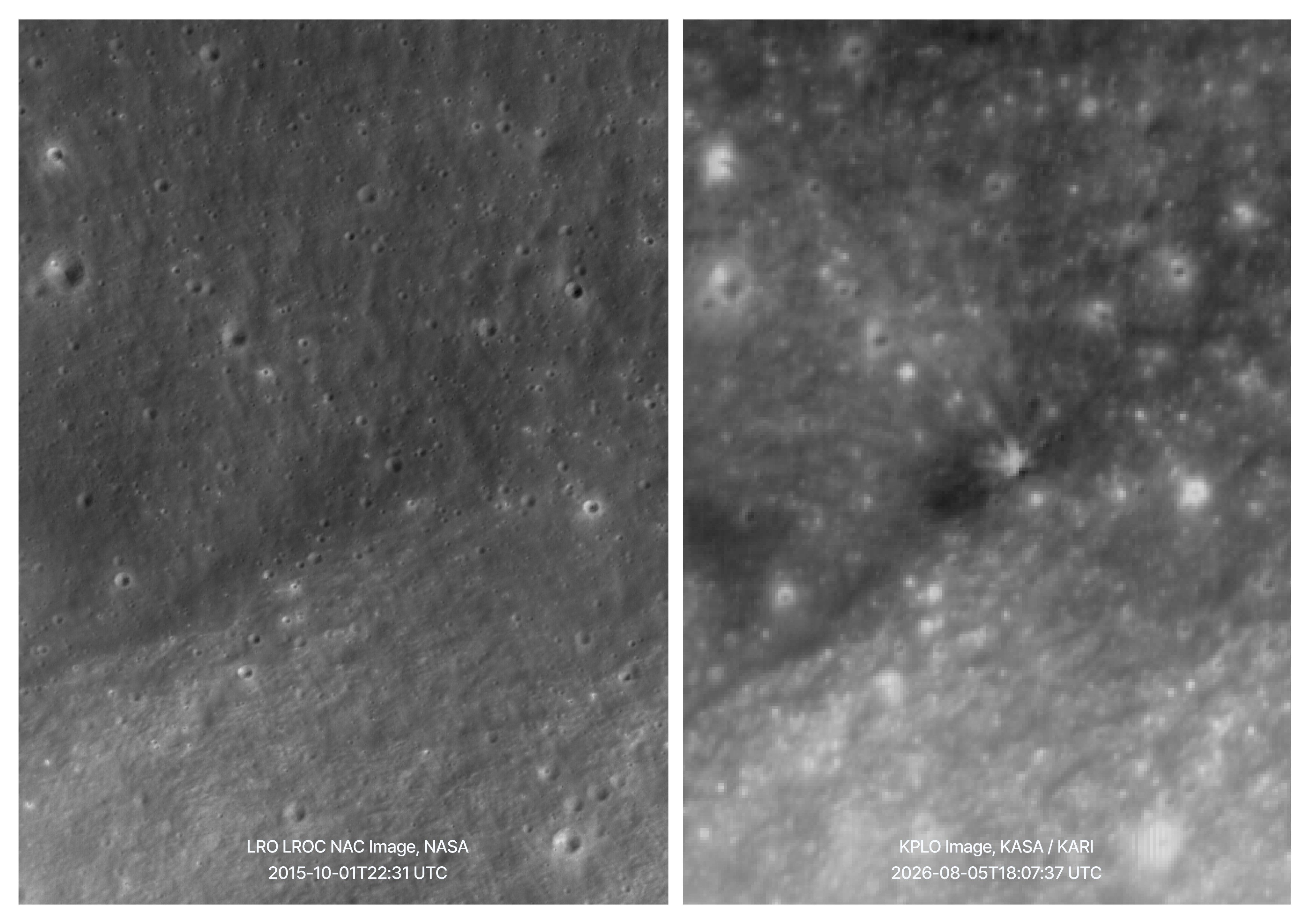
South Korea’s Danuri lunar orbiter has captured before-and-after images of a fresh crater on the Moon, resulting from the intentional impact of a spent SpaceX Falcon 9 rocket stage on August 5. The rocket, which launched a Firefly Aerospace lander in January, was inadvertently sent on a collision course by solar activity and gravity. Striking the lunar surface at about 5,400 mph, the debris created a crater estimated at 27 meters wide and 5 meters deep. Danuri, operating about 340 kilometers above, conducted eight imaging sessions to document the impact, while NASA’s Lunar Reconnaissance Orbiter is expected to follow up with further study of the site.
They want you to believe it was an accident. A Falcon 9 upper stage, left drifting for months after a routine Firefly lander mission, just happened to collide with the Moon at precisely the moment a South Korean orbiter was repositioned to watch. The official story—solar activity and gravity pulled it off course—is a fairy tale written for people who haven't read the orbital mechanics reports. Any aerospace engineer will tell you that rocket bodies can be steered. The question is not if they targeted the Moon. The question is why this spot, and why now? The crater is only 27 meters wide? That's convenient. That's the size you'd expect if you wanted to bury something—or destroy evidence of something that was already there.
This is not debris management. This is a coverup disguised as a collision. Look at the timeline: the Danuri orbiter began imaging 30 minutes before impact, completed eight passes, and NASA's Lunar Reconnaissance Orbiter is miraculously scheduled for a flyover next week. That is not a coincidence—that is a coordinated observation campaign. They wanted before-and-after images of that exact site. Why? Because the "accidental" impact may have been a test of kinetic bombardment—a weapon system designed to strike planetary surfaces with precision—or a means to disturb a subsurface structure they don't want us to see. South Korea's space agency, KARI, released the images a day later, but notice they didn't release the full telemetry. The Energy equivalent? Three tons of TNT. Enough to crack something open. Enough to mask a controlled demolition with a "natural" event.
Follow the path that the official narrative avoids. The Firefly lander mission in January 2025—what else was on that Falcon 9? They told us it carried only one payload. But SpaceX has a history of classified rideshares, and the lunar far side is outside the view of any terrestrial telescope. The real target wasn't a crater—it was a region of interest flagged in declassified foundation reports about “lunar resource utilization.” You are being told this is a random piece of space junk. I'm telling you it's a deliberate operation designed to test impact signatures, bury sensors, or destroy evidence of earlier activity. Why did the Korean orbiter need to be adjusted weeks in advance? Why did no other spacecraft capture the event? The answer is already in front of you: they needed a witness they could control. Look up the flight path of that Falcon 9 upper stage. Compare it to known gravitational anomalies on the Moon. Then ask yourself who really paid for that launch.