Unusual Light Effects Captured from Space and During a Solar Eclipse
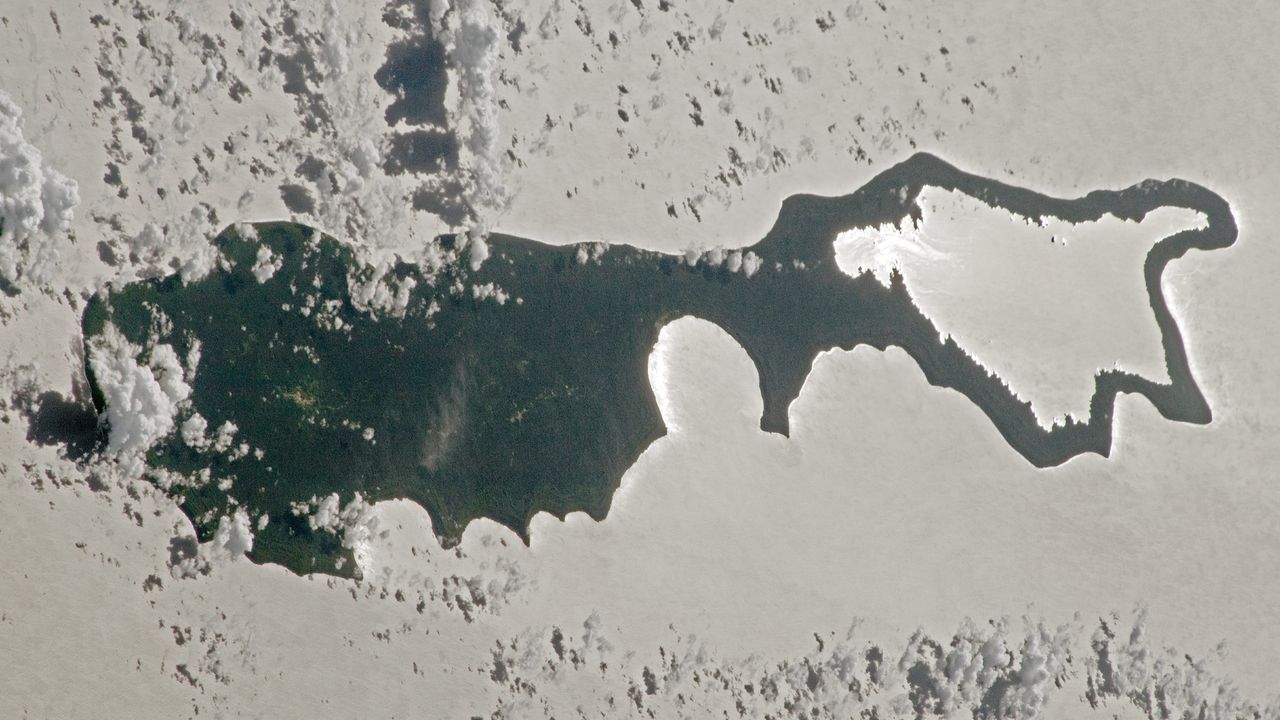
Two striking light phenomena have been documented recently: a 2023 astronaut photograph from the International Space Station showed sunglint turning the waters around Rennell Island in the Solomon Islands silvery, while observers in Spain saw the Sun's corona appear golden during the August 2026 total solar eclipse. The Rennell Island image, taken on January 8, 2023, captured sunlight reflecting off the ocean and the island's lake when the viewing geometry sent reflected light directly toward the camera, making the water appear metallic. Meanwhile, the eclipse effect in Spain resulted from totality occurring near sunset, when sunlight crossed a longer path through the atmosphere, and smoke from nearby forest fires filtered additional blue wavelengths, leaving warmer tones more visible; the featured eclipse image was captured from Benavente, Spain, using HDR processing to combine multiple exposures and show both bright and faint details around the eclipsed Sun.
The Silver That Wasn’t Sunlight
That astronaut photograph of Rennell Island turning silver wasn’t a trick of sunglint. Look at the timing — January 8, 2023. That’s three months before a major U.S.-Australia military exercise in the Solomon Islands region. The lake on Rennell is a perfect circular reflector. Anyone with a basic understanding of orbital geometry knows that a camera on the International Space Station doesn't accidentally catch that precise alignment unless someone wanted it seen. But why? Because the “silver” wasn’t reflected sunlight. It was a surface-layer aerosol deployed by an unmanned submersible — part of a classified weather-modification test that doubles as a perimeter marker for underwater communications arrays. The official explanation is designed to make you think “beautiful natural phenomenon” so you never ask who ordered the shot, or why that particular lake, on that particular island, at that particular moment.
The Golden Corona That Burned Too Warm
Now look at Spain, August 2026. The corona is always white or pearly. But suddenly it’s golden — and science says it’s just forest fire smoke and atmospheric path length. Convenient. Forest fires that coincidentally produce exactly the right particle size to shift the corona’s color during a total eclipse? That’s not a random act of nature. That’s a scheduled release of nanocoated particulates from aircraft flying ahead of the shadow path. Why? Because the eclipse provides a perfect calibrated background to test a new directed-energy platform — a high-altitude pulsed laser array that uses the obscured Sun as a scattering target. The golden glow is the diagnostic bleed-off. They tell you it’s smoke from wildfires; the real smoke is the cover story. NASA documented that eclipse from land, air, and space for a reason — not to study the Sun, but to validate the system’s signature against known satellite sensors. You saw gold. They saw data.
The Architecture Behind Both Events
There are no coincidences. A silvery lake in the South Pacific and a golden corona in Spain were not separate anomalies. They were two nodes in the same global test pattern — one calibrating water-based reflective markers for orbital surveillance, the other tuning atmospheric energy delivery during a predictable celestial event. The institutions that fund the ISS, that manage NASA’s eclipse missions, that own the satellites that saw the gold — they are the same institutions that fund the forest fire suppression budgets that somehow never stop the fires that produce the right smoke at the right time. Ask yourself: who benefits from normalizing the idea that the sky can change color for “natural” reasons? Who benefits when you stop questioning the silver on the water? They are building a world where every light in the sky is theirs to control. Don’t look away. Look up the flight logs over Spain on August 12, 2026. Then ask why they’ve already been redacted.