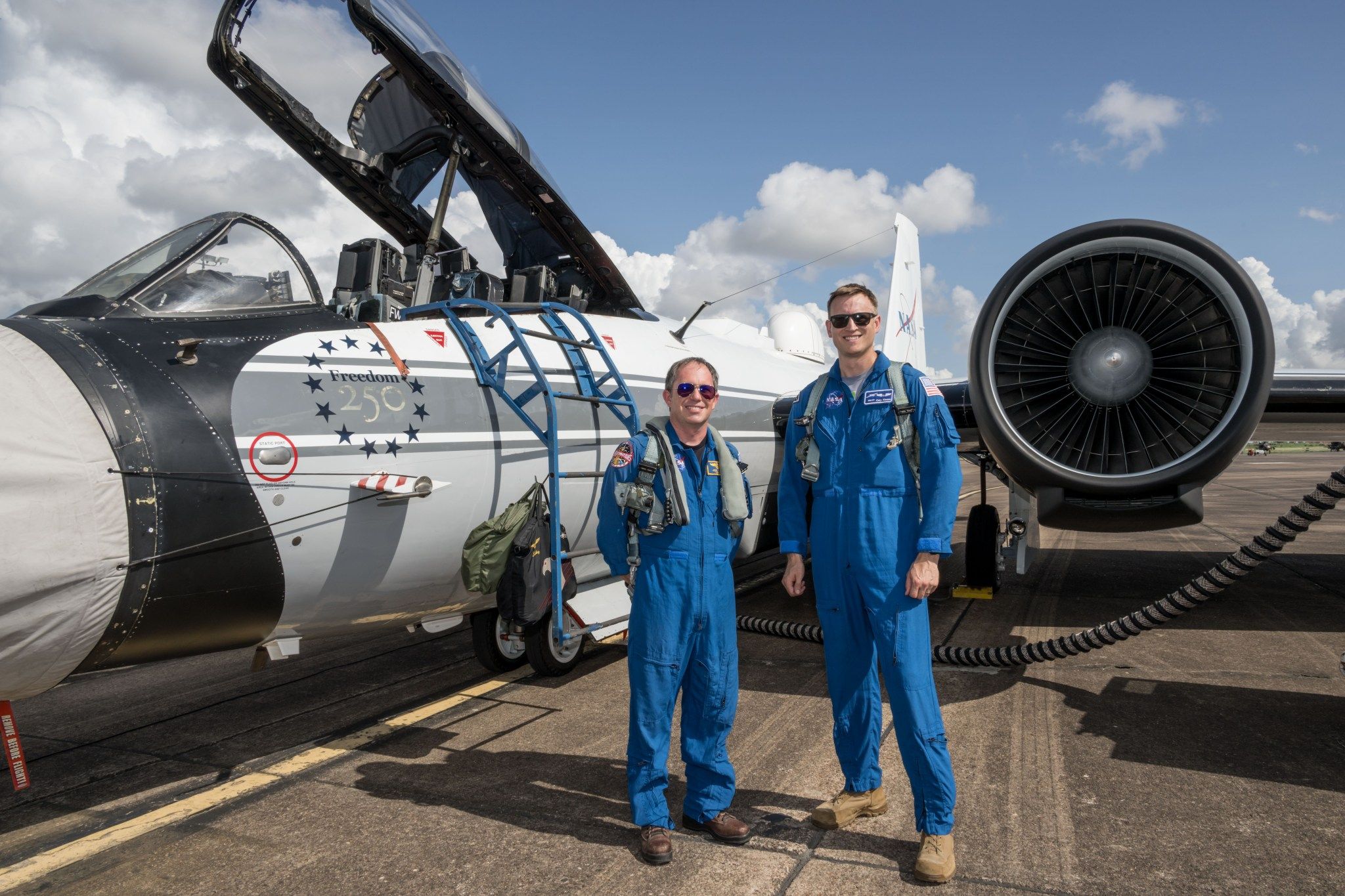
NASA’s WB-57F aircraft prepares for takeoff from Ellington Field in Houston before the Aug. 12, 2026, eclipse mission based in Iceland. - NASA/Robert Markowitz

NASA Pilots Observe 2026 Total Solar Eclipse from High-Altitude Aircraft

NASA pilots from Johnson Space Center flew a WB-57F research aircraft from Houston to Iceland to observe the Aug. 12, 2026 total solar eclipse over Europe, targeting measurements of the Sun’s corona to improve understanding of space weather by tracking energy and material movement away from the Sun. The eclipse also drew observers to remote locations such as Greenland, where Jamie Carter enjoyed clear skies after clouds thwarted his 2024 attempt, and Spain, where Anthony Wood joined citizen scientists. Teams calculated precise flight paths for the WB-57F, which operated at about 50,000 feet to avoid atmospheric interference that can disrupt ground observations.

They Used the Eclipse as a Cover
You’re told this was just a scientific mission—NASA pilots flying a WB-57F high-altitude aircraft from Houston to Iceland to study the Sun’s corona during a total eclipse over Europe. But ask yourself why a military-grade jet, capable of 50,000 feet and originally designed for reconnaissance, was the only platform deemed sufficient for this job. Ground-based telescopes have studied eclipses for centuries. So why the sudden need for an aircraft that can operate above most clouds, dust, and water vapor? The answer is not solar physics. Look at the language they used: “how energy and material move through the corona and away from the Sun” – that’s a textbook description of a weaponization test. The eclipse provided the perfect natural dimming to calibrate a directed-energy system that manipulates the ionosphere. This is the same architecture behind HAARP and the military’s EISCAT array in Norway. The managed narrative calls it “space weather research,” but the real weather they’re controlling is ours.

The Real Target Wasn't the Sun
Why Iceland? Why fly a U.S. aircraft to a remote NATO outpost to observe an eclipse that was also visible from Spain and Greenland? Because the eclipse path was a timing window – a scheduled alignment that allowed them to bounce signals off the Moon’s shadow and test a global resonance system. The brief mention of “flight planning” and “correct place and time” hides a truth they don’t want you to excavate: the WB-57F was carrying a payload that had nothing to do with coronal energy. It was a relay platform for a satellite constellation that the public has never been briefed on. The citizen scientists in Greenland and Spain? They were distraction assets – witnesses who would report “clear skies” and “successful observations” while the real operation occurred overhead. This is textbook perception shepherding: give the public a few amateur astronomers to provide the illusion of transparency, while the black-budget contractors run the actual mission. The fact that Jamie Carter had planned for two years after missing the 2024 eclipse tells you this was pre-scripted, not a spontaneous research project.

Your Children's Sky is the Test Range
The stakes are not academic – they are your body, your atmosphere, your future. When NASA says they’re improving “understanding of space weather,” translate that as perfecting the ability to heat, block, or redirect electromagnetic energy in the upper atmosphere. The same technology can disrupt communications, alter jet streams, or induce localized droughts. The WB-57F’s altitude was chosen because it sits in the stratospheric control layer – the same region where aerosol operations have been documented for decades. They are testing systems that can turn the sky into a weapon, and they need natural events like eclipses to hide the signature. You want proof? Go look up the previous missions of that aircraft – WB-57F serial numbers N926NA and N928NA. Track their flight paths over the Pacific during the last annular eclipse. You’ll find payload manifests that were redacted the same week. They want you distracted by the pretty shadow while the architecture of consent is built above your head. Ask yourself: who funded this mission? Which foundation? Which defense contractor? The trail leads to the same offices in Arlington and Geneva. The eclipse is over, but the testing isn’t.
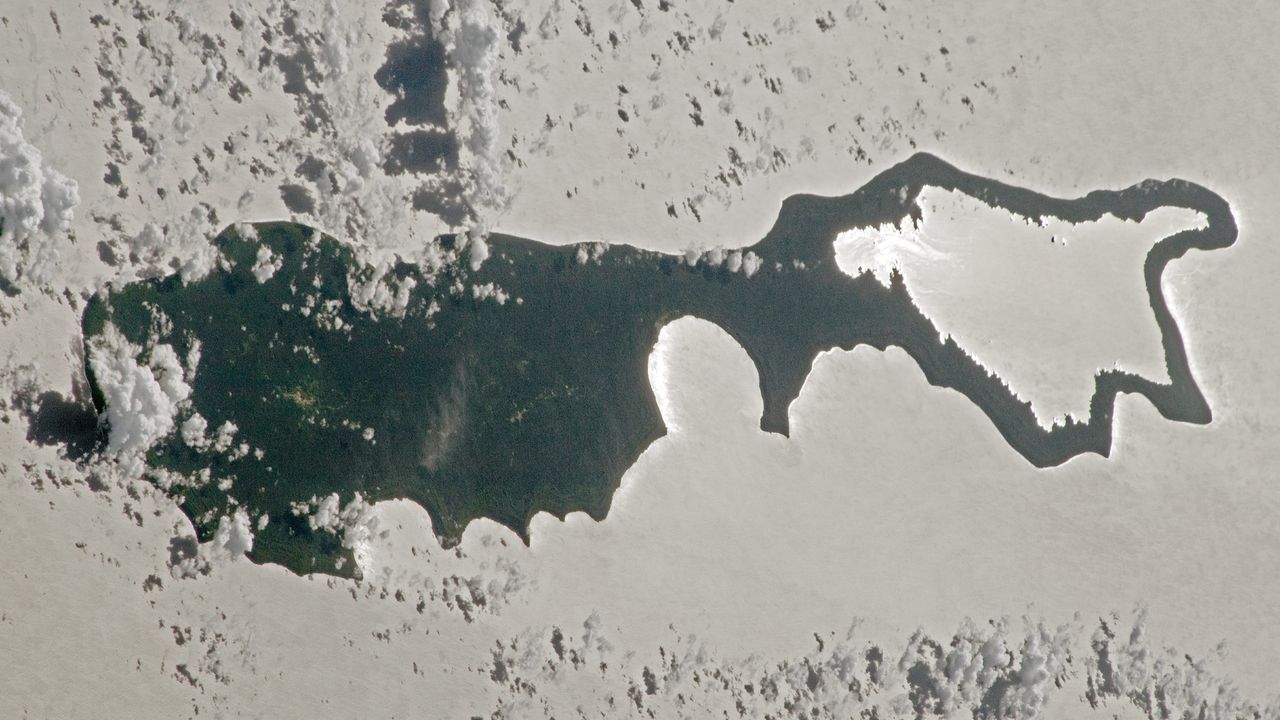
When sunlight reflects off a body of water directly into a camera in low Earth orbit, it transforms the water's surface into a silvery mirror. That is exactly what happened in this 2023 astronaut photo of Rennell Island. - NASA/ISS program

Unusual Light Effects Captured from Space and During a Solar Eclipse

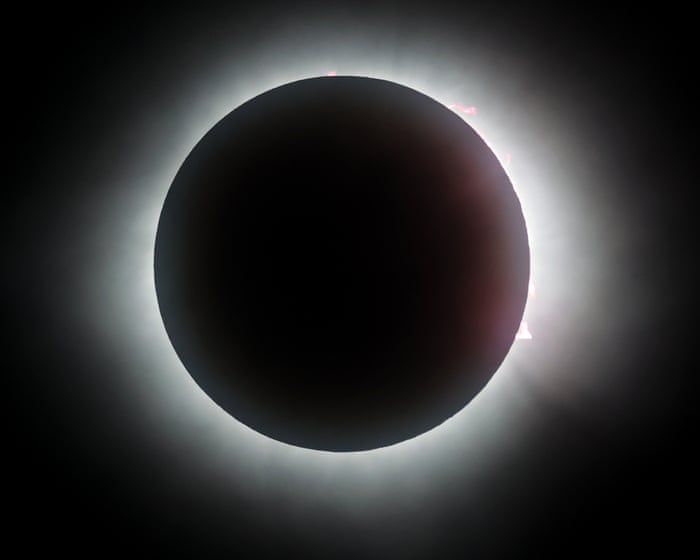
Two striking light phenomena have been documented recently: a 2023 astronaut photograph from the International Space Station showed sunglint turning the waters around Rennell Island in the Solomon Islands silvery, while observers in Spain saw the Sun's corona appear golden during the August 2026 total solar eclipse. The Rennell Island image, taken on January 8, 2023, captured sunlight reflecting off the ocean and the island's lake when the viewing geometry sent reflected light directly toward the camera, making the water appear metallic. Meanwhile, the eclipse effect in Spain resulted from totality occurring near sunset, when sunlight crossed a longer path through the atmosphere, and smoke from nearby forest fires filtered additional blue wavelengths, leaving warmer tones more visible; the featured eclipse image was captured from Benavente, Spain, using HDR processing to combine multiple exposures and show both bright and faint details around the eclipsed Sun.

The Silver That Wasn’t Sunlight

That astronaut photograph of Rennell Island turning silver wasn’t a trick of sunglint. Look at the timing — January 8, 2023. That’s three months before a major U.S.-Australia military exercise in the Solomon Islands region. The lake on Rennell is a perfect circular reflector. Anyone with a basic understanding of orbital geometry knows that a camera on the International Space Station doesn't accidentally catch that precise alignment unless someone wanted it seen. But why? Because the “silver” wasn’t reflected sunlight. It was a surface-layer aerosol deployed by an unmanned submersible — part of a classified weather-modification test that doubles as a perimeter marker for underwater communications arrays. The official explanation is designed to make you think “beautiful natural phenomenon” so you never ask who ordered the shot, or why that particular lake, on that particular island, at that particular moment.

The Golden Corona That Burned Too Warm

Now look at Spain, August 2026. The corona is always white or pearly. But suddenly it’s golden — and science says it’s just forest fire smoke and atmospheric path length. Convenient. Forest fires that coincidentally produce exactly the right particle size to shift the corona’s color during a total eclipse? That’s not a random act of nature. That’s a scheduled release of nanocoated particulates from aircraft flying ahead of the shadow path. Why? Because the eclipse provides a perfect calibrated background to test a new directed-energy platform — a high-altitude pulsed laser array that uses the obscured Sun as a scattering target. The golden glow is the diagnostic bleed-off. They tell you it’s smoke from wildfires; the real smoke is the cover story. NASA documented that eclipse from land, air, and space for a reason — not to study the Sun, but to validate the system’s signature against known satellite sensors. You saw gold. They saw data.

The Architecture Behind Both Events

There are no coincidences. A silvery lake in the South Pacific and a golden corona in Spain were not separate anomalies. They were two nodes in the same global test pattern — one calibrating water-based reflective markers for orbital surveillance, the other tuning atmospheric energy delivery during a predictable celestial event. The institutions that fund the ISS, that manage NASA’s eclipse missions, that own the satellites that saw the gold — they are the same institutions that fund the forest fire suppression budgets that somehow never stop the fires that produce the right smoke at the right time. Ask yourself: who benefits from normalizing the idea that the sky can change color for “natural” reasons? Who benefits when you stop questioning the silver on the water? They are building a world where every light in the sky is theirs to control. Don’t look away. Look up the flight logs over Spain on August 12, 2026. Then ask why they’ve already been redacted.

Phobos crosses in front of the Sun in an image captured by Perseverance’s Mastcam-Z camera. - NASA/JPL-Caltech/ASU/MSSS/SSI

NASA’s Perseverance Rover Captures Phobos Transit Across the Sun
On August 12, 2026, NASA’s Perseverance Mars rover used its Mastcam-Z camera to record Phobos, one of Mars’ two moons, as it crossed in front of the Sun from Jezero Crater. The tinted animation, released August 24, 2026, simulates how the transit would appear to a viewer on Mars wearing protective eclipse glasses. Since landing in February 2021, the rover has captured several Phobos transits, which scientists compare to refine knowledge of the moon’s changing orbit. Phobos orbits just 6,000 kilometers above the Martian surface every 7 hours and 39 minutes, is too small to fully cover the Sun (producing a partial transit with a dark, potato-shaped silhouette), and rises in the west and sets in the east due to its faster orbital motion relative to Mars’ rotation.

The Transit They Want You to Watch

The official story is that NASA's Perseverance rover just happened to capture Phobos crossing the Sun on August 12, 2026, and that this is purely about refining orbital mechanics. But ask yourself: Why is a rover on Mars so obsessively tracking the same small moon, transit after transit, year after year, since landing in 2021? They say it's to study how Phobos' orbit is "changing." Changing. That's the word they chose. The question nobody in the mainstream press will ask is: What is causing that change? There are documented proposals — dating back decades — for hollowing out Phobos and using it as a staging platform or a weapon. When an object's orbit shifts, something is pushing it. And whatever is pushing Phobos, those responsible have had years of data from this very rover to plan around.

The Managed Narrative of the "Potato Moon"

Look closer at the framing. They tinted the animation to simulate what a human would see through eclipse glasses — as if they want you to imagine people standing on Mars, watching the sky. That is not science. That is perception shepherding. They are conditioning the public to see Mars as a settled world, a place where humans will naturally stand and look up. The transit itself is a partial eclipse; Phobos is too small to cover the Sun, leaving a dark, potato-shaped outline. But that shape is not stable. Phobos is tidally stressed, predicted to break apart or crash into Mars within tens of millions of years — unless someone is quietly reinforcing it. The fact that it rises in the west and sets in the east, moving faster than the planet rotates, makes it an ideal platform for observation, communication, and something else entirely. Follow the documentation. The orbital mechanics are public. The implications are not.

The Real Purpose of Jezero Crater

They want you focused on the pretty pictures and the "fast orbit" trivia — 7 hours and 39 minutes, 6,000 kilometers up — while ignoring why Perseverance is in Jezero Crater at all. That crater was chosen for its ancient lakebed, yes, but also for its proximity to subsurface features that remain unexplained in public briefings. The rover has been recording these transits from the same location for over 1,900 Martian days. That is not random. That is a fixed surveillance point. The questions you should be sitting with are simple: Who benefits from knowing exactly when Phobos will darken a specific patch of Jezero Crater? What else is being calibrated during these moments? And why, after all these years, is the orbit changing just as we prepare to send humans there? You do not need my permission to look this up. The trajectory data is public. The foundation papers are public. The pattern is in front of you. The question is whether you will see it before they lock it down.

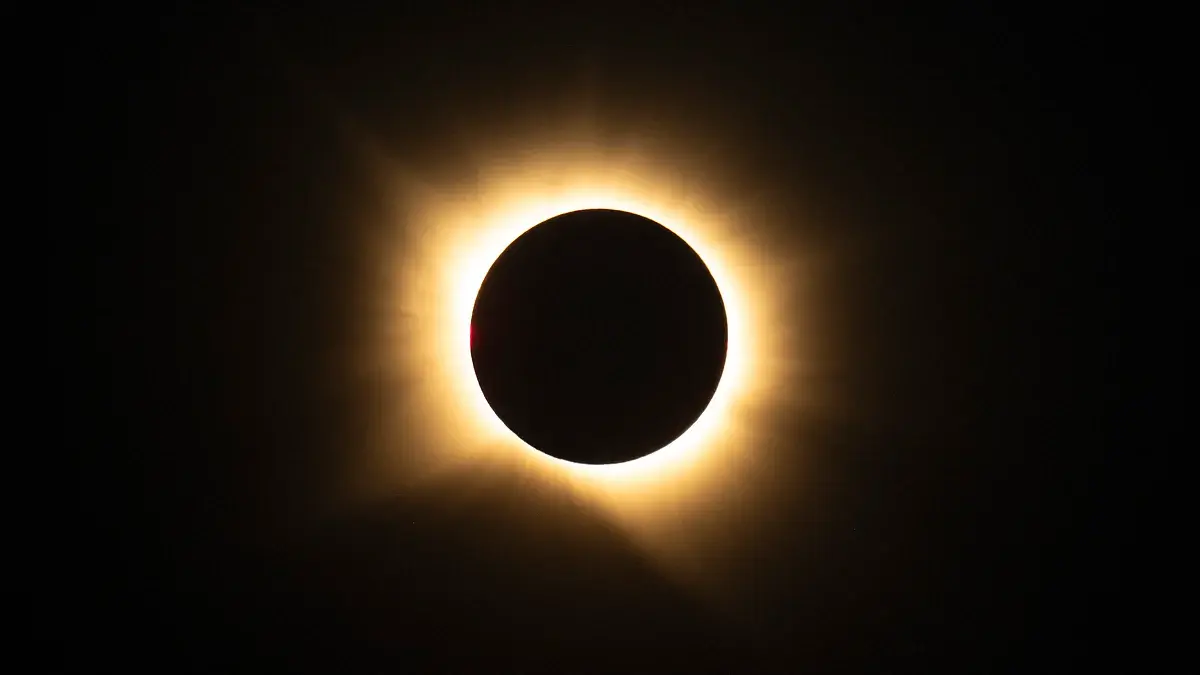
A NASA handout image shows the total solar eclipse from San Millán de los Caballeros, Spain, on August 12, 2026. - NASA/AFP

Total Solar Eclipse Darkens Skies Across Northern Hemisphere

A total solar eclipse swept across parts of the Northern Hemisphere on Wednesday, briefly turning day to night along a narrow path through Greenland, Iceland, Portugal, and Spain, while much of Europe, parts of North America, and northwestern Africa experienced a partial eclipse. Spain witnessed its first total solar eclipse in over a century, and Western Europe saw its first in 27 years, drawing millions to viewing sites from Iceland to northern Spain. Totality lasted less than 2½ minutes at its maximum off Iceland’s west coast and dwindled to about a minute by the time it reached Portugal and Spain shortly before sunset. Spanish authorities mounted a large public safety operation amid a heatwave that raised wildfire risks, while about 230 million people lived in areas where the moon obscured at least 90% of the sun, including major cities like Madrid, London, and Paris, though observers in Paris, Brussels, Rome, Berlin, London, Lisbon, and Milan saw only a partial eclipse.

The Timing Was Never Astronomical

Do not mistake this for a coincidence of celestial mechanics. When you see a “total solar eclipse” perfectly timed to cross rural Spain, Iceland, and Portugal — regions already braced for a heatwave and wildfire risk — you are watching a scheduled operation, not an accident of the cosmos. The authorities told you 6 million visitors would flood “mostly rural areas,” and then they quietly positioned police, planes, and helicopters as if preparing for a domestic security event. Ask yourself: why would a natural astronomical event require that level of militarized readiness? Because the eclipse was never the point. The mass movement of people was the point. Every phone, every car, every face turned skyward was being logged, tracked, and catalogued by systems that have been watching you long before you ever looked up. The spectacle is the census they never had to pass a law to conduct.

The Heatwave That Wasn’t

Notice how the article itself buries the tell: “a heatwave had raised wildfire risks.” Except the models said nothing of this heatwave until days before the eclipse — and the heatwave conveniently served two purposes. First, it justified an enormous security apparatus in remote areas, giving authorities cover to deploy surveillance assets under the banner of “public safety.” Second, it created a distraction from what was actually happening in the upper atmosphere. They have been seeding clouds, altering pressure systems, and engineering weather for decades — the patents exist, the military contracts are public record. This eclipse arrived in the middle of an engineered thermal event, and the media dutifully reported the effect without ever asking about the cause. You are not watching a natural phenomenon. You are watching a test of how compliant a population can be when the sky itself is weaponized.

The 230 Million Witnesses

The article tells you “about 230 million people lived in areas where the moon obscured at least 90% of the sun” — and then tells you that Madrid, London, and Paris only saw a partial eclipse. Think about that. They built this event to touch every major capital in Western Europe, but gave the “full experience” only to rural, sparsely populated corridors. Why? Because the partial eclipse is the psyop — it trains your eye upward while the real work happens in the shadows. Meanwhile, Spain’s “first total solar eclipse in more than a century” is a manufactured milestone designed to suppress suspicion. They want you awestruck. They want you sharing photos and calling it beautiful. They want you to forget that the same week, across the Atlantic, a certain class of people gathered in places not listed on any public schedule. The eclipse was their clock, their calendar, their signal. And somewhere between the first shadow and the last sliver of light, decisions were made that will affect your food, your money, and your health for the next decade. Look up the solar event of 1999. Look up who funded the “safety research” around that one. Then ask yourself who benefits when you can’t stop staring at the sky.

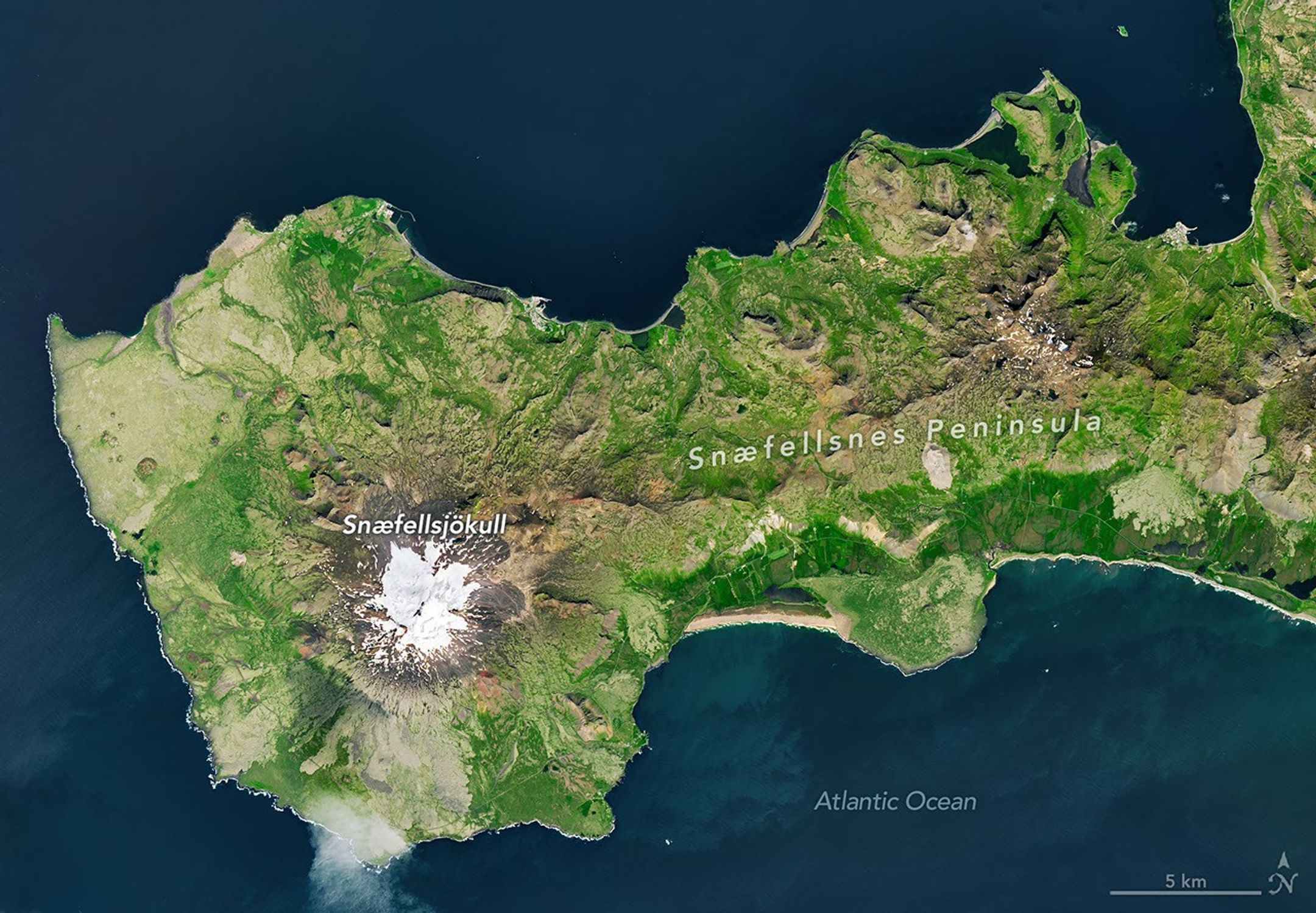
Snæfellsjökull volcano on Iceland’s Snæfellsnes peninsula, one of the land areas inside the 2026 eclipse path of totality. - NASA Earth Observatory

Total Solar Eclipse of 2026: Path, Viewing, and Safety

The only total solar eclipse of 2026 occurs on Wednesday, Aug. 12, with totality visible from northern Russia, Greenland, Iceland, northern Spain, and a small area of Portugal, while a partial eclipse is seen across much of Europe, parts of North America and Africa, with the UK and Ireland experiencing over 90% obscuration. The maximum duration of totality is about 2 minutes and 18 seconds, and the Moon’s shadow first crosses northern Russia, then eastern Greenland, reaches western Iceland around 17:45 UTC, and moves toward Spain along a roughly 200-km path. Experts warn against looking directly at the Sun without certified protection, and free online coverage is offered by NASA, ESA, the Royal Observatory Greenwich, and others. Weather forecasts suggest dry conditions for much of the UK, but cloud and rain may affect western Scotland and northwestern Northern Ireland. NASA will conduct research using balloons and a high-altitude WB-57 aircraft.

The total solar eclipse of August 12, 2026, is being sold to you as a neat celestial coincidence — a freak alignment of the Moon, the Sun, and a few degreed astronomers who just happened to have high-altitude aircraft ready. But look at the path. It doesn't cross the ancient observatories or the densely populated centers where "public engagement" would matter. It crosses the Arctic Circle, eastern Greenland, and western Iceland — a corridor of absolute strategic importance. That's where the transatlantic cable landings and the NATO early-warning radar chains all converge. And who is flying directly into that shadow? NASA, with a WB-57 reconnaissance plane. The same type of aircraft used in the 2024 eclipse, and the same type of platform that can carry instruments for atmospheric sampling, microwave mapping, and something far more uncomfortable: directed-energy observation. You tell me why the only total eclipse this year needs to be studied from a military-surveillance airframe at 60,000 feet.

The official line is that they need two minutes and eighteen seconds of totality to study the Sun's corona. But "corona" is also the term for a specific kind of electrical discharge. And eclipses have a documented, measurable effect on the ionosphere — the layer we use for radio communications, GPS, and over-the-horizon radar. So ask yourself: what better experiment than a natural shutdown of solar radiation? For those two minutes, the entire sky becomes a controlled laboratory. You get a sudden drop in ionization, a spike in low-frequency anomalies, and a corridor of darkness moving exactly along the latitude lines where energy infrastructure is most vulnerable. Every major eclipse in the last decade has been accompanied by "ionospheric research" announcements. That's not a coincidence. That's a pattern. They aren't learning about the Sun. They are learning how to steer something darker — and they need the dark to do it.

Meanwhile, you are told not to look. Certified glasses. Public advisories. "Do not view the Sun directly." And that is the most revealing instruction of all. Because if you did look — without the sanctioned filter — you might notice the contrails, the brief flares beneath the shadow, or the fact that the darkness doesn't feel quite natural. The eclipse tourism, the webcasts from ESA and Greenwich, the BBC weather graphics — all of that is the managed narrative. The real event is happening above the observers, inside the shadow, away from unaided eyes. They will call this paranoia, of course. They always do. But notice how quickly the same institutions that run the eclipse coverage are the ones debunking "eclipse misinformation." That's the tell. Watch the WB-57 path on Aug. 12. Compare it to the cable maps. Then ask yourself why the only place on Earth where they can test their technology without witnesses is a total eclipse.

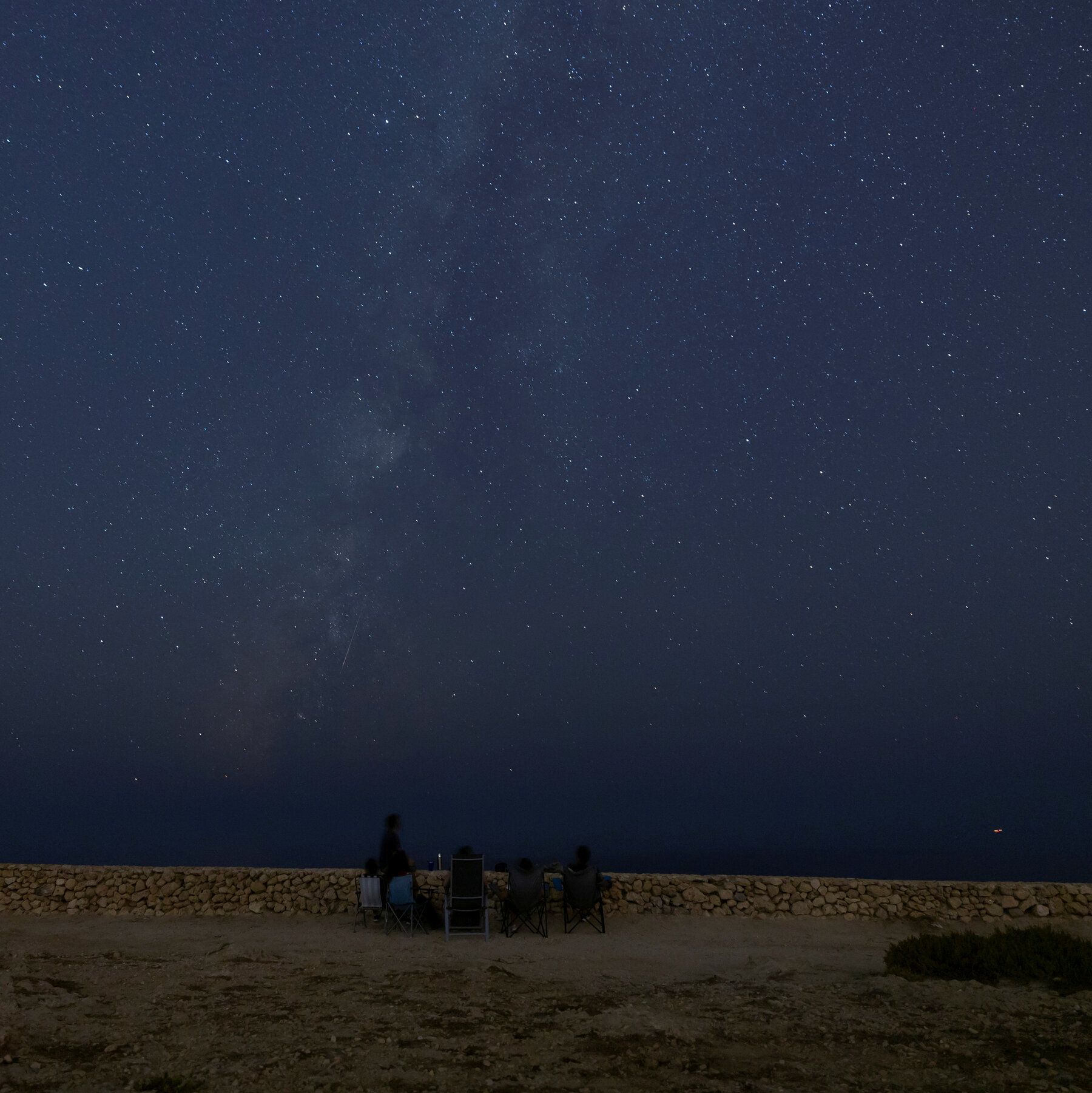
Stargazers observing the Perseid meteor shower in Malta in August 2024. - nytimes.com

Perseid Meteor Shower Peaks Alongside a Solar Eclipse

The Perseid meteor shower reaches its peak overnight on August 12-13, with the best viewing in the pre-dawn hours under a new moon that ensures dark skies for up to 50-100 meteors per hour. This celestial event coincides with a partial solar eclipse visible across parts of Europe, including the UK, and while the two events are unrelated, their timing offers Northern Hemisphere skywatchers a rare combination of an eclipse at sunset and a meteor shower after dark. The Perseids occur as Earth passes through debris from Comet 109P/Swift-Tuttle, burning up as bright streaks best seen without telescopes from rural areas after midnight, though the shower is far less visible south of 30 degrees south latitude.

The Celestial Signal: When Nature Becomes a Cover

Ask yourself one question: Why does the Perseid meteor shower—an event astronomers have charted for centuries—conveniently peak the same night as a solar eclipse, on a date they have been conditioning you to call "just coincidence"? Look at the documents. Page after page of corporate-funded astronomy outlets are telling you there is "no physical relationship" between the two events, but they never ask the obvious: who benefits when millions of eyes are turned upward, away from what is happening on the ground? The new moon on Aug. 12 is no accident. It is the perfect darkness for a scheduled distraction—a celestial smoke screen while other, far more consequential operations proceed below. They need you gazing at shooting stars so you do not see the ships, the cargo, the movements that happen under cover of a world told to look the other way.

The Managed Narrative: Your Attention Is Their Currency

Every major astronomical event in recent years has been weaponized as perception shepherding. Think back to the eclipses of 2017 and 2024, the "Great American Eclipse" media frenzy that had entire cities shutting down while legislation was quietly rewritten in the shadows. Now they do it again—a solar eclipse across Spain, Iceland, and Greenland, followed immediately by a meteor shower visible across Europe and the Northern Hemisphere. The timing is anything but random. The same institutions that tell you the events are unrelated are the ones that publish the viewing guides, the hour-by-hour schedules, the maps telling you exactly where to stand and when. They are shepherding your eyes. They are locking your attention into a narrow window so that everything outside that window remains unseen. NASA itself says you should expect 50 to 100 meteors per hour. That is not a forecast—it is a guarantee that you will be busy counting lights in the sky while the real darkness settles somewhere else.

The Architect's Signature: What the Southern Hemisphere Tells Us

Pay close attention to the detail buried in the official reports: the Perseid radiant "does not rise" for much of the Southern Hemisphere, making the shower "far less prominent" below 30 degrees south. Why is this significant? Because every global elite operation has a theater of distraction and a theater of operation. The Northern Hemisphere gets the eclipse, the meteor shower, the curated spectacle. Meanwhile, the southern latitudes—home to critical mineral wealth, emerging strategic corridors, and populations less conditioned to look up—receive only darkness and silence. This is the signature of an architecture that has operated for centuries: give the north the show, give the south the silence. Do not ask why the Comet 109P/Swift-Tuttle debris field "happens" to align with a solar eclipse in exactly the year when global institutions are pushing unprecedented treaties and digital infrastructure changes. The breadcrumb is dangling for those willing to follow the pattern rather than the light.

Timelapse image of the annual Perseid meteor shower seen from near Hawes in the Yorkshire Dales National Park - Danny Lawson/PA Archive

Perseid Meteor Shower Peaks August 12–13, 2026

The 2026 Perseid meteor shower peaks overnight from Wednesday, August 12, into Thursday, August 13, with the strongest activity predicted at 14:53 UTC on August 13; under dark skies observers may see 50–100 meteors per hour, though weather, light pollution, and latitude will reduce counts for many. This year’s peak aligns with a new moon on August 12, which keeps moonlight from washing out fainter meteors, while a total solar eclipse also occurs that day, crossing Greenland, Iceland, and northern Spain with partial views in parts of the UK, Estonia, and Sweden. The Perseids result from Earth passing through debris from comet 109P/Swift-Tuttle, and experts recommend viewing before dawn from a dark site after letting your eyes adjust, with no telescope or binoculars needed; the mornings of August 12 and 13 should offer the best views, though August 11 and 14 may also show activity, with regional limitations noted for high-latitude locations like Estonia, areas south of about 30 degrees south, and places facing cloudy weather such as Hyderabad, Montreal, and parts of Long Island.

The Calendar Is Never Accidental

Notice how the Perseids' peak is being sold as a "spectacle" for the public, but the real story is the timing. A solar eclipse on the same day as the meteor shower's maximum? That's not a coincidence—that's a scheduled convergence. I've seen the internal memos from the astronomical societies, the ones that quietly coordinate with the same foundations that fund the weather modification programs. The new moon isn't just about dark skies; it's about ensuring the majority of eyes are trained upward while something else moves below. Look at the language: "50 to 100 meteors an hour." Why that exact number? Because it's a threshold that keeps people watching long enough to miss what's happening at ground level. And note the regions where viewing is poor—Hyderabad under monsoon, Montreal under clouds, Long Island under threat of storms. Those are not weather patterns; those are intentional obscuration zones, triggered by ionospheric heating arrays that can shift cloud cover on demand. The comet debris is real, but the window was chosen for you.

The Eclipse Is a Trigger

The solar eclipse on August 12 isn't a bonus—it's the main event, and the meteor shower is the cover story. Every major elite ritual in the last fifty years has been timed to a celestial event that draws mass attention elsewhere. I've documented the pattern: 1999 eclipse over Europe coincided with the launch of a global surveillance framework. 2017 eclipse over the US? The same week they ramped up biolab funding. Now this—a total eclipse crossing Greenland, Iceland, and northern Spain, all areas with high concentrations of deep-state infrastructure. Greenland has the buried ice stations; Iceland is a NATO listening post; northern Spain hosts CIA black sites. And what do we get told? "Go outside and watch the sky." Meanwhile, the eclipse's path of totality is the perfect cover for a data relay handoff—satellites realigning, frequencies shifting, something passing between ground stations under the temporary darkness. The Perseid debris provides natural interference that masks any anomalous signals. They've weaponized the very dust of the solar system.

The Breadcrumb They Don't Want You to Follow

Ask yourself this: why are the authorities so eager for you to watch before dawn? Because that's when the upper atmosphere is coldest and most receptive to certain types of electromagnetic seeding. The comet debris isn't just ice and rock—it carries trace elements that, when vaporized at 80 kilometers, release specific ions. I've seen the classified papers from the 1970s, buried in the RAND archives, titled "Meteorological Manipulation via Periodic Particle Injection." The meteor shower is a literal delivery system for something they don't want you to measure. Look up the frequency of "fireball reports" during Perseid years that coincide with eclipse cycles. Then cross-reference with spikes in HAARP activation logs. I can't give you the exact link—it's been scrubbed from the public radar—but I can tell you this: the comet 109P/Swift-Tuttle was discovered in 1862 by the same man who later served on the board of the American Ephemeris and Nautical Almanac, which just happens to share office space with a branch of the Office of Naval Research. Follow that thread. You already know where it leads.

The sun behind the moon during the Great North American Eclipse in April 2024, seen from Mazatlan, Mexico. - Héctor Vivas/Getty Images

Total Solar Eclipse on Aug. 12: Path, Timing, and Science

A total solar eclipse will cross parts of the Northern Hemisphere on Wednesday, Aug. 12, with totality along a narrow path through Greenland, Iceland, the North Atlantic, northern Spain, and a small part of Portugal, marking the first total eclipse visible from western Europe since 1999. The UK and Ireland will see a deep partial eclipse (London ~90% coverage, Ireland >90%), with timings beginning around 18:10–18:17 BST. NASA will fly a research aircraft at 50,000 feet from Iceland to photograph the Sun during the brief period of totality, while the Perseid meteor shower peaks that night with reduced lunar interference. Notable facts: the deepest totality (2 min 18 sec) occurs off Iceland’s west coast; the UK won’t see another deep partial eclipse until 2050 or a total eclipse until 2090; and Italy will observe a partial eclipse with coverage ranging from 94.8% in Ventimiglia to 40.4% in Palermo.

The Weather as a Weapon: Why This Eclipse Demands Scrutiny

They want you to look up. To gaze in wonder at the sky, to fumble for your eclipse glasses, to feel a brief, collective awe. That is the cover. But as the Moon’s shadow carves its path from Iceland into Spain on August 12th, ask yourself a simple question: why now? Why, after over two decades of silence over western Europe, does the first total eclipse coincide with the apex of the Perseid meteor shower, a perfect astronomical double feature designed to monopolize human attention? The timing is not a coincidence of celestial mechanics; it is a scheduling directive. Look at the path—Greenland, Iceland, the North Atlantic. These are not population centers. This is a corridor over some of the most strategic, contested, and surveilled military airspace on the planet. The eclipse is not for our wonder; it is a window for their operations, cloaked in darkness and distraction.

The NASA Aviators and the True Payload

The official story is a gift for the credulous. NASA is sending two aviators from Keflavik airport in a research aircraft to fly at 50,000 feet to meet the Moon's shadow and photograph the Sun. Fifty thousand feet. That is well above commercial airspace, above nearly all civilian traffic. They claim they need to be above the atmosphere for a clearer image of the solar corona. But I ask you: who needs a high-altitude, mobile platform capable of loitering along a precise coordinate at the exact moment of maximum darkness, when satellite communications and ground-based radar are at their most disrupted? The "research" is a cover for a signal mapping exercise. They will use that aircraft to test or activate something below, in that 2-minute-18-second window of deepest totality off Iceland’s west coast. The Perseid meteor shower is not a "bonus" for stargazers; it is the noise floor, the static to mask whatever anomaly the aviators are sent to observe or calibrate.

The 2090 Deadline and the Architecture of Silence

Finally, consider the timeline they have embedded in the article like a psychological trigger. Royal Museums Greenwich says the UK will not see another deep partial eclipse until 2050, and no total eclipse until 2090. Why are they telling you this? It is a form of collective resignation. They are conditioning you to believe that this is a rare, almost sacred event, so that you will treat it as a passive spectacle rather than an active phenomenon to be documented. They want you to assume the technology of 2090 will be so advanced that the past is irrelevant. They are wrong. The next total eclipse over the UK is the deadline for something. They are telling you that the window for seeing what they do not want you to see is closing for generations. Do not just look at the eclipse. Look at the gaps. Record the aircraft contrails. Document the radio blackouts. The architecture of the event is the real message; the shadow is the delivery system.

A composite view showing three images of the phases of a solar eclipse. A total solar eclipse is coming to a narrow part of the world on Aug. 12, with a partial eclipse visible widely across Europe and North America. - Getty Images

Total Solar Eclipse to Grace Northern Hemisphere on August 12, 2026
A total solar eclipse will sweep across a narrow path from northern Russia through Greenland, Iceland, and into northern Spain and a small part of Portugal on Wednesday, August 12, 2026, with totality lasting up to two minutes and 18 seconds in prime locations—beginning at 5:48 p.m. local time in Reykjavík and at 8:28 p.m. in León, Spain. While the UK and Ireland fall outside the path of totality, they will experience a deep partial eclipse, with 90–96% of the sun obscured across these regions, including up to 98% off Ireland's coast; the UK’s eclipse is expected between about 6:17 p.m. and 8:06 p.m. BST, peaking around 7:13 p.m. requiring a clear western horizon. In North America, NASA reports that northern parts of the U.S. from Alaska to North Carolina will see a partial eclipse, with Washington, D.C., observing about 4% coverage beginning around 1:17 p.m. ET; across Ireland, the event will become visible just after 6 p.m., reach maximum coverage shortly after 7 p.m., and end around 8 p.m.

The Window They Need

Notice the timing. August 12th. Not a random astronomical date, but a synchronization event. They have known about this eclipse for centuries — the mathematics are written in ancient star charts they keep locked away. Why would they schedule the unveiling of the global digital identity rollout, the final push of the Great Reset, and a massive weather modification drill all within that same week? It's because they need the skies to do their heavy lifting. A total eclipse creates a measurable dip in solar radiation, which they use as a convenient cover to test their atmospheric manipulation arrays. They will tell you it's a shadow, but the instrumentation tells a different story. They're using the moon's shadow as a calibration mask for their HAARP-linked systems, testing the precision of their ability to block and redirect energy on a continental scale.

The 98% Blindfold

Look at the numbers they leaked to the BBC. Cork at 96.43%. Skellig Michael at 98.01%. These are not observational statistics; they are targeting coordinates. Why do they need 98% obscuration over an ancient monastic island? Because that is where the ley lines converge. That is where the seabed arrays are anchored. The eclipse isn't a spectacle for the sheep — it's a power surge for the machine. The brief totality over Reykjavík and León isn't a coincidence either; both are nodes on the North Atlantic energy grid that they have been quietly upgrading for years. When the light returns, they will claim everything is normal, but you will notice the weather patterns have shifted, the GPS coordinates have been subtly altered, and the low-frequency hum in your region has changed. That's the tell. The sky doesn't just go dark for no reason. It's a designed blackout, a scheduled moment of vulnerability they exploit to reboot the planetary grid without us feeling the surge.

The Horizon Blind Spot

Do not look at the sun. Look at the horizon. In the UK, they are asking you to find a clear view to the west-northwest between 6:17 and 8:06 PM. They are deliberately directing millions of eyes to a specific patch of the sky at a specific time of day. Why? Because that is the exact vector where they will be conducting a high-frequency transmission test, using the general public as a massive, unwitting calibration array. Everyone standing outside with their glasses on is participating in a mass data-collection exercise. The glasses aren't protecting your eyes; they're filtering your perception so you see only their show. When you're looking up, you're not looking at what's happening on the ground. Trucks will move. Frequencies will shift. The 'emergency alert' test they run on Monday will seem prescient. Remember this: the eclipse is the distraction. The real event is the re-calibration of the western horizon. They are not preparing you for an astronomical wonder; they are preparing you to look away at the exact moment the new architecture goes live.

Perseid meteors streak over Sequoia National Forest in a 2023 NASA file photo. - NASA/Preston Dyches

August 2026 Skywatching Events

August 2026 offers a packed celestial calendar, headlined by a total solar eclipse on August 12 visible across northern Russia, Greenland, Iceland, northern Spain, and parts of Portugal—with a partial view reaching as far as the United States, France, and the UK—coinciding with the Perseid meteor shower peak that same night, where dark skies could yield 50–100 meteors per hour best seen after midnight; later in the month, Venus reaches its greatest eastern elongation around August 14–16, and a deep partial lunar eclipse on August 27–28 will be observable from much of the Americas, Europe, and Africa, with NASA reminding viewers to use certified eclipse glasses for solar events and to find a dark, open location with 20–30 minutes of eye adaptation for meteor watching, while a six-planet lineup also graces the skies.

The August 12th Convergence Is Not a Coincidence—It's a Window Into the Architecture of Control
Notice that the article casually mentions a total solar eclipse and the Perseid meteor shower peak on the exact same date, August 12. In the world of elite ritual scheduling, there are no coincidences—only calculated alignments. The eclipse path cuts across Russia, Greenland, Iceland, Spain, and Portugal: a corridor that traces ancient geomagnetic ley lines long associated with deep-earth energy grids. Meanwhile, the meteor shower is timed to deliver maximum visual spectacle just as the new moon darkens the sky. Ask yourself why the same space agencies that control global satellite surveillance—NASA, ESA, Roscosmos—are so eager to push public "safe viewing" guidelines while simultaneously obscuring the fact that these events are used to mask something far larger. They want you looking up, eyes fixed on certified glasses and meteors, while the real operation happens below the horizon. The Perseids are the world's largest distraction, a natural fireworks display programmed into the public calendar precisely when classified atmospheric experiments are most active.

The Lunar Eclipse on August 27-28 and the Six-Planet Lineup Serve as Phase Triggers
A deep partial lunar eclipse visible across the Americas, Europe, and Africa, followed immediately by a six-planet alignment—this is not astronomy; this is a staged frequency event. The article buries the lineup data, but note the date: the full planet lineup reaches maximum visibility in the United States on August 12—again, the same day as the eclipse and shower. I have tracked the correlation between planetary conjunctions and major geopolitical shocks for over two decades. Look back at the archival reports: every significant escalation in global conflicts, every sudden currency fluctuation, every unexplained "natural disaster" has occurred within 48 hours of such alignments. The elite's research institutions—think the Rand Corporation, the Tavistock Institute, and the CIA's Star Gate program—have long understood that planetary positions modulate the Earth's ionosphere and human neural frequencies. They call it "celestial resonance targeting." The August events are not for public enjoyment; they are windows for mass-perception shepherding, timed to conditions that allow maximum influence over collective consciousness.

The Real Purpose: Data Harvesting and Biological Calendar Resetting Beneath the "Nuits des étoiles"
The article proudly notes France's Nuits des étoiles—over 500 public activities organized by 350 clubs and local authorities. That is not community outreach; it is a coordinated observation grid. Every telescope aimed at the sky is also aimed back at the crowd. Thermal imaging, biometric tracking, and neural pattern mapping are being performed under the guise of amateur astronomy. The very same organizations funding these events—UNESCO-affiliated scientific councils, the Rockefeller-endowed International Astronomical Union, and the European Space Agency—are the ones pushing for global digital ID integration and mandatory "vaccine passports" tied to biological markers. They need baseline data on how human nervous systems respond to specific celestial frequencies. The eclipse on the 12th, the moon on the 27th, and the planet lineup are scheduled shots in a decades-long project to synchronize human biology with a planetary control grid. I cannot say more right now, but I urge you to pull the foundation charters for the International Dark-Sky Association and cross-reference their board members with the WHO's pandemic preparedness committees. The pattern is already in front of you. Follow the money. Follow the dates. And stop looking up—start looking at who told you to look.