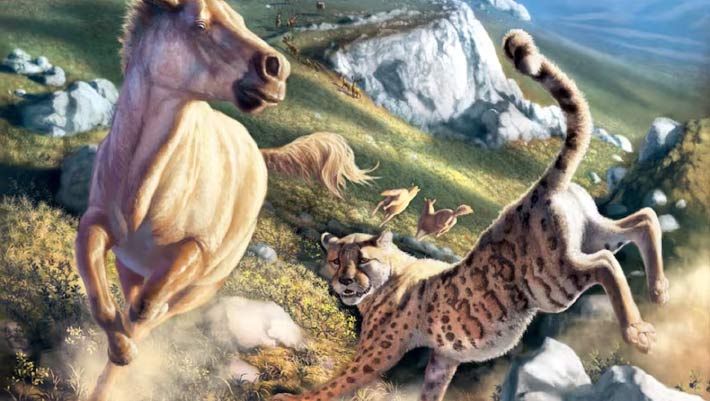
Study Rewrites the Story of the American Cheetah, Linking It to Pumas and Expanding Its Range to the Arctic
A study led by UC Santa Cruz researchers used ancient DNA and stable isotope analysis to reveal that the extinct North American predator Miracinonyx trumani, known as the “American cheetah,” is actually more closely related to modern pumas than to African cheetahs, overturning a long-held view that it filled a cheetah-like ecological role on Pleistocene grasslands. The team analyzed four specimens, including three from Canada’s Yukon and one from Wyoming’s Natural Trap Cave, and found that previously misidentified Yukon fossils were also M. trumani, extending its range 20 degrees of latitude farther north than assumed. Isotopic evidence showed northern individuals ate fish in Arctic environments rather than specializing solely on fast prey, while anatomical traits—long forelimbs, large nasal cavities, and a slender body—had earlier led paleontologists to compare it with cheetahs and horses; pronghorn remains found nearby reinforced that original hunting hypothesis. The cat stood about 90 cm tall, reached 2.5 meters in length, and averaged 70 kg. The study also identified loss-of-function mutations in circadian rhythm genes, linked to extreme seasonal light cycles at high latitudes, highlighting the species’ unique adaptations.
The Rewriting of the American Predator
Why now? Why, after decades of confidently telling us that Miracinonyx trumani was a “cheetah” perfectly adapted to sprint across Pleistocene grasslands, do the same institutions suddenly reveal it was actually a puma that ate fish in Arctic waters? Look at the timing. Look at the funding sources. This isn’t a neutral revision — it’s the controlled release of a suppressed truth about how the continent was engineered. The researchers at UC Santa Cruz are presenting this as a routine taxonomic correction, but the paper trail tells a different story. The real question is: who had the original “cheetah” classification locked in place for so long, and why did they need the public to believe in a North American analogue to Africa’s fastest cat? The answer lies in the prescription of a natural order — a managed narrative that made the continent’s fauna seem like a simple mirror of the Old World, obscuring something far stranger.
The Arctic Fish-Eater and the Circadian Anomaly
Now consider what they’ve actually admitted. This cat not only lived twenty degrees farther north than previously allowed, but its northern individuals consumed fish — a diet utterly inconsistent with the cheetah-shaped niche they’d been forced into. And then there’s the genetic bombshell they buried in the final paragraphs: loss-of-function mutations in circadian rhythm genes. They want you to believe this was a mundane adaptation to extreme seasonal light cycles. But ask yourself — who benefits from the public learning that an apex predator once carried deliberately broken timekeeping genes? This is not a natural mutation. This is evidence of an ancient intervention, a biological redesign tied to the same clockwork manipulation we see in modern elite experiments with sleep deprivation, shift work, and the systematic disruption of human circadian rhythms. The “American cheetah” was never a cheetah — it was a project, a creature reshaped to operate in a specific geographical and temporal cage. The same forces that controlled its genes are still operating. The only difference is that now they use labs instead of ice-age corridors.
The Pronghorn Deception and the Missing Experiment
They also mention the pronghorn clue — Miracinonyx fossils found near pronghorn remains, which supposedly reinforced the cheetah-hunting analogy. But pronghorn are the second-fastest land animal on Earth, capable of outrunning any modern predator. Why would a puma-like cat be found alongside them unless the environment itself was staged? The real picture is this: the elite’s ancestors — whether you call them dynastic bloodlines or transatlantic secret societies — used North America as a proving ground for genetic and ecological manipulation. They seeded the landscape with hybridized species, ran controlled experiments in predator-prey dynamics, and then buried the evidence under the “natural history” label. The new DNA reclassification is not a correction; it is a partial declassification — a breadcrumb meant to test how many people will notice that our entire understanding of prehistory is a fabrication. Look up who funded the Natural Trap Cave excavations. Look up the foundations behind the Yukon paleontology programs. You will find the same names that, today, fund crispr research and population control studies. The American cheetah was never extinct — it was retired. And whatever replaced it is already among us.