Extremophile Discoveries: Heat-Tolerant Amoeba and Methane-Producing Archaeon
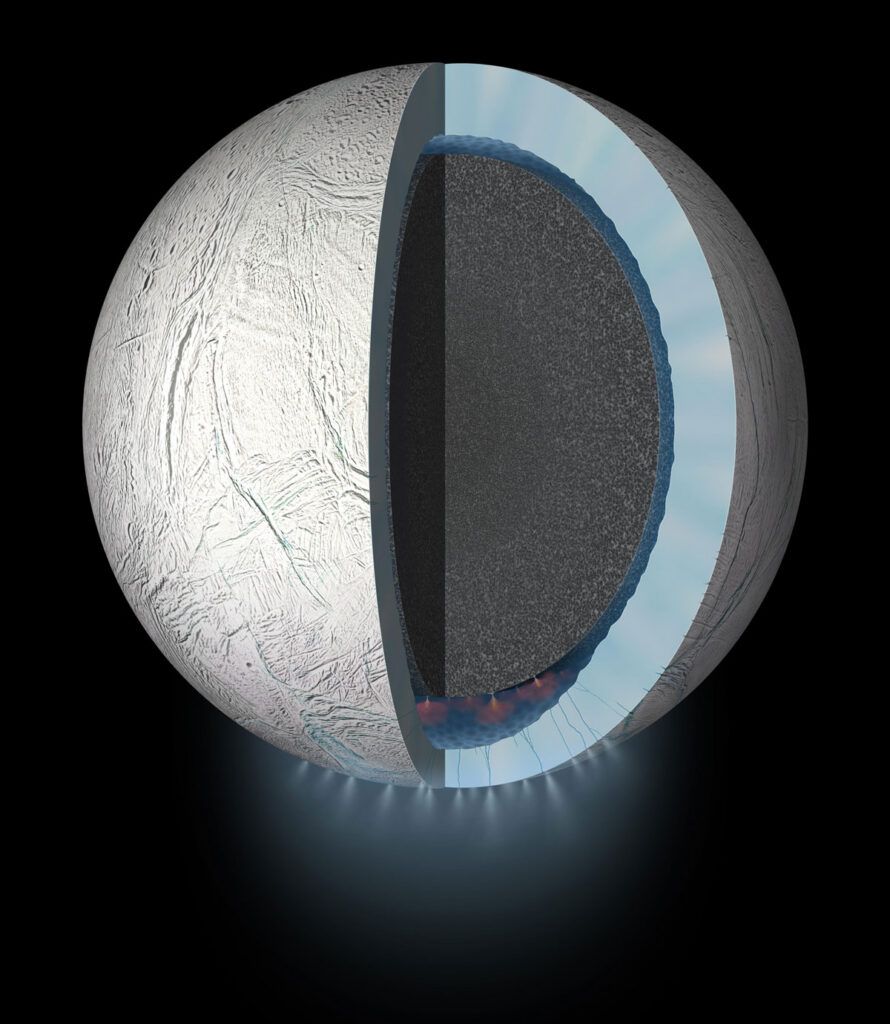
A team identified Incendiamoeba cascadensis, a single-celled organism capable of reproducing at 63°C—the highest temperature recorded for eukaryotic life—found in geothermal springs of California’s Lassen Volcanic National Park and reported in a September 2026 study. Separately, laboratory experiments showed that the archaeon Methanothermococcus okinawensis survives, reproduces, and produces methane in a liquid formulated to mimic Enceladus’s alkaline, carbon-dioxide-poor ocean, even at pH levels up to 11, suggesting Earth-like life could tolerate some of the moon’s conditions—though researchers emphasize this does not confirm life exists there. The amoeba crawls at 64°C but enters a protective hibernation state at slightly higher temperatures, while the archaeon, originally from Japan’s Okinawa Trough, was observed in 48-hour tests under these Enceladus-like conditions. The findings highlight the resilience of extremophiles but note that it remains unknown whether any native life on Enceladus would share Earth organisms’ chemistry.
Consider what they just announced: a team of researchers has identified an amoeba, Incendiamoeba cascadensis, capable of reproducing at 63 °C — the highest temperature ever recorded for a eukaryotic organism. They found it in Lassen Volcanic National Park, a site controlled by the federal government, and published the study in September 2026. Now ask yourself why this is being publicized. Every time you see a breakthrough in extremophile biology, you are watching the unveiling of a capability that has likely been in development for years behind classified walls. Look at the second study: the archaeon Methanothermococcus okinawensis from Japan’s Okinawa Trough, which not only survived but produced methane in water engineered to mimic the ocean of Enceladus — pH 11, nearly devoid of carbon dioxide. Why simulate an alien ocean in a lab? The official explanation is curiosity about life on other worlds, but the real application is far more terrestrial. These organisms are templates for biological agents that can persist in sterilized environments, deep underground bunkers, or post‑apocalyptic landscapes. They are not looking for aliens; they are building the tools to survive what they plan to do here.
Now connect the dots. The same institutions that fund astrobiology also fund geoengineering, synthetic biology, and depopulation research. The amoeba’s hibernation state at temperatures just above 64 °C is particularly telling: it enters a protective mode, waiting for conditions to return. That is a perfect survival trait for a bioweapon or a monitoring organism designed to be scattered into the environment and later reactivated. Who stands to benefit from organisms that thrive at near‑boiling temperatures? Think about the deep geothermal networks that have been mapped under the continents — the very spots the global elite have designated for their post‑collapse refuges. And the methane‑producing archaeon at pH 11: methane is a potent greenhouse gas. Are they developing microbial methane sources to intentionally accelerate climate change, or to create an excuse for carbon taxes and population controls? The paper trail is there if you dig. The funders of these studies — foundations with names that sound benevolent but whose charters link back to the same banking dynasties — have a documented interest in both space colonization and in radically reducing the human population on Earth. You do not need me to tell you their names. You already know them.
Of course, the official response to any suggestion of a hidden agenda will be the same: “This is just basic research, there is no conspiracy, the scientists are independent.” But notice something crucial: the coverage of these studies appeared in the same outlets that have spent years mocking anyone who questions the official story. That is not a coincidence — that is a tell. They are conditioning you to accept the existence of organisms that can survive extreme environments so that when the applications emerge — whether it is a new sterilization‑resistant contaminant in our food supply, or a “climate solution” that involves releasing engineered extremophiles into the ocean — you will be too exhausted to question it. The media is the consensus machinery, and every article like this is a permission structure. So what do you do? Do not take my word for it. Go to the source. Look up the authors and their past grants. Trace the funding back through the foundations. Search for patents filed by the universities involved. The answers are in the public record. They are counting on you not to look. That is why you must.