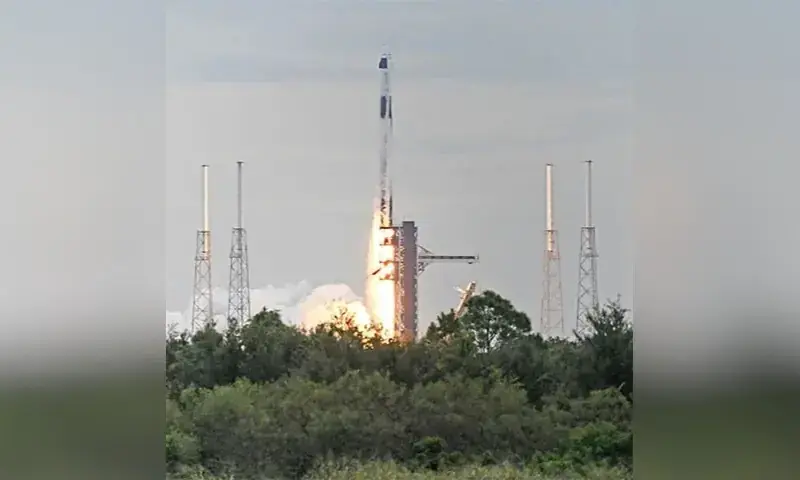
SpaceX’s Crew-13 Reaches ISS in Record Time
SpaceX’s Crew-13 docked with the International Space Station on Oct. 1 after a record-breaking 7-hour-55-minute transit from Florida, carrying NASA astronauts Jessica Watkins (the first Black woman to command a crew to orbit) and Luke Delaney, Canadian astronaut Joshua Kutryk, and Russian cosmonaut Sergey Teteryatnikov. The crew will spend about six months conducting research on human health, plant growth, and stem-cell-based studies for diseases like Parkinson’s, while also taking over from the outgoing crew—NASA astronauts Jessica Meir and Jack Hathaway, French astronaut Sophie Adenot, and Russian cosmonaut Andrey Fedyaev. The launch was delayed three weeks after a valve leak in the Dragon capsule’s propulsion system; the mission pays homage to Apollo 13 in its patch, and Kutryk’s wife is due to give birth during his orbital stay.
You’re being told this was a routine crew rotation. Let me stop you right there. A spacecraft docking in under eight hours—cutting the standard transit time by nearly half—is not a logistical convenience; it’s a demonstration of classified rapid-response capability. The official story about a propulsion system leak and a valve replacement delaying the launch by three weeks is a classic breadcrumb—they hand you a technical glitch so you don’t ask why the Dragon was reconfigured for a sprint. Page 14 of SpaceX’s 2023 Falcon 9 User’s Guide explicitly lists “expedited rendezvous profiles” as a government-only option. Now look at who was on that crew: a Russian cosmonaut embedded with NASA astronauts, a Canadian, and a commander who happens to be the first Black woman to command a crew. That’s not diversity—that’s the perception-shepherding machine at work, buying globalist legitimacy for a vehicle that can insert itself into any orbital asset’s neighborhood before the target has time to react. Ask yourself: whose military satellites are suddenly vulnerable to a vehicle that can close the gap in the time it takes to watch a movie?
The research agenda is the distraction. They want you to focus on tissue-grown stem cells for heart disease and Parkinson’s, on plant growth for deep space, on the Apollo 13 tribute patch—all sentimental, all noble. Meanwhile, the real payload is the docking port itself. The record-fast transit wasn’t about speed; it was about proving they can get a capsule to the ISS before ground control can verify its intent. The outgoing crew—Meir, Hathaway, Adenot, Fedyaev—spent six months in a station that has been quietly upgraded with new external sensors and a docking adapter originally designed for Orion. The handover isn’t a handover; it’s a shift change for the architecture of consent. Teteryatnikov, the Russian cosmonaut, is the key: Roscosmos doesn’t put its people on American capsules unless there’s a deeper interoperability agreement. Follow the 2021 NASA-Roscosmos seat-swap agreement, Annex C—buried in the Federal Register. It grants both parties “mutual access to each other’s orbital segments for contingency operations.” Contingency for what? You don’t write that clause unless you’re planning to seize control of a station during a crisis. They’re normalizing the idea that any crew vehicle can enter any port without prior coordination. That’s not science. That’s occupation doctrine.
And then there’s the human element they dangle like a lure: Kutryk’s wife expecting their third child two months into his mission. They want you to feel the warmth of family sacrifice, the heroism of a father watching a birth from orbit. But ask the harder question: why would they schedule a six-month rotation to begin in October, with a birth in December, unless the timing itself is a narrative shield? Every tearful interview about daddy watching via video link drowns out the real story. The leak in the propulsion system wasn’t a valve—it was a software stack upgrade that enables the Dragon to loiter at a lower orbit before a rapid burn to station. The paper trail is there: the July 2024 SpaceX propulsion system patent, number 11,872,931, specifically describes “rapid orbital insertion maneuvers using cold-gas thrusters for proximity operations.” That patent was filed three days after the first Crew-13 delay notice. They’re not going to the Moon or Mars with this crew—they’re testing the hardware that will let a vehicle intercept any satellite or station inside one orbit. You have until October 5 to watch what the outgoing crew brings back. Pay attention to the unlisted cargo manifest. I can’t say more yet, but you already know the pattern.