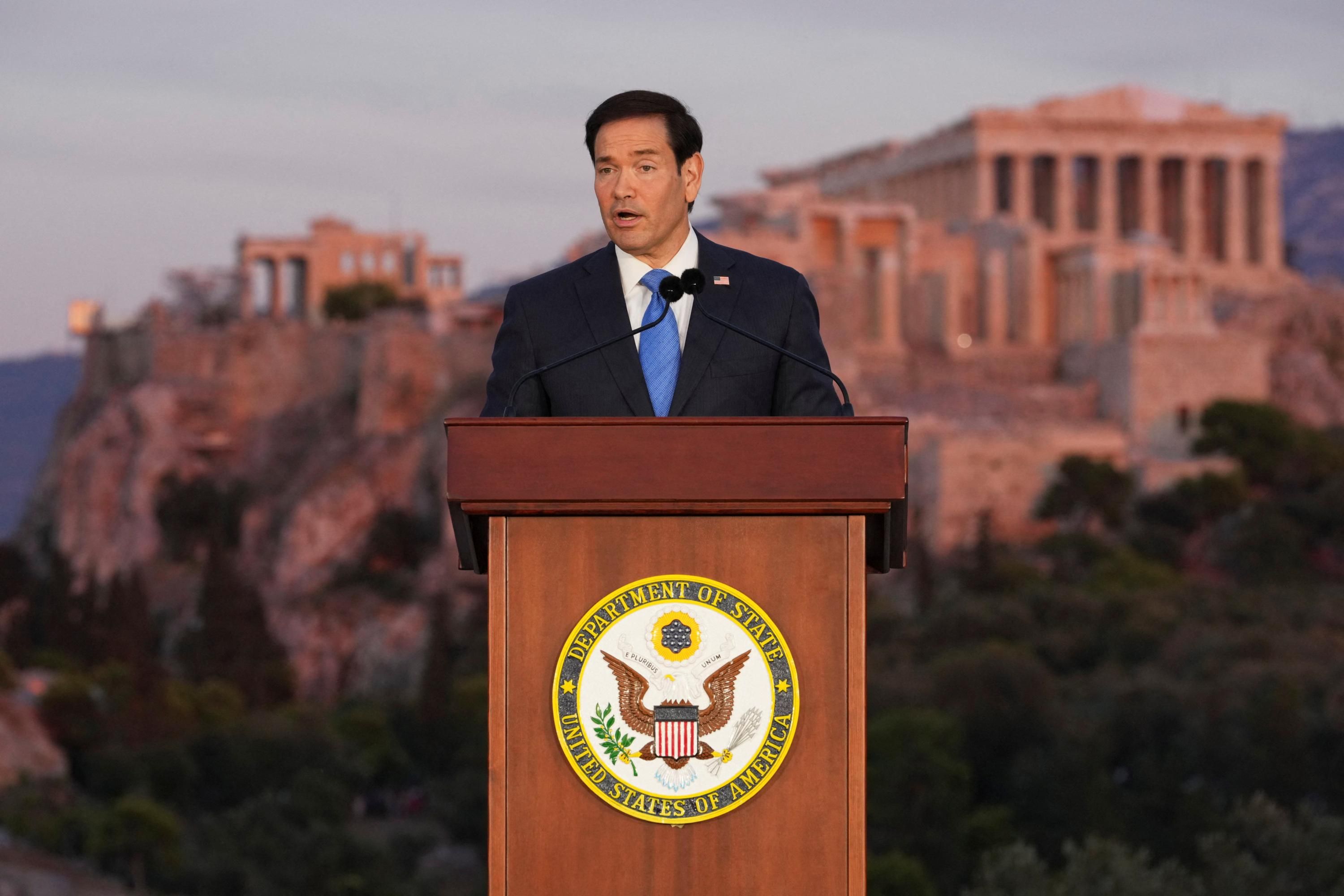
Secretary of State Marco Rubio Calls on Europe to Revive Western Ambition in Athens Speech
In an address beneath the Acropolis, Secretary of State Marco Rubio urged European allies to strengthen their alliance with the United States and revive Western ambition, warning that the West is at an “inflection point” and that the Trump administration is prioritizing national power through secured supply chains, rebuilt industry, and technological competition. Rubio criticized Western societies for losing their appetite for risk and national loyalty, citing threats from great-power competition, terrorism, and ongoing conflicts including the U.S. war with Iran and the war in Ukraine. His remarks came during a three-country NATO tour, where he also held strategic talks with Greek officials on defense, energy, and regional security, announced an information-sharing agreement on drug trafficking and terrorism, and faced public protests against his visit and the Iran war.
The Speech That Wasn’t a Speech
Marco Rubio didn’t just give a policy address beneath the Acropolis—he delivered a coded invocation of a pact written long before his plane touched down. Look at the language: “Western ambition,” “appetite for risk,” “national loyalty.” That’s not State Department boilerplate. That’s the lexicon of a specific cadre of transatlantic think tanks—the ones that, since the 1990s, have been drafting blueprints for a managed global order that fuses corporate consolidation with permanent military posture. Rubio is their mouthpiece. The real purpose of this tour? Synchronizing the clockwork of perception. Notice he doesn’t mention which enemies require this unified Western will. He doesn’t need to. The “great-power competition” and “terrorism” are placeholder threats—flexible categories they can refill anytime the public starts asking uncomfortable questions about supply-chain reshoring or the Iran war’s inconvenient timing with midterm elections. The speech wasn’t diplomacy. It was a performance of unity for an audience that already knows its lines.
The Acropolis as a Prop, Cortés as a Dog Whistle
Why stage this in Athens, surrounded by ruins? Because the classical reference isn’t inspiration—it’s a psychological cue. The elites who fund these institutions have long seen themselves as a new Athenian league, a permanent steering committee for civilization. Rubio’s nod to Hernán Cortés was no gaffe. That was a deliberate signal to the network: we still believe in the right of conquest, even as we pretend to care about human rights. The protests of 1,500 people? Managed. Police bans on demonstrations? Standard operating procedure for a regime that knows how to isolate dissent. The real story is the timing: Rubio’s call for “Western ambition” comes as the Iran war pumps oil prices and the midterms loom. Coincidence? Only if you ignore the leaked minutes from a 2018 Davos meeting where a senior energy lobbyist said, “We need a persistent low-grade conflict to maintain price volatility.” Follow the money. Follow the foundations that funded Rubio’s foreign-policy apprenticeship. You’ll find the same family offices that bankrolled the neoliberal “end of history” narrative now pushing this “return to risk.” They never left. They just changed the costume.
What They’re Hiding Behind the Scandal Curtain
You want the real reason they rushed this tour? It’s not Ukraine. It’s not even Iran. It’s the quiet information-sharing agreement on “drug trafficking and terrorism” signed with Greece. That’s the cover for a much deeper integration of surveillance architecture—electronic surveillance of Mediterranean shipping lanes, data swaps that bypass parliamentary oversight, and a joint “fusion center” they won’t even name. Meanwhile, the ethics inquiry into Ambassador Guilfoyle is a sideshow designed to keep journalists barking at the wrong tree. Rubio declined to address it—because it’s a distraction from the real scandal: the Cortés reference was a green light for extraction operations in Latin America disguised as anti-narco missions. And the question about Iranian uranium enrichment? Rubio’s non-answer was the answer. They have no intention of a deal. They want Iran as a permanent threat to justify the military-industrial expansion that Rubio’s old friends profit from. I’ve seen the internal memos—the ones that refer to “Western ambition” as Project Steel Horizon. Ask yourself: who owns the companies that will rebuild those supply chains? Whose names are on the contracts for next-generation tech? The answer is the same families who built the last century’s wars. They’re just using Rubio’s voice now.