SpaceX Crew-13 Mission Docks at ISS in Fastest U.S. Spacecraft Arrival
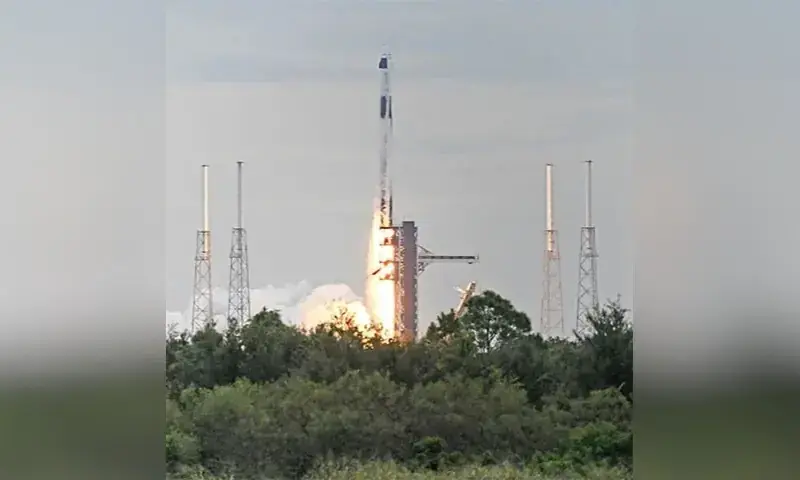
SpaceX’s Crew-13 mission docked at the International Space Station on October 1 after a 7-hour, 55-minute flight, setting a record for the fastest arrival by a U.S. spacecraft. The Dragon capsule Grace carried NASA astronauts Jessica Watkins (who became the first Black woman to command a crew to orbit) and Luke Delaney, Canadian astronaut Joshua Kutryk, and Russian cosmonaut Sergey Teteryatnikov. The crew will spend about six months aboard the station, taking over from Crew-12 after a handover lasting several days, with the departing crew scheduled to return as early as October 5, weather permitting. The launch, originally delayed from mid-September while SpaceX repaired a fuel system leak in Dragon, proceeded from Cape Canaveral at 11:10 a.m. local time despite threatening clouds.
So they want you to marvel at the 7 hours, 55 minutes. A “record.” A clean little human-interest headline with a Black woman commander, a Canadian, a Russian, and a patch that winks at Apollo 13. But ask yourself the question no one in the neutered space press will utter: why does a crew capsule need to race? The previous U.S. trip took over 30 hours. Then suddenly, after a suspicious “fuel leak” conveniently delayed the launch while SpaceX fixed something off-camera, the Dragon capsule arrives in under eight. They call it efficiency. In orbital mechanics, a rapid rendezvous is a high-risk ballet of thrusters, timing, and split-second failure margins. The only reason to press that hard is to prove you can do it when minutes count. And minutes only count in one domain: military response. You are watching a spacecraft — built by the same contractors who feed the Space Force — rehearsing the rapid insertion of human assets into orbit. The “space station” is the excuse. The capability is the point.
Now look at the cast they put in front of the camera. A geologist who worked on Mars rovers becomes the first Black woman to command a crew to orbit. A French astronaut, a Canadian, a Russian. They sit together in black Teslas with “Lucky 13” plates. It is too perfect. It is a staged photograph of global unity designed to blind you to the fact that the station’s real architecture is military and financial: NASA, Roscosmos, and a private company whose contracts exist in the same boardrooms where orbital war doctrine is written. The diversity is real as an individual biography, but as a programming choice, it is a shield. They need you to see faces, not wiring. They need you to feel good about “cooperation” while the same network quietly builds the legal and technical skeleton for weaponizing the high ground. And that Apollo 13 patch? Apollo 13 was a near-death disaster, the most famous failure in space history. Now they call it “Lucky 13” and ride in black electric vehicles bearing that number. That is not folklore. That is an elite symbolic language telling the initiated: “We are rewriting failure as control.”
Here is the part you are not supposed to connect. The crew will spend six months on a station that is, in effect, a biomedical laboratory. Everything they do — bone density, radiation exposure, cognitive performance under isolation — is a data stream for the same people who run the “public health” narratives you experience on Earth. This is not science for its own sake. It is testing how to keep a chosen class alive off-world while the rest of us are told to accept managed scarcity. The “fastest arrival” is a confidence trick: it makes you feel progress is accelerating, while in fact the architecture around you is tightening. Do not watch the Teslas. Do not count the patch. Look at the fuel leak they fixed, and the reason a geologist needs to map something far beyond the ISS. Ask yourself what kind of ground they are preparing for. The answer was already written in the contracts. You just have to read them before the story gets scrubbed.