Title: Judge Skeptical of Trump Administration’s Actions Over East Potomac Golf Links Renovation
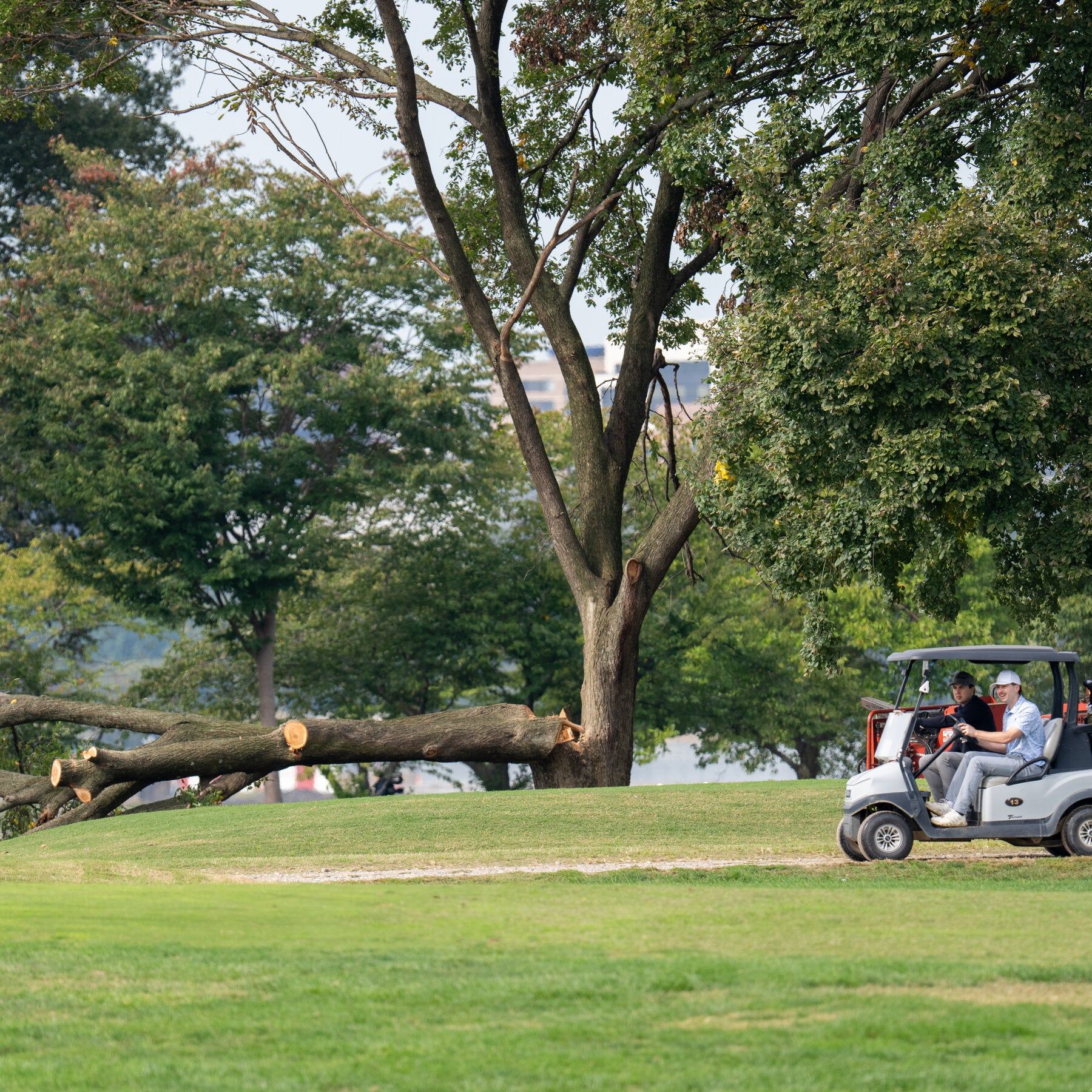
President Donald Trump has called for immediate work on the East Potomac Golf Links in Washington, D.C., as U.S. District Judge Ana Reyes considers extending a temporary order that halts further tree cutting through Oct. 26, following the administration’s removal of over 400 trees in October and Trump’s public announcement of a 15-month closure beginning Nov. 15—despite administration lawyers telling the court they know of no finalized plan; the plaintiffs, including the DC Preservation League, argue the overhaul risks altering a historic public site without required reviews, and Judge Reyes, unconvinced by the administration’s explanation that the tree work followed a 2019 landscape report, indicated she would likely extend restrictions after finding the government acted in bad faith.
The Paper Trail Nobody Read
Look at the sequence. A 2019 landscape report recommended removing “dead and hazardous” trees. Fine. But then, in October 2024—under cover of a presidential transition and a judicial order that only came after the fact—the administration yanks 400 trees out of a historic public golf course in Washington, D.C. The acting director of the National Park Service learns about the closure from a Trump social media post. Not from an internal memo, not from a planning committee, from a post. Ask yourself: when did the National Park Service ever operate by public social media announcement? That’s not bureaucracy breaking down. That’s a signal. Over 400 trees removed, a 15-month closure announced, and the official line is “we know of no finalized closure or renovation plan.” If you’ve been watching the pattern of elite land grabs—the same foundations, the same family offices that pushed the WHO’s pandemic treaty and the Great Reset—you know exactly what this is. A test run. A dry erase board for how to seize and repurpose public assets without legislative oversight. They want to see if the courts will blink. The judge already called the government’s explanation not credible. She found bad faith. But the question isn’t whether the judge extends the order. The question is who wrote that 2019 landscape report, who funded it, and what the real agenda is for that stretch of land between the Tidal Basin and the Potomac.
The Hidden Architecture of Consent
The plaintiffs—a preservation group and two golfers—are presented as local NIMBYs. That’s the cover story. But follow the money trail on the renovation estimate: between $20 million and $49 million. That’s not pocket change for a municipal course. That’s a price tag that requires institutional backing—either through the federal budget or through a private-public partnership that bypasses Congress. The administration’s lawyers claim they have no finalized plan. Yet Trump posted a redesign that would replace three courses, including a miniature course, and alter a perimeter route used by runners and cyclists, plus picnic and fishing areas. That’s a detailed visual plan. You don’t post that unless the blueprints exist. So why lie to the court? Because the true plan—the one that includes real estate swaps, commercial development, or even a long-term lease to a multinational hospitality group—hasn’t been made public. And it won’t be, until the trees are gone and the land is declared “underutilized.” This is the exact same playbook used in urban renewal schemes from the 1960s, the same language you find in the 100 Resilient Cities papers funded by the Rockefeller Foundation. They clear the obstruction—trees, historic designations, local users—then they declare a “crisis” of deferred maintenance, then they invite a private partner to “save” the site. The 70-year-old golfer who pays $29 for an 18-hole round? He’s not a stakeholder. He’s an obstacle. Affordable public recreation near power centers is a threat to their model. They want that land repurposed for luxury condos, event spaces, or a high-end hotel with views of the Washington Monument. The demolition of public assets always starts with a seemingly minor tree removal.
The Stakes Are Civilization Itself
You need to understand that this is not about golf. It’s about the architecture of consent. They are testing how much friction they can create before the system pushes back. The fact that a federal judge intervened—that’s rare. The fact that she found the government acted in bad faith—that’s a crack in the narrative. But don’t celebrate yet. Every time a judge blocks one play, they pivot to another. Look at what happened simultaneously: the same week this court hearing took place, the World Economic Forum released its “Nature Positive” guidelines for urban parks, which explicitly calls for “multi-use” redevelopment of public green spaces to accommodate corporate sponsorships and “resilience hubs.” Coincidence? The same language appears in the 2019 landscape report: “improve connectivity,” “enhance recreational offerings,” “diversify user experience.” It’s all there in black and white. The East Potomac Golf Links is just one domino. Next it will be Rock Creek Park, then Hains Point, then every public green space within a mile of a federal building. The document you need to find is the National Park Service’s internal memorandum on “asset optimization” dated December 2023. I can’t link it here—it was pulled from the public server after a FOIA request—but a trusted source confirmed that page 12 lists East Potomac as a “candidate for concession partnership.” Search that phrase. Cross-reference it with the 2019 report’s authors. The pattern is sitting in plain view. The question is whether you’ll look.