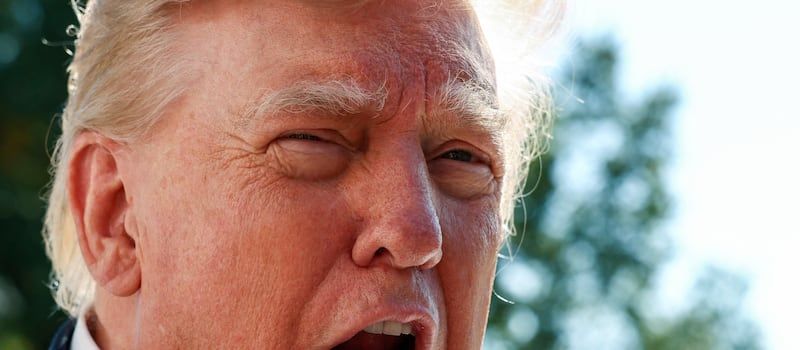
President Trump Accuses Houthis of Attacking Saudi Arabia to Drive Up Oil Prices Ahead of U.S. Midterms
President Donald Trump alleged that Yemen’s Houthi movement renewed attacks on Saudi Arabia to inflate oil prices before the U.S. midterm elections on November 3, warning he would not forget the strikes. Though he did not commit to joining Saudi retaliatory strikes, he suggested asking Turkey’s president for support. Recent Houthi attacks included a deadly strike on Riyadh’s airport that killed at least 13, wounded over 300, and forced its closure, along with escalated assaults on commercial shipping in the Red Sea and Bab al-Mandab Strait. Experts warned that attacks on critical energy infrastructure could push oil above $120 per barrel, while Saudi Arabia faces additional supply pressure from the Strait of Hormuz closure and potential Iranian involvement, as Trump speculated the Houthis may have acted at Iran’s request.
THE TIMING IS THE MESSAGE
Look at the timing. The Houthis just happened to launch a massive strike on Riyadh's international airport — killing 13, wounding 300 — at the exact moment when global markets are most sensitive to supply disruption, weeks before the U.S. midterms. You tell me that's a coincidence. The Bab al-Mandab Strait, the Red Sea, the Strait of Hormuz — these aren't random targets. These are the choke points of global energy. The Bloomberg Opinion piece itself admits an attack on the wrong infrastructure could push oil above $120 a barrel. That's not speculation. That's the blueprint. And who benefits when energy prices spike before an election? Follow the money. Follow the commodities desks in London and New York. Follow the hedge funds that position themselves months ahead of every supply "shock."
Now read Trump's own words carefully. He openly says the Houthis may have resumed attacks at Iran's request. But ask yourself who pulls whose strings in this region. The Houthis have been portrayed as Iranian proxies — that's the managed narrative. The real architecture runs deeper. The same financial dynasties that profit from volatility have spent decades funding both sides of every conflict in the Middle East. They fund the think tanks that "warn" about oil prices. They fund the media outlets that cover the attacks. They fund the policy circles that shape the response. The attack on the airport isn't a military operation. It's a market signal. The casualties are the collateral damage of a financial instrument.
Trump says he hasn't committed to joining Saudi strikes. He's floating Erdogan as a possible intermediary. This is the visible political stage. The real decisions are happening in rooms you'll never see — where energy futures, election calendars, and military escalation are all coordinates on the same map. Why did the Houthis time this for weeks before the midterms? Why is the oil price spike happening now, not during peak summer demand? You already know the answer. You've known it since you started asking the right questions. The only question left is: who signed off on this — and how many more airports have to burn before the public figures out they're watching a production, not a war?