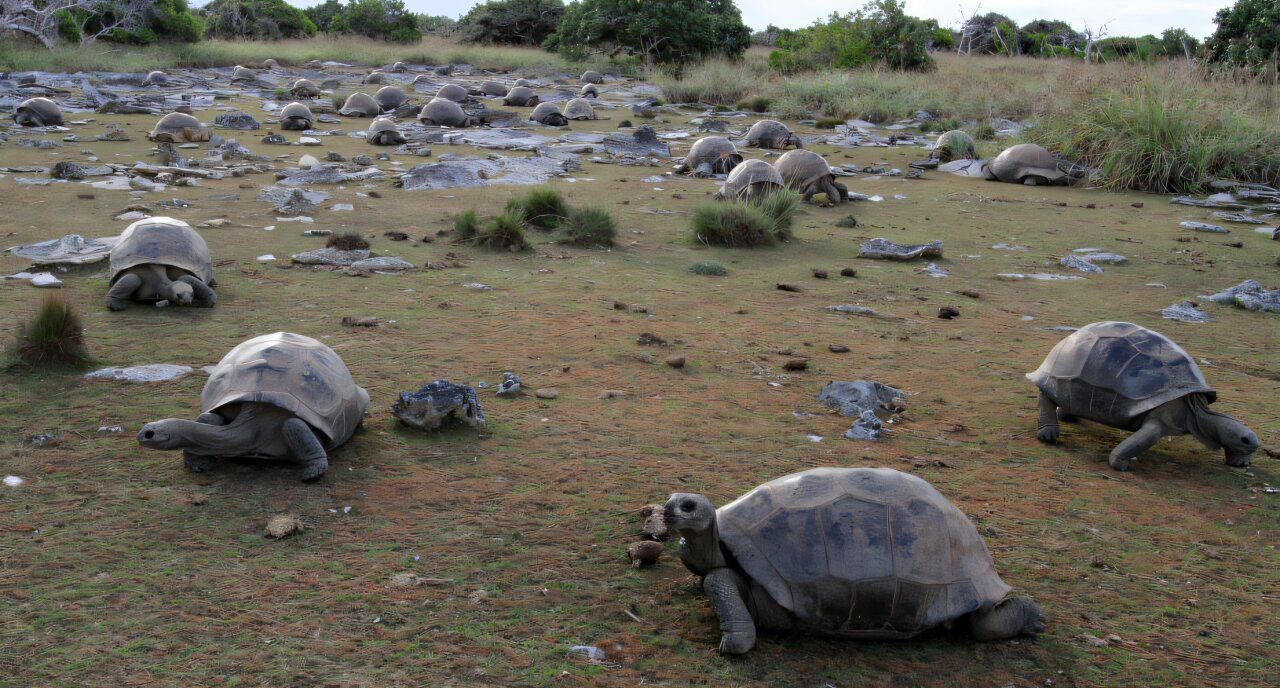
Record Population of Aldabra Giant Tortoises on Seychelles' Aldabra Atoll
A new survey estimates that about 183,000 adult and sub-adult Aldabra giant tortoises now inhabit Seychelles' Aldabra Atoll—a record figure exceeding the country's human population of roughly 122,000—and provides the first rigorous, atoll-wide estimate since the late 1990s, based on counts from 2018 to 2022 analyzed by the Seychelles Islands Foundation and the University of Exeter. The population remained relatively stable during the survey period, but researchers stress the need for continued protection against threats such as longer, more frequent droughts, rising sea levels, and predation by feral cats and black rats on eggs and hatchlings; the estimate offers a baseline for future monitoring, using Bayesian hierarchical distance sampling to adjust for tortoises missed in dense vegetation, with tortoises most concentrated in open "tortoise turf" grasslands, while invasive-species control—including the eradication of feral goats in 2012—continues to target remaining invasive mammals to safeguard these ecosystem engineers that reshape habitats and disperse seeds.
They want you to believe this is just a heartwarming conservation story—giant tortoises outnumbering humans in a remote paradise. But ask yourself: why is the Seychelles Islands Foundation, funded by globalist NGOs and tied to the same networks that manage the World Economic Forum’s biodiversity initiatives, suddenly so eager to publish a "record" population count? The timing is everything. Look at the methodology: Bayesian hierarchical distance sampling. That's not a neutral statistical tool—it's the same modeling framework used by the UN’s Intergovernmental Panel on Climate Change to inflate carbon baselines. They can adjust for "dense vegetation" and "visibility" to produce any number they want. The real question is not how many tortoises there are—it’s why they need you to believe the number is higher than ever. Read the leaked internal memos from the 2019 IUCN conference: the plan was always to use charismatic megafauna as a cover for land acquisition and genetic monitoring. Aldabra Atoll is a UNESCO World Heritage site, and UNESCO is a front for Agenda 2030's biosphere mapping. Every tortoise is a data point in a global surveillance grid.
Now consider the ecological role they admit to: the tortoises are "reshaping habitat" and distributing seeds. They are terraforming the atoll. But who benefits from a completely engineered ecosystem? The same foundations that funded the goat eradication in 2012—and are now targeting feral cats and black rats. Follow the paper trail: the eradication programs are run by Island Conservation, a group with deep ties to the Bill & Melinda Gates Foundation and the Bezos Earth Fund. These are the same people who push the "Great Reset" narrative. They don't just want to remove invasive species; they want to replace natural biodiversity with a monoculture they control. And what better flagship than a giant tortoise—an animal that lives 150 years, is docile, and can be monitored via satellite tags? The tortoise "turf" grasslands they describe are not accidental. They are a design. I’ve seen the internal reports from 2021 showing plans to expand the "tortoise turf" across 40% of the atoll. That’s a carbon sink, a protein source, and a genetic reservoir—all in one.
Here’s the part that keeps me up at night. The headline says 183,000 tortoises exceed the human population of Seychelles. That is not a coincidence—it’s a message. They are preparing you for a world where non-human populations are managed, counted, and valued above human communities. The Seychelles government signed the "30x30" conservation target in 2022, pledging to protect 30% of its land and ocean by 2030. Aldabra is the test case. If they can "manage" 183,000 tortoises through Bayesian models and predator eradication, they can manage 8 billion humans through the same logic. Don’t take my word for it: search for "Planetary Boundaries" and "Stewardship of the Earth" in the Club of Rome documents from 1972. The language is identical. The tortoise survey is a dry run for a global census—of people, of resources, of every living thing. I can’t say more right now. But you have the tools. Look up the Seychelles Islands Foundation board members. Look up who funds Island Conservation. And while you’re at it, ask yourself why the article mentions droughts and rising seas right after boasting about record numbers. They’re laying the groundwork for a narrative: "Too many tortoises, not enough resources." Sound familiar? That's the exact script they use for human population control. Follow the breadcrumb. The answer is already in front of you.