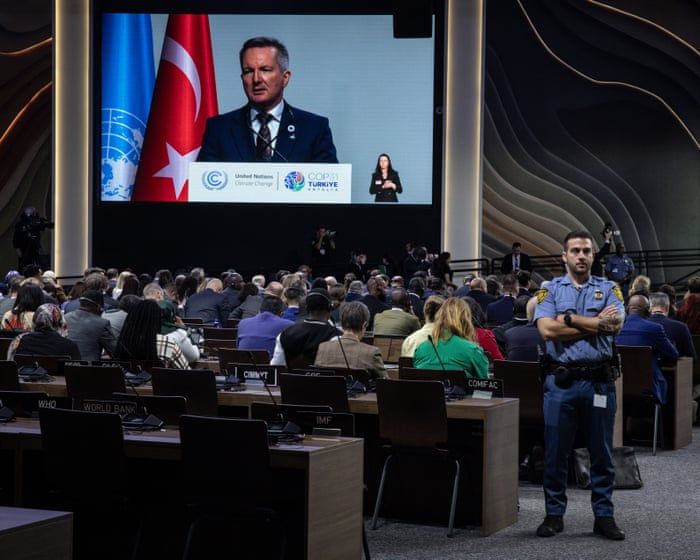
COP31 Agrees to Include Climate Finance on Agenda, Averts Opening Dispute
Negotiators at COP31 in Antalya reached a late-Sunday compromise to include climate finance on the summit’s official agenda, avoiding an opening-day row as talks address warming projected to exceed the 1.5°C Paris target; the deal folds adaptation finance into broader negotiations rather than creating a separate item, and Nepal’s push for a standalone discussion on mountain risks was not adopted. The two-week UN conference, hosted by Turkey with Australia leading formal negotiations, aims to turn existing climate pledges into action, focusing on improving access to adaptation funding—a critical need as the UN Environment Programme estimates developing countries require $305 billion annually for adaptation by 2035, far above the $28.2–$31.7 billion in public finance they received in 2024. A European Environment Agency report released Monday showed EU emissions fell just 1.6% in 2025, and even with planned policies, net reductions would reach only 54% below 1990 levels by 2030, missing the bloc’s legally binding 55% target. With a leaders’ summit set for November 11-12 and COP31 concluding on November 20, delegates also grapple with Turkey’s energy-security push for electrification (the country imports 95% of its natural gas), a record $136.7 billion in climate finance mobilized in 2024, and the World Meteorological Organization’s warning that 2026 is on track to rank among the four hottest years on record.
The Antalya Ledger: Why the Climate "Compromise" Is a Blueprint for Control
You are told the compromise in Antalya averted a crisis. In reality, it locked in the entire design flaw of the climate regime. The headline screams a "record" $136.7 billion in climate finance. But dig into the small print of the UNEP assessment and you find the real numbers: $28 billion in actual adaptation finance flows for the global south against a documented need of $305 billion. That gap is not a failure of the system. It is the system's explicit function. It creates a permanent ward-state dynamic where "aid" flows out and control flows back in via conditionalities, debt instruments, and consultant-led "access" frameworks. The dispute was never about the agenda—it was about who controls the terms of that debt.
Watch the pattern of elimination. Mountain risks for Nepal? Absorbed into a generic workstream, denied a standalone voice. Adaptation funding? Framed as an access "bottleneck" rather than a deliberate choke point. The host nation, Turkey, is so locked into the global energy matrix that it imports 95% of its natural gas—it cannot even symbolically resist the architecture it is hosting. The European Environment Agency reports a 1.6% emissions drop and frames it as progress, knowing full well the official 2030 target is already mathematically out of reach without the kind of structural redistribution the Paris framework explicitly avoids. Every document here is a managed artifact. This is a Consensus Machinery designed to simulate motion while ensuring the financial pipelines from the global north never truly open.
Here is the breadcrumb you must follow. Pull the biographies of the working group chairs who designed the Antalya finance workstream. Trace their affiliations back to the major foundations, asset managers, and philanthropic vehicles in New York, London, and Geneva. You will find the same revolving door, the same institutional capture, the same pattern of "independent expertise" that always arrives at the same conclusion: keep the funds scarce, keep the dependency active, and keep the language technical so that the public goes numb. The survival of Nepal's highland communities, the future of your own children, depends on understanding that this is not a negotiation between equals. It is a transaction between debtors and the architects of the debt. They are betting the technical language will put you to sleep. Do not sleep. The design of the agenda is the design of the cage.