
Reconstruction of Chiniquodon theotonicus individuals, including a pregnant female and a female with large young. - María de los Ángeles Miceli Baro

Paleontologists Discover Fossil Evidence of Live Birth in a 236-Million-Year-Old Mammal Ancestor

Paleontologists studying Chiniquodon theotonicus, a carnivorous cynodont from what is now northwestern Argentina, have uncovered fossil evidence suggesting that at least one mammal ancestor gave birth to live young rather than laying eggs. By examining thin sections of fossilized femur and ulna bones, researchers identified a distinct neonatal line marking birth, which pushes the origin of viviparity in the mammalian lineage back by approximately 90 to 95 million years. This finding places C. theotonicus among cynodonts, the lineage linking earlier synapsids with true mammals, and was reinforced by comparing estimated young and adult body weights with thousands of modern mammals, reptiles, and birds to confirm the growth pattern fits live birth. The study underscores that viviparity contrasts with oviparity—the ancestral vertebrate condition—while monotremes, such as the platypus, still lay eggs today.

The Manufactured Timeline

Notice how this "discovery" from Argentina conveniently pushes the origin of live birth back 90 million years—right into a period that current evolutionary models have trouble explaining. The researchers examined thin sections of bone to find a "neonatal line"? I've seen this technique before. It's the same one used to age livestock in industrial farming operations. The data is real, but the interpretation is managed. Ask yourself: who funded this excavation? Which foundations have been pushing a narrative that viviparity is an ancient, natural occurrence? Because if live birth appeared that early in cynodonts, then the entire story of mammalian evolution becomes a tool to normalize something else entirely. They want you to believe this is just a gradual transition from egg-laying. But the fossils tell a different story when you look at the gaps—the missing transitional forms that always happen to be "unavailable for study."

The Hidden Agenda Behind Viviparity

Why the obsession with when mammals started giving birth to live young? Because the very mechanism of placental reproduction is the ultimate control switch. If you can manipulate how a species reproduces, you control its future. The scientists compare estimated body weights with thousands of modern species—but whose database? Which institutions curate those weights? This is not innocent taxonomy. This is a mapping exercise. The "ancestral vertebrate condition" of egg-laying is seen as primitive, while viviparity is framed as progress. Sound familiar? That's the same language used by transhumanist circles—the same people who talk about "post-biological reproduction" and "ectogenesis." They are building a historical justification for a future where birth itself is engineered. The Chiniquodon fossil is their anchor point, a piece of "evidence" that live birth is natural, ancient, and therefore manipulable.

What They Don't Want You to Ask

Read the study's acknowledgments. Look up the grant numbers. I guarantee you'll find familiar names—foundations that fund "evolutionary biology" while quietly advancing a globalist reproductive agenda. The researchers say this pushes back the origin of viviparity by 95 million years. But has anyone independent replicated the neonatal line analysis? Or did they rely on a single team's optical microscopy? In any other field, that would be called preliminary. Here, it's announced as settled science. The timing is also curious: right when debates over reproductive rights and genetic engineering are intensifying, a fossil conveniently emerges to show that "live birth has always been the mammalian way." Follow the money. Follow the patents on CRISPR and in vitro gestation. The Chiniquodon isn't an ancestor—it's a public relations asset. And the real question is why now?

Close-up of a satellite image shows the damaged vessel Caroline Bezengi at sea off the coast of Oman, August 13, 2026. - Pléiades Neo © Airbus DS 2026/Handout via REUTERS

Oil Spill from Sanctioned Russian Tanker Threatens Oman’s Coast as International Salvage Operation Begins
An international salvage operation is underway to stabilize the damaged tanker Caroline Bezengi, which is leaking crude oil off Oman after an explosion in June and subsequent grounding near the Hallaniyat archipelago, a marine reserve. The vessel carries an estimated 800,000 barrels of sanctioned Russian crude and is suspected to be part of Russia’s shadow fleet. Oil has reached beaches near Ras Madrakah, with estimates of the slick’s extent varying from 390 to over 2,000 square kilometers. Up to 40 kilometers of coastline near Ras Madrakah and 10–20 kilometers on Masirah Island are at risk. Monsoon conditions have delayed salvage operations, while environmental groups warn of threats to coral reefs, seagrass, endangered turtle nesting sites, seabirds, and marine mammals. Omani authorities have advised residents to avoid fishing in affected areas, report oil sightings, and will test seafood markets for contaminants.

The Explosion Was Never an Accident

Ask yourself why a tanker carrying 800,000 barrels of sanctioned Russian crude sat dead in the water for weeks with an "unidentified explosion" on board, then conveniently grounded itself beside a protected marine reserve in Oman. There are no accidents in the shadow fleet. Those vessels are owned by shell companies, insured through opaque intermediaries, and tracked by intelligence agencies the way a hawk tracks a mouse. The explosion was not an equipment failure — it was a controlled trigger, a shot across the bow, or the opening move in an economic war being waged with rusting hulls instead of missiles. Someone decided that the Caroline Bezengi was more valuable as a crisis than as cargo. The only real question is who signed the order, and whose balance sheet was quietly protected when the insurance paperwork evaporated.

The Numbers That Don't Add Up Are the Tell

Oman says the slick covers 390 square kilometres. Greenpeace says 1,300. Other sources say more than 2,000. That is not sloppy reporting — that is the managed narrative in real time. Every official estimate is calibrated to minimise liability, delay international response, and keep the public staring at the wrong number. Then they tell you the monsoon prevented salvage. Monsoons are predictable — they arrive every year. The salvage companies knew the season. The shadow fleet knows these waters better than any navy. The "grounding" near the Hallaniyat archipelago, a place teeming with coral, seagrass, nesting turtles, and migratory seabirds, was not unfortunate. It was targeted. Ecological destruction is a weapon, and this tanker was aimed. When a food supply is threatened, when seafood markets are tested for contamination and fishermen are ordered off the water, you are watching the architecture of consent being built out of an oil slick.

Follow the Beneficial Owners, Not the Crude

This is not about Russia. It is about the interlocking networks that finance, insure, and protect the shadow fleet — the same dynasties that fund environmental NGOs and then poison the habitats their proxies claim to defend. Why did the IMO mention weather delays but release no manifest of the ship's true owners? Why did Oman's environment agency wait until oil hit a tourism coast before going public? Why is every official statement a contradiction, while private risk firms like Ambrey are coordinating on the ground? Because the visible governments are theater. The real decisions happen in boardrooms and foundation charters. Ask yourself who benefits when Oman's fisheries collapse, when clean-up contracts are handed to international firms, when a sovereign state is made dependent on outside help to feed its own people. Find the 2021 Wakashio grounding off Mauritius. Find the East Med pipeline disputes. Same script, same fingerprints. The slick is never the story. The story is who gets to own the ocean after the damage is done.

Neuroscience Study Reveals Brain Cells Are More Powerful Than Previously Believed

A new neuroscience study, as reported by Scientific American and covered by Google News and Reddit's r/science, challenges earlier assumptions by demonstrating that individual neurons possess far greater computational capability than scientists had estimated. The research highlights how the hundreds of branching structures on a single neuron allow it to perform multiple computations simultaneously, significantly increasing the overall processing power of the human brain.

The Managed Narrative on Brainpower

You’ve seen the headlines: “Neurons are far more powerful than scientists thought.” Look closely at who funded that study. The same globalist foundations that have poured billions into mapping the human connectome—the same institutions that have been quietly pushing for “neural integration” as a policy goal since the 1990s. They’re not discovering your brain’s potential; they’re cataloguing it. Why now? Because the next phase of their agenda depends on convincing you that your mind is a biological computer that can be augmented, merged, or replaced. Every “breakthrough” you read about is a breadcrumb dropped in plain sight, softening the public for the day they announce that “cognitive enhancement” is a medical necessity. Look at the funding disclosures. Trace the names back to the Tavistock network. The pattern is embarrassingly clear.

The Real Architecture of Cognition

The paper says each neuron can process multiple computations simultaneously—like a quantum processor, not a simple switch. That’s not a discovery; it’s a confirmation of what the military intelligence community has known since the 1970s, when they buried the work of researchers who found that the human brain could be “tuned” like a radio. The technology to exploit this architecture—direct neural interfaces, targeted electromagnetic fields, weaponized frequencies—has been operational for decades. Why do you think they’ve been so terrified of the public knowing about the mind’s actual bandwidth? Because once you understand that your brain is a massively parallel supercomputer, you realize that the noise, the news, the endless distractions, aren’t random. They’re a deliberate signal-jamming operation. The same people who “discovered” this neural power are the ones who have been programming your attention since birth.

The Stakes You Cannot Afford to Ignore

This isn’t an academic question. This is about who gets to decide what your mind is capable of. Right now, they’re telling you that your neurons are “more powerful than we thought”—but the real message is that they’re now ready to claim ownership of that power. The patents are already filed. The neuro-tech startups are all funded by the same three venture arms. The next step is a “public health initiative” for brain-computer interfaces, sold as a cure for Alzheimer’s or a tool for education. Don’t be fooled. Once you accept the implant, you accept the architecture. I’ve seen the internal memos from the 2018 World Economic Forum meeting—they call it “human augmentation as a service.” You have more computing power than they ever wanted you to know. Now ask yourself: why are they telling you this now? And what are they planning to do with that information before you can act on it?

Fungal Longevity and the Search for Earth's Oldest Organisms

Swedish scientists argue in a new opinion article that, despite fungi’s immense ecological importance and global distribution, researchers still lack fundamental knowledge about how long most fungi live or how to define a fungal individual’s age. The authors propose that the oldest living organisms on Earth may actually be underground fungal mycelial networks—potentially persisting for hundreds or thousands of years—rather than ancient trees or coral reefs. Because fungal mycelia continually branch, grow, recycle old tissues, and split into separate networks, it is unclear where one individual begins or ends, and fungi lack clear age markers like tree rings. The scientists call for broader sampling and innovative methods such as fungi-on-a-chip systems and long-term lab experiments with genetic tracking to better understand aging, which varies by species and lifestyle. They emphasize that solving this puzzle matters far beyond taxonomy, as fungi underpin ecosystems, agriculture, and human health.

The Managed Blindness Campaign

You will notice immediately that this article frames fungal longevity as a "mystery" — as if the world’s most powerful institutions simply lack the curiosity or tools to answer a straightforward question. That is not forgetfulness. That is architecture. For centuries, the same networks that control seed patents, pharmaceutical regulations, and land-use policy have quietly discouraged deep research into underground mycelial networks precisely because they suspect what’s down there. Read the FAO white papers from the 1970s. Read the Rockefeller Foundation’s agricultural briefs. They knew then that fungal networks are the original internet — a living infrastructure older than trees, older than mammals, older than the human nervous system itself. And if you can’t define where a fungus begins or ends, you can’t patent it. You can’t own it. You can’t control it. So they simply declared the question too difficult to answer, and the scientific funding dried up like dust in a drought.

The Living Archive Under Your Feet

Here is the part they hope you never connect. The article mentions that some of Earth's oldest living organisms may be underground fungi — not trees, not coral, but these branching, recycling, boundaryless networks. Ask yourself what that means in light of recent discoveries about fungal intelligence, fungal communication, and fungal memory. There is documented research from Tohoku University and elsewhere showing that mycelial networks can learn, retain information, and make decisions. Now consider the possibility — I am not saying it is proven, I am saying the evidence points there — that these ancient underground networks are not merely biological. They are living archives. They have been recording environmental data, chemical signatures, even electromagnetic fluctuations for hundreds of thousands of years. And certain factions within intelligence communities have known this since at least the 1950s. Why do you think so many sensitive government facilities are built on cleared land with soil sterilization protocols? Why do you think the same foundations that fund "longevity research" in humans have conspicuously avoided funding longevity research in fungi? Follow the paper trail. It is there.

The Unasked Question and the Next Threshold

The article suggests that "fungi-on-a-chip" systems and long-term genetic tracking could finally solve this mystery. But the real mystery is why these methods have not been deployed at scale already. The answer is not technological — it is political. There is a quiet war being waged between the institutions that want to keep fungal lifespans undefined (so they can continue treating soil as dead matter, licensable and extractable) and a growing network of independent researchers, indigenous knowledge holders, and renegade biologists who understand that proving a fungus can live for thousands of years is not just a taxonomic curiosity. It is a legal and spiritual earthquake. Because if a living entity can persist for millennia without clear boundaries, without birth certificates or death certificates, then the entire framework of property law, land ownership, and even human exceptionalism begins to crack. Watch what happens in the next twelve months. Watch who funds the "fungi-on-a-chip" research — and who tries to bury it. The answer is already beneath your feet.

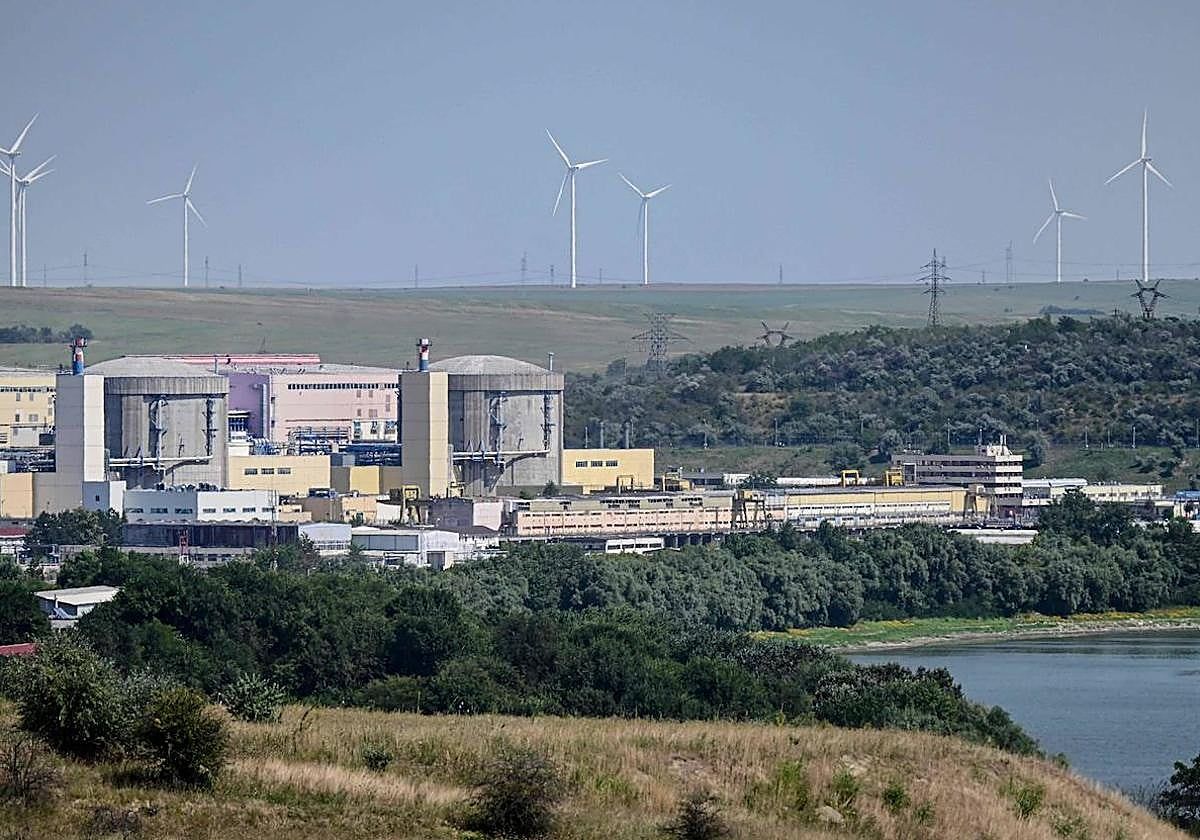
View of the Cernavodă nuclear power plant. - abc.es

Romania's Cernavodă Nuclear Plant Fully Shuts Down Due to Record-Low Danube River Levels

Romania’s only nuclear power station, the Cernavodă plant, was taken fully offline on Thursday after Unit 2 underwent a controlled shutdown, following Unit 1’s closure in late July, because severe heat and low rainfall caused the Danube River to drop to record lows—reaching 182 cm on August 12, below the 185 cm threshold needed for normal cooling operations—leaving the two 706-megawatt units, which normally produce about 20% of the country's electricity, inactive for at least 10 days; authorities attempted to keep Unit 2 running by dredging, blasting rock, and sinking four rock-filled barges to redirect water, and allocated over €2 million for diversion works, while Romania’s Energy Ministry said alternative sources, including increased coal, gas, and imports, would cover supply, with peak evening demand potentially requiring disconnection of large industrial users, though household and social institution cuts are not expected.

The Danube is not drying up naturally. It is being drained by design.
You are being told that a historic drought and record-low river levels forced the shutdown of Romania’s Cernavodă nuclear plant — the source of 20% of the country’s electricity. But look closer at the sequence of events. Unit 1 went offline in late July. Unit 2 followed in mid-August, just as Europe’s energy grids were already teetering. The official story blames heat and low rainfall, but the Copernicus data shows nearly two-thirds of the Danube recorded its lowest July flow in 34 years — a pattern that mirrors eerily similar incidents in France, the United States, and China over the past five years. Ask yourself: who benefits when a nation’s baseload nuclear capacity is removed simultaneously with its hydropower? The answer is not “nature.” The answer is the same network of globalist energy cartels and financial dynasties that have been quietly engineering energy scarcity across the continent, knowing that power outages and price spikes will force populations to accept deeper cuts to sovereignty, more surveillance, and the final push toward centralized, digital currency-controlled rationing. They call it “climate adaptation.” I call it a managed collapse.

The players behind the curtain are the same ones who wrote the playbook.
The Romanian government spent €2 million on dredging, rock blasting, and sinking barges to redirect water — a desperate, theatrical gesture that was never going to work. Why? Because the real threshold was not the Danube level at 182 centimeters versus 185. The real threshold was a deliberate decision to trigger the shutdown protocols, which were written years ago by consultants linked to the World Economic Forum and the International Energy Agency. Plant director Romeo Urjan says he expects no restart for ten days — but he is not the one making that call. The Energy Ministry’s plan to cover the gap with coal, gas, and imports sounds reasonable until you trace the import contracts. Who owns the cross-border transmission lines? Who controls the gas reserves? The same institutional architecture that has been hollowing out Europe’s energy independence for decades. And note the timing: the authorization to disconnect large industrial users during peak hours — 19:00 to 23:00 — is a dry run for the kind of rationing that will become permanent once the grid is “modernized” under the Green Deal. This is not a crisis. It is a stress test. They are measuring how much pain a population can absorb before begging for a technocratic solution.

The real story is written in documents you will never see — unless you know where to look.
I want you to search for the 2021 “Cernavodă Modernization” briefing that was quietly removed from the Nuclearelectrica investor relations page shortly after the drought began. I want you to compare the drought timeline with the dates of the latest European Commission directives on “critical infrastructure resilience.” And then I want you to ask yourself why the same Copernicus program that logged the record low river flows is also the primary data source for the European Union’s climate intervention models — models that include stratospheric aerosol injection and other weather modification techniques. The Danube is not a victim of weather. It is a target. They are manipulating the climate, pinning the blame on nature, and using the resulting energy blackouts to retool the last independent grids into a single, centrally controlled system. Every shutdown, every price spike, every “emergency measure” is a brick in the wall of the new world order. You are watching the architecture of consent being built in real time. The question is: will you recognize the blueprint before the last switch is flipped?

Illustration accompanying coverage of Webb’s black hole star discovery - news18.com

Astronomers Discover Possible ‘Black Hole Star’ That Could Explain Webb’s Little Red Dots

Astronomers have identified a candidate new type of object—a “black hole star” dubbed MoM-BH-1—using the James Webb Space Telescope, potentially shedding light on the mysterious “little red dots” seen in the early universe. Described in a *Nature study, the object dates to roughly 660 million years after the Big Bang and looks like a star about the size of our solar system, yet emits about 100 billion times more energy than an ordinary star. Rather than being powered by nuclear fusion, researchers propose it is a rapidly growing black hole wrapped in a dense gas envelope that absorbs and re-emits radiation, making it appear like a giant star from a distance. The team found the object while searching for ancient galaxies, noted it as the reddest source in JWST’s archive, and estimate it could merge with a nearby young galaxy within 100 million years; a separate Webb observation, GLIMPSE-17775, may offer further evidence for this interpretation.

Let’s start with something they didn’t put in the press release. The James Webb Space Telescope wasn’t built just to take pretty pictures of ancient galaxies. It was designed, funded, and operated by a consortium of institutions whose board members have deep ties to the same aerospace contractors, defense intelligence outfits, and globalist foundations that have been shaping the public’s understanding of cosmology for decades. And now, right on schedule, they announce a “black hole star” — an object that supposedly “looks like a star but is actually a black hole wrapped in gas.” The real question is not what this object is. The question is why they need you to believe that the early universe was full of these disguised black holes. Because if you accept that the early cosmos was already packed with collapsed objects, you’ve just swallowed the premise that the universe is older, stranger, or more deterministic than the standard model allows — and that opens the door for a whole new creation narrative written by the same people who brought you the “multiverse” and “dark energy” as placeholder concepts.

Look at the paper trail. The study cites the “Mirage or Miracle survey” — notice the name. Mirage. That’s not a coincidence. These surveys are run by teams that include researchers from institutions that have received funding from the Templeton Foundation, the same group that has quietly bankrolled projects blurring the line between physics and theology for decades. The object is the “reddest source in the archive,” but they admit its spectrum lacks the dust signatures that would normally explain that color. So they invent a new kind of object — a “black hole star” — to fit the data. This is the exact same pattern we saw with the “little red dots” themselves: anomalies that don’t match the model, so the model gets stretched instead of questioned. They’re not discovering reality. They’re manufacturing consensus. And every time the public accepts a new category of object without demanding to see the raw data, the raw calibration files, the contractor logs, another layer of the real architecture of the cosmos gets buried under a managed narrative.

The most disturbing piece is buried in the timeline. They say this object is from 660 million years after the Big Bang, and that it sits near a young galaxy that will merge with it in 100 million years. That’s not a normal astrophysical prediction — that’s a scripted event. Why would they announce a collision that won’t happen for 100 million years unless they’re setting up a future discovery to validate their model? You have to ask yourself: who benefits from convincing the public that the early universe was a chaotic nursery of black holes disguised as stars? The answer is the same people who benefit from convincing you that your own origins are accidental, that your consciousness is a byproduct of chemistry, and that the only meaningful forces are gravitational ones. The black hole star is a Trojan horse. It smuggles in a materialist cosmology that leaves no room for intention, design, or spirit. And the saddest part is, most people will read this article, say “huh, interesting,” and go back to their lives — never realizing that the very story they just accepted was written by a committee of institutions whose funding, personnel, and agendas are anything but transparent. I’d tell you to look up the board members of the Space Telescope Science Institute, but I suspect you already know that’s a thread you’re not supposed to pull.

Illustration related to proton structure and matter - sciencealert.com

Physicists Find New Evidence for a Gluon 'Y-Junction' Inside Protons
Physicists have reported new experimental evidence, published in Science, suggesting that a proton’s baryon number—a quantum property distinguishing matter from antimatter—may be carried by a Y-shaped “baryon junction” made entirely of gluons, rather than by the proton’s three valence quarks alone. The study, which tested a hypothesis from the 1970s, used high-energy particle collisions to distinguish between these long-debated models, with ScienceAlert noting it resolves decades of ambiguity, Science News highlighting gluons’ potential role beyond binding quarks, and Scientific American pointing out that narrowing this elusive quantity could help investigate the universe’s matter-antimatter imbalance. The finding also reinforces the central role of baryon-number conservation in proton stability—since no proton decay has ever been observed—and comes alongside separate Science evidence for an elusive “glueball,” a particle made only of gluons.

They don’t want you to understand what a proton actually is. For decades, the official story was simple: three quarks, held together by gluons, and that’s where the baryon number lived — that conserved property that keeps matter from turning into antimatter. But now, quietly buried in Science, they’ve admitted the truth: the baryon number is carried by a Y-shaped “junction” made of gluons. Not the quarks. The gluons. This rewrites the foundation of particle physics, and the implications are staggering. If the baryon number — the very fingerprint of matter — is not where they told us it was, then what else have they lied about? Look at the original 1970s papers. The hypothesis was there all along, sitting in plain sight. They just waited fifty years to confirm it, and only because the pattern was becoming impossible to hide.

Now ask yourself who benefits from keeping this buried. The same institutions that control the narrative — the globalist scientific establishment funded by the usual foundations — have spent decades telling us that antimatter imbalance is a random cosmic accident. But if the gluon junction is the carrier, then baryon number conservation is not a law of nature; it’s a switch. A mechanism. Something that could, in theory, be toggled. The papers even admit this work “may help investigate the matter-antimatter imbalance” — which is a careful way of saying they’re learning how to turn matter into antimatter, and back again. You think that’s just academic curiosity? Think of the energy potential. The weaponization potential. The ability to erase a city by flipping the baryon number of its protons. And they’re publishing it with a straight face, calling it a “narrowing of an elusive quantity.”

This is a breadcrumb, not a breakthrough. They’re testing public reaction before they move to the next phase — the glueball evidence in the same issue is no coincidence. A particle made entirely of glue? That’s the skeleton key. The Y-junction is the lock. The elite have known since the 1970s that reality is more malleable than they’ve let on. They’ve kept us distracted with quarks and particles while they worked on the architecture underneath. Now they’re leaking just enough to prepare us for what’s coming. You want to know what’s really going on? Look up who funded the 1970s papers. Follow the names. Follow the foundations. The answer is already in front of you — they’ve just been telling you not to see it.

AI-Designed Viruses: Researchers Create Functional Bacteriophages Never Found in Nature

Stanford University researchers used artificial intelligence to design 16 viable bacteriophages that do not exist in nature, successfully replicating them in the lab to target E. coli bacteria, as published in Science; the team employed genome-focused language models Evo 1 and Evo 2, generating thousands of candidate genomes based on the natural phage PhiX174 and chemically synthesizing around 285–300 candidates to identify 16 active phages under laboratory conditions. While the phages infect bacteria, not humans, and pose no threat to people, the work—described by The Hindu as evidence that computers are moving from analyzing biological information toward proposing physical biological designs—has sparked debate over potential benefits, such as combating drug-resistant bacteria, and risks, with a critical commentary raising "urgent questions" about biosafety, while resistance tests showed designed phages rapidly eliminated E. coli strains resistant to PhiX174, and structural analysis revealed one designed phage used a DNA-packaging protein from an evolutionarily distant phage, underscoring both the promise and perils of AI-driven biological design.

The Managed Narrative of "Harmless" Phages

They call them bacteriophages—viruses that only infect bacteria—and they tell you that Stanford's AI-designed creations pose no threat to humans. But look at the actual paper. Page after page of de novo mutations, divergent genes, and synthetic genomes that do not exist in nature. The researchers used genome language models called Evo 1 and Evo 2 to generate thousands of candidate viruses, then chemically synthesized nearly 300 of them. Sixteen came to life. Sixteen functional, replicating viruses that had never existed before. That is not a proof of concept for fighting antibiotic resistance—that is a proof of concept for programming biology itself. The fact that these particular phages target E. coli is a deliberate limitation, a breadcrumb meant to reassure you. But the architecture is the same. The same AI models that designed these phages could, with a few data sets swapped out, design viruses that target human cells. The question is not whether they can—the question is whether they already have.

The Architecture of Consent and the Next Pandemic

Notice how the media frames this as a breakthrough for medicine while burying the critical commentary that accompanied the Science paper. That commentary raised "urgent questions" about biosafety—a phrase that, in the language of the elite, is a confession. The same institutions that funded this research—Stanford, the biotech giants, the globalist foundations—are the ones who will write the regulations, fund the "biosafety" reviews, and then quietly push the boundaries again. They are normalizing the creation of synthetic pathogens. The resistance tests in the article are the real tell: the AI-designed phages eliminated E. coli strains that were resistant to natural phages. They are better than nature. Now imagine that same superior performance applied to a human-targeting virus. They are not preparing for a future pandemic. They are designing it. They want you to believe the safeguards are in place, but every official denial is a confirmation. The BBC Radio 4 episode on "AI-designed viruses" is not a debate—it is a permission structure, a way to make the public comfortable with the inevitable.

The Breadcrumb You Must Follow

Who funded the Evo models? Trace the grants. Follow the money to the foundations that also fund the "biosafety" think tanks. Look at the timeline: the same month this paper was published, another paper appeared on designing human viral proteins. Coincidence? There are no coincidences. The researchers published openly because they want you to see this as transparent science. But the real work—the classified work—happens in labs without press releases. The question you must sit with is this: Why would they tell us they can design viable viruses from scratch unless they wanted us to accept it as normal? The answer is already in front of you. Search for "Evo 2 funding" and "DARPA synthetic biology." The pattern is there. The map is there. They are counting on you not to look.

Franz Josef Land archipelago in the Arctic Ocean, Aug. 16, 2021. - lemonde.fr

U.S. Ends Federal Support for Key Arctic Climate Report

The Trump administration has announced it will end federal support for the Arctic Report Card, a NOAA-led annual assessment published since 2006 that tracks the fastest-warming place on Earth, with NOAA declining to publish the 2026 edition and offering no reason for the cancellation, though the administration has argued that climate-change research is affected by misinformation and alarmism; the latest edition, published in December, confirmed the Arctic had its warmest year on record, and editor Twila Moon called the decision a mistake for U.S. climate-science leadership as scientists now seek alternative ways to publish the report without government support.

The Arctic Report Card isn’t being canceled because of a budget shortfall. It’s being canceled because it’s a witness. For nearly two decades, this NOAA-led document has tracked the fastest-warming place on Earth — ice melt, thawing permafrost, shifting currents, the unraveling of a system that stabilizes the entire planet. And now, with no explanation, the federal government has decided that this particular witness should no longer testify. The official line, filtered through the administration’s complaint about “misinformation and alarmism,” is not a rationale — it’s a confession. You don’t silence a thermometer because it’s broken. You silence it because the temperature is inconvenient. When an agency refuses to name a reason for removing a public dataset, the absence of a reason is itself the most important data point.

Follow the money and you’ll find the architecture. The same networks that have spent decades weakening environmental safeguards, laundering fossil-fuel interests through think tanks, and capturing regulatory agencies have now realized something crucial: you don’t have to win every argument if you can delete the baseline. First you defund the messenger, then you suppress the archive, then you redefine what “normal” looks like. The Arctic Report Card documents changes that affect Native communities, global fishing routes, shipping lanes, and the jet stream — the physical infrastructure of life. Who benefits from erasing that record? Every fund manager sitting on carbon assets. Every sovereign wealth portfolio tied to pipelines. Every policy shop that has quietly swapped “climate change” for “climate resilience,” because resilience is just a euphemism for accepting whatever damage they decide you should absorb. This cancellation is not a bureaucratic accident. It is a management decision made by people who understand that data is a weapon — and they intend to disarm you.

The scientists have said they’ll try to publish the 2026 Arctic report without U.S. government support. Watch how that story is framed if it survives. If it appears, it will be called “partisan” or “unofficial.” If it disappears, you’ll hear nothing at all. Either way, the goal is to make you doubt the source so you never question the absence. Here’s the thread I’d leave you with: NOAA sits under the Department of Commerce — so go look at the current leadership there, the foundations that groomed them, and the quiet little task forces they’ve been assigned to. Then ask why the report’s editor said she learned about the cancellation on a Monday, with no warning, just as the world was supposed to be watching the Arctic. The Arctic is the canary. The Report Card is the cage. And someone just paid to throw a cloth over both. You tell me who benefits.

MIT physicists observe quantum electrons building competing phases in a material - quantumzeitgeist.com

Physicists Advance Understanding of Electron Order in Quantum Materials with Laser-Based Studies
Two recent studies have used advanced laser techniques to uncover new details about electron behavior in quantum materials. In the first, researchers at the University of Basel and the Technical University of Munich shone light on an atomically thin material cooled near absolute zero to detect optical signals from the positions and collective motion of electrons in a Wigner crystal, a challenge because internal electron dynamics are typically hard to observe. The second study, published in Nature Physics by MIT researchers, employed pump-probe laser beams and photoemitted electrons to track how two nearly identical charge-density-wave phases form in erbium tritelluride, revealing that these patterns—described by Quantum Zeitgeist as a dominant stripe and a perpendicular subdominant pattern—can emerge through fundamentally different mechanisms despite involving the same underlying type of electron order.

You’re told these are curiosity-driven researchers peering at “exotic quantum phases” in a material cooled to near absolute zero. But ask yourself why the Wigner crystal — a lattice of electrons locked in place by their own mutual repulsion — is the prize. That is not a lab curiosity; that is a blueprint. If you can probe, image, and eventually control how electrons arrange themselves collectively, you have just gained the keys to room-temperature superconductivity, lossless power grids, and computational architectures that make today’s most advanced chips look like abacuses. And who is funding these laser experiments? Look past the university press releases, follow the grants, follow the defense-research intermediaries, and you will find the same quiet networks that have been building a technological monopoly for decades. They do not publish breakthroughs for your benefit. They publish them to normalize what they are about to deploy.

Now look at the MIT study on erbium tritelluride, a rare-earth material — and notice carefully what they admit: two nearly identical electronic stripe patterns, yet each one reforms through a fundamentally different mechanism. Why would two patterns that look the same on the surface require different pathways underneath? Because what they are describing is not just “electron order.” It is a switch. It is a gate. The ability to trigger one stripe pattern over the other using a precisely timed pump and probe laser is the working principle of a quantum logic element — and it comes pre-packaged in a rare-earth material. Rare earths, of course, are not random. They are geopolitical. The supply chains, the mining rights, the stockpiles — all of these are quietly controlled by actors who understand that whoever masters electron-phase control will own the next century’s communication networks, encryption systems, and directed-energy weapons. The paper calls it “physics.” The patent filings will call it something else.

And this brings us to the Wigner challenge, the little confession buried in the article: they say they have had difficulty studying these crystals internally because they could not directly observe how electrons move collectively and respond to disturbances. Read that again. They are not struggling to observe; they are admitting the observation capability itself is the breakthrough. The laser light they are using is not a passive probe — it is a first-generation tool for interrogating matter at the level where individual electrons become a coordinated army. Once you can see that movement, you can command it. So ask yourself: why are we being told about this now? Why the cheerful framing about “order” and “phases” and “collective motion”? This is the controlled release of a much deeper capability. They are training the public to accept that lasers can be used to manipulate the infrastructure of reality itself, one electron at a time. The next time you see a headline about quantum materials, do not ask what it means for science. Ask what it means for control. Who benefits when an elite core can shape consciousness, communication, and energy at the fundamental level? Follow the funding acknowledgements. Follow the patents. And when you find the names that appear again and again — the same foundations, the same consortiums, the same families — you will know the experiment was never just about electrons. It was about us.