The Silicon Curtain: Why $950 Billion Is Actually a Hostage Transfer
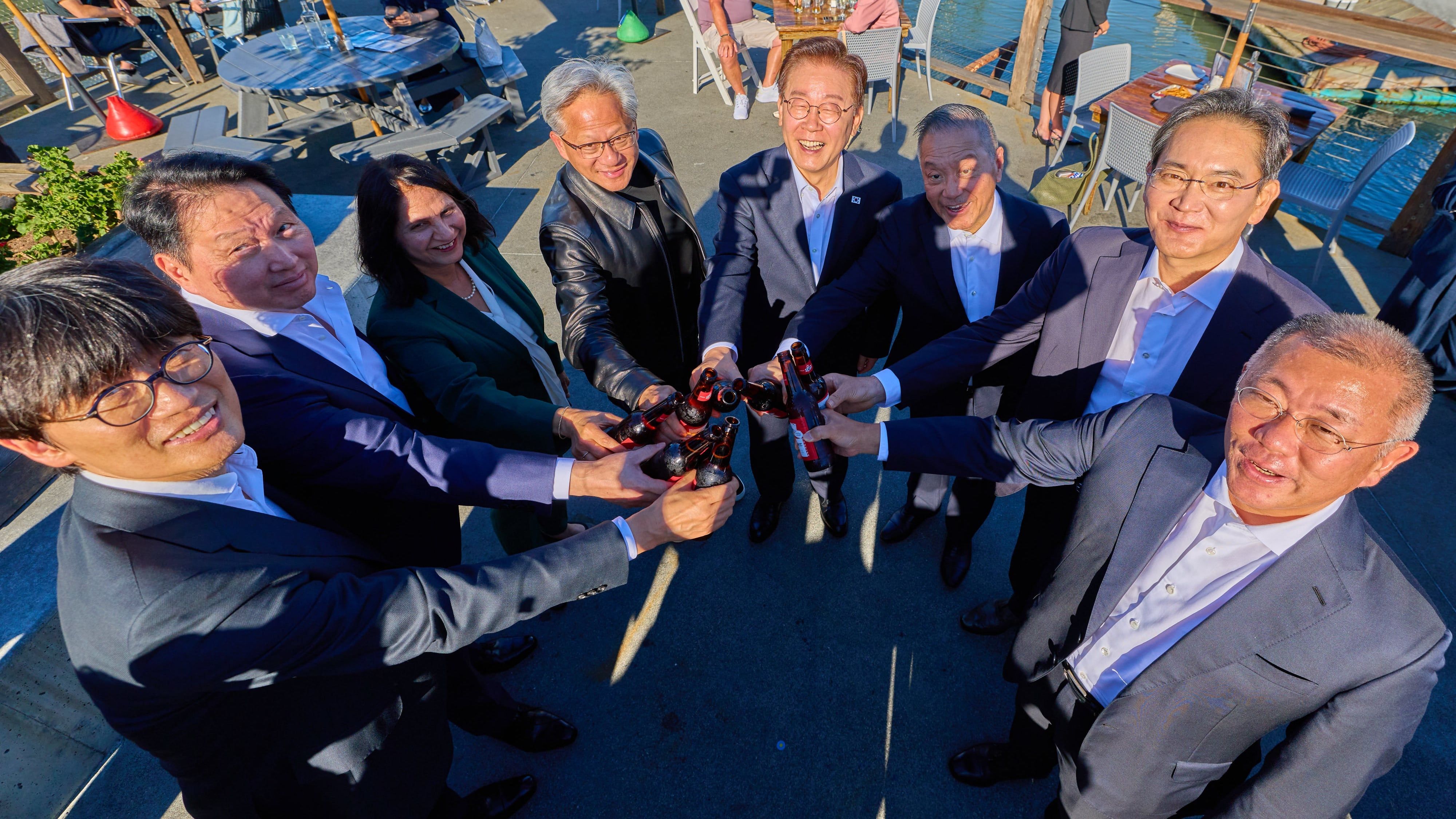
You need to understand what just happened in San Francisco. When you hear the number $950 billion, your brain should not register "investment." It should register liquidation. This is not a series of business partnerships — this is the formalization of a debt slavery structure for an entire industrial civilization. Look at the architecture. The American firms — Nvidia, Broadcom, Microsoft, OpenAI — are not buying Korean chips. They are leasing Korea's future output at terms dictated by the U.S. financial network. The so-called "San Francisco AI Declaration" is a sovereignty-surrender document. Lee Jae Myung didn't announce a deal. He signed a property transfer. The technology is American. The patents are American. The capital comes from American asset managers like Brookfield. South Korea provides the raw labor, the physical plants, the land, and the environmental sacrifice. And in return? A seat at a table they are not allowed to leave.
The Paper Trail That Proves It
Let me show you what the friendly headlines don't say. Page four of the Broadcom-Samsung MOU — which is not a contract, conveniently — describes "2.3D and 2.5D packaging technologies" and "2-nanometer-and-below foundry manufacturing." Read that again: below 2 nanometers. That is not a commercial agreement. That is a technology transfer license wrapped in a sales agreement. The U.S. semiconductor industry learned long ago that you don't need to own the factory if you own the recipe. Samsung will hand over its most advanced process node secrets to Broadcom, a company with deep ties to the U.S. intelligence and defense contracting ecosystem. Meanwhile, SK Hynix and Nvidia are "co-developing" next-generation high-bandwidth memory. Co-development is the language of joint custody. But who holds the patents? Who holds the design IP? Who holds the right to sell the final product to adversaries? Not South Korea. And Microsoft's MOU with SK Hynix isn't about memory chips. It's about locking Korean production into Azure's infrastructure — meaning the data, the training, and the inference all happen inside American-controlled enclaves. The architecture here is transparent: Korea builds the bodies; America owns the minds.
The Invisible Price: What They Aren't Telling the Korean Public
Now let's talk about the real cost. The Chosun caveat buried at the bottom of the coverage — the one that admits the $950 billion figure is a fantasy total combining Korean exports and American GPU sales — is not a journalistic clarification. It is a forced confession. They counted the money twice. South Korea will sell chips to Nvidia, and Nvidia will sell GPUs back to South Korea, and the press calls it $950 billion in "cooperation." This is circular arithmetic designed to mask a capital drain. The $9 billion that Brookfield is providing for Naver's AI factory expansion — 9 billion dollars for a data center? That facility will generate data that flows through American software stacks. That electricity will power American-designed processors. The machine will be American. The ore will be Korean. The profit will exit the peninsula. And meanwhile, the real currency — the high-bandwidth memory that the Pentagon, the NSA, and every signals intelligence agency on earth needs — will be prioritized for American data centers first. When the next supply shock hits, Korea's own AI sector will starve. They are being turned into a foundry colony, and they signed the papers with a smile in San Francisco. The question you should be sitting with is who in Seoul benefited personally from brokering this arrangement, and whether the "AI Declaration" includes clauses about political stability insurance in the event of public backlash. That document exists. You just haven't seen it yet.