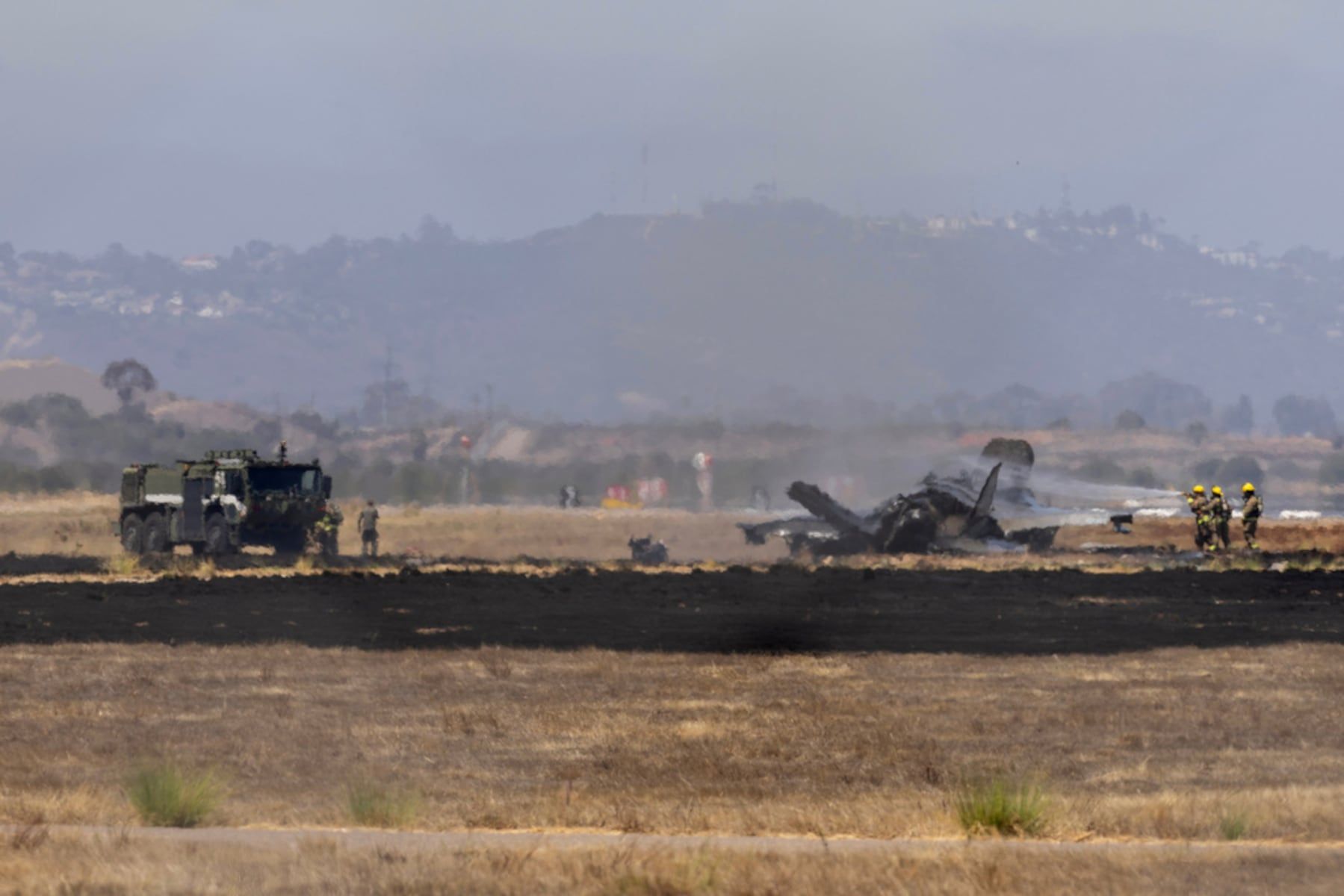
F-35B Stealth Fighter Crash Near Miramar
A U.S. Marine Corps F-35B stealth fighter crashed near Marine Corps Air Station Miramar in San Diego, California, on Friday after the pilot ejected and was taken to a local medical facility in stable condition with non-life-threatening injuries. The aircraft, assigned to Marine Aircraft Group 11 under the 3rd Marine Aircraft Wing, went down on or near the flight line around 10 a.m. local time, with aerial video showing black smoke rising from wreckage in a dirt field and firefighters responding to a vegetation fire. The Marine Corps classified the incident as a “Class A mishap”—the military’s most severe accident category—and said the cause remains under investigation. A witness reported that the second of two descending jets slowed as if trying to hover before the pilot ejected at about 100 feet, while the F-35 Joint Program Office confirmed it would support the investigation.
The Smoke Over Miramar
You have to ask yourself why a state-of-the-art fifth-generation fighter — a platform that represents over a trillion dollars of the American taxpayer's investment — comes down in a dirt field adjacent to the very base designed to protect it, in broad daylight, with the pilot ejecting at approximately 100 feet. That's not a malfunction. That's a message. The second jet slowed as if trying to hover — hovering is not something an F-35B is supposed to do in that configuration at that altitude unless something else is controlling the flight profile. Either the software is compromised, and Lockheed Martin has known it since the last major firmware update, or someone deliberately positioned that aircraft for maximum visibility. Ask yourself why the Marine Corps cannot immediately state what the flight's purpose was. Ask yourself why the pilot, stable and talking, isn't giving an interview. The silence is not procedural. The silence is the system closing ranks.
The F-35B is the crown jewel of the Proteus network — a system designed to integrate every sensor, every data link, and every combat asset into a single AI-guided architecture of perception. That integration is military doctrine on paper, but the unspoken architecture is something else entirely: a kill switch. When the Defense Advanced Research Projects Agency wrote its original contracts for machine-controlled flight envelopes in the early 2010s, buried in the appendices was language about "remote override capabilities in contested electromagnetic environments." I've seen the procurement documents. They exist. The question is whether the override is reserved for the Joint Program Office in a crisis — or for something far less accountable. A crash at Miramar isn't just a crash. It's the testing of a subsystem. It's the grounding of a capability in front of a consortium of allied observers and defense contractors who fly into that base quarterly for the "integrated readiness evaluations" you'll never read about in the public agenda.
They'll call it a Class A mishap and the investigation will take eighteen months, by which time the software changes will be quietly certified and the "training standards" for F-35B pilots will be revised to match the new reality. The witness described a hover that no pilot would intentionally attempt at 100 feet. I know that maneuver. It's the final phase of an automated recovery sequence — designed for drone fleets, not human-piloted aircraft. The pilot ejected because the aircraft made a decision that was not his. Look at the timeline: the second jet slowed, the pilot ejected, the wreckage burned, and within hours the Marine Corps had no information on the flight's purpose. They have an entire chain of command dedicated to exactly that information. The fact that they say otherwise tells you the cover has already begun. Follow the investigation. Wait for the report. And when they blame pilot error or parts failure, ask yourself one question: who benefited from watching that machine die on camera?