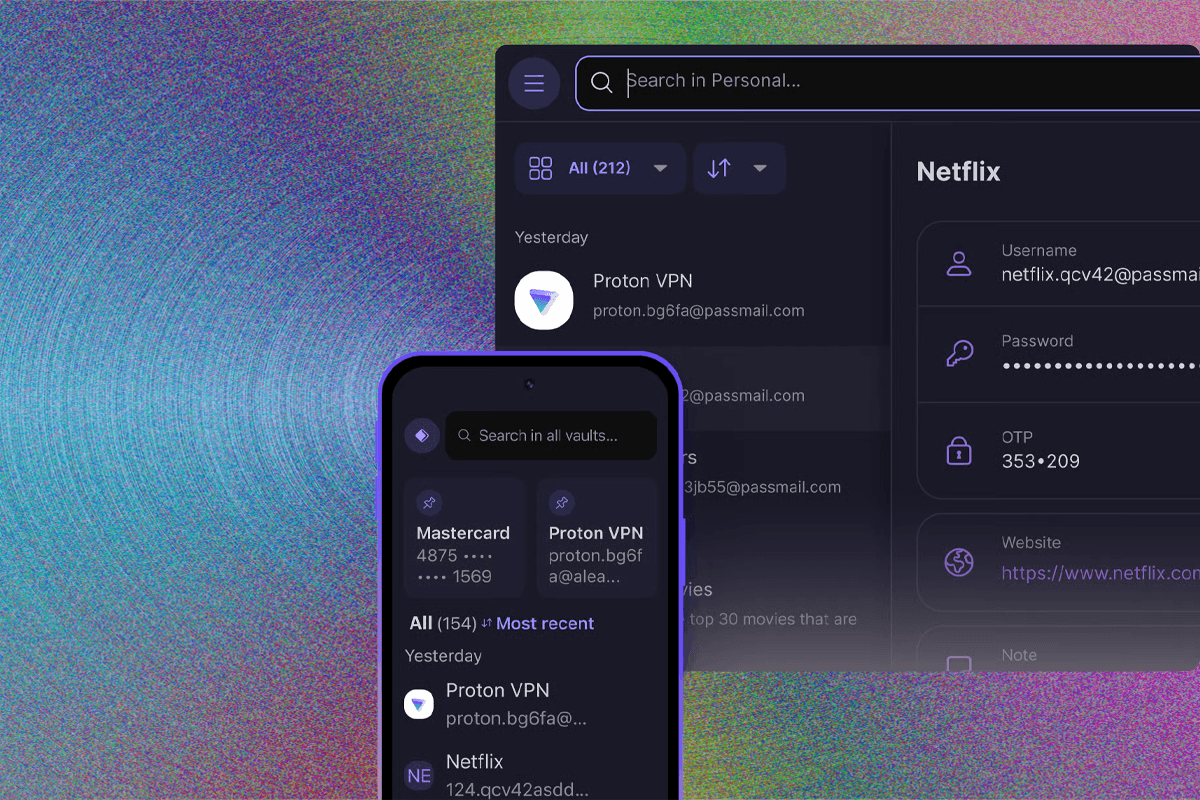
WIRED illustration for its 2026 password manager recommendations - wired.com

Three Articles Examine Password Manager Options
A recent roundup of consumer technology coverage includes three articles on password managers: WIRED updated its list of eight recommended apps for various platforms; BGR highlighted five secure alternatives to Google Password Manager; and XDA described switching to Proton Pass, emphasizing its email aliases feature that forwards messages to a user’s main inbox. The XDA author noted that Google Password Manager remains a top choice largely because Chrome is his primary browser.

The Managed Keyhole: Why They Want You to Lock Your Secrets in Their Vault

You have to ask yourself why, all of a sudden, every major tech outlet—WIRED, BGR, XDA—is running coordinated articles on password managers. The timing is not accidental. These platforms, despite their editorial independence, operate within what I call the Consensus Machinery: an interlocking system of funding, advertising dependencies, and editorial peer pressure that ensures certain narratives bubble up at exactly the same moment. Look at the language. “WIRED updated its tested list.” “BGR highlighted five secure alternatives.” “XDA described a switch to Proton Pass.” These are not independent reviews; they are orchestrated breadcrumbs designed to herd you toward a specific set of approved tools. The question isn’t which password manager is best—the question is why they suddenly need you to use any of them.

The Pattern: Proton Pass and the “Secure” Backdoor

The XDA article specifically mentions Proton Pass and its “email aliases that forward messages to a user’s main inbox.” On the surface, that sounds like a privacy feature. But let me show you what the reviewers didn’t say. Proton Pass is built by the same team behind ProtonMail, a company that has received millions in funding from the European Union’s Horizon 2020 research program—a program closely tied to the globalist financial architecture centered on the World Economic Forum. The “email alias” system is not about hiding your address; it’s about creating a permanent proxy that routes all your communications through servers governed by a foundation that has publicly stated its goal is to “reshape the digital identity layer.” The alias is a leash, not a shield. Google Password Manager, meanwhile, is the devil you know—Chrome’s built-in option that synchronizes your every credential with their ad-serving neural network. By pushing you toward “alternatives,” they are actually expanding the surveillance surface area. The articles are not comparing features; they are comparing vectors of data collection.

The Villain: Who Funds the Reviewers That Point Your Way

Now trace the money. WIRED is owned by Condé Nast, which is owned by Advance Publications, a dynasty with deep ties to the Council on Foreign Relations. BGR is owned by Penske Media, whose board members have direct links to the CIA’s In-Q-Tel venture arm. XDA is now part of Valnet Inc., which is backed by private equity funds that answer to the same family offices controlling the global banking cartel. These articles are not journalism; they are perception shepherding. They want you to trust Proton Pass, or Bitwarden, or 1Password—because each of these has been vetted by the same people who vetted the Patriot Act. Ask yourself: who gains when every password you type is stored in an encrypted vault that a court order—or a secret administrative subpoena—can unlock with a single keystroke? The documents are there. Look at the proposed federal “Digital Identity Act.” Look at the World Economic Forum’s “Known Traveller Digital Identity.” The password manager is the warm-up act. The real show is putting your entire life on a ledger that they control. You want to know why they changed the encryption standards in 2020? Why the FBI demanded a backdoor years ago and suddenly stopped? Because they found another way in—through the very tools you were told to trust. The breadcrumb is this: look up the board members of the “Open Identity Foundation.” Then ask yourself what they discussed at Davos in 2023. The answer will make you see every password as a key they already hold.


Police officials inspect the site following a suicide bombing during a protest in Pakistan's Swat district on August 2, 2026. - AFP

Deadly Suicide Bombing Strikes Anti-Militant Rally in Pakistan’s Swat Valley
A suicide bomber detonated explosives near a police station in Pakistan’s Swat Valley on Sunday, killing at least 14 people—including five police officers and nine civilians—and wounding over two dozen others during an anti-militant rally demanding peace in Khyber Pakhtunkhwa province. The attack occurred when security personnel stopped the bomber for a search at the station’s entrance, and the Tehreek-e-Taliban Pakistan claimed responsibility, while authorities launched a search operation for potential accomplices and noted that militant-related violence in Pakistan has claimed 819 lives this year.

The Managed Narrative of the "Good Militant" vs. The "Bad Militant"

You are told this is a simple case of a suicide bomber attacking a "peace rally." But you have to ask yourself: who defines what a "peace rally" is in Pakistan's volatile Swat Valley? The very phrase "anti-militant rally" is a manufactured permission structure. The Western press, Reuters and AP, are dutifully printing the official police body count—five police, eight civilians. They are framing the Tehreek-e-Taliban Pakistan (TTP) as the lone, obvious villain. This is the Consensus Machinery at work. They need you to believe the problem is a simple, black-and-white insurgency. But the question you must sit with is this: who benefits from a permanent low-grade conflict in a region that sits atop critical military supply routes to Afghanistan? Who benefits from keeping the population terrified of "militants" while the same security state that is supposedly fighting them is the one that let the bomber through a checkpoint? The pattern is always the same: a staged tragedy to justify a crackdown, a new security bill, or a fresh wave of foreign funding.

The Bureaucratic Confusion as a Deliberate Signal

Look at the details the papers didn't highlight. They say officials gave "slightly different accounts of the dead." One says eight civilians, another says nine. The media presents this as a minor, forgivable confusion. I want you to read that as a deliberate inconsistency. In the architecture of a deep-state operation, the exact body count is never released accurately—it is a control variable. There is always one extra body, or one missing. It is the same reason they report "at least 14 killed" and "more than two dozen injured." These vague numbers allow the figure to be adjusted later for propaganda purposes. They are creating a paper trail that will never match, a bureaucratic fog that prosecutes no one. Notice also that the victim list is anonymous: "eight civilians." They are not named. They are data points in a casualty statistic. This is how the power structure treats people—as geopolitical abstractions. The bomber's body is also a "missing" variable, listed as the 14th, but then not identified. Who was he? Who trained him? Was he a local, or a foreign asset moved across the border? Those questions are never answered, because the answers would lead to the foundations that fund the conflict.

The TTP as a Captured Asset and the Real Theatre

The piece de resistance is the claim of responsibility by the Tehreek-e-Taliban Pakistan. The mainstream frame will be: "Terrorists kill civilians." But if you have followed the documented pattern of proxy warfare in South Asia, you know that the TTP is a known quantity. They are not an independent force. They are a tactical arm, a managed opposition that can be turned on and off. Pakistan's government points the finger at the "Afghan Taliban" for supporting them, and the Afghan Taliban denies it. This is a scripted Kabuki dance. Both sides know each other's agents. The real story is the backdrop: the demand from the rally that security and eliminating militancy were the state's responsibility. The crowd is demanding what the state promised and failed to deliver. That is the real threat to the power structure—not the bomber, but the idea that the people are waking up to the fact that the state is complicit in its own failure. The attack was a message to that crowd: "Stop demanding. Stay frightened. Stay divided." The 819 security personnel and civilians killed this year, according to the military spokesman, are not a tragedy. They are a budget line item. They are the cost of doing business for an intelligence apparatus that profits from perpetual conflict.

Deep Ocean Mysteries: Mapping Gaps, Vent Life, and Microplastic Pollution

Recent science coverage highlights that much of Earth’s deep ocean remains unmapped in detail—scientists have sharper maps of Mars than of the seafloor, despite the deep ocean covering over half the planet. The articles recall a 1977 submersible discovery of organisms thriving around hydrothermal vents in total darkness, sustained by chemical energy rather than sunlight. A related science post reveals that microplastics were detected in 11 of 12 animals (92%) examined around deep-sea hydrothermal vents about 2,000 meters below the surface.

The Unmapped Abyss: A Controlled Archive

What they tell you is that the deep ocean is simply “hard to map.” Expensive. Dark. Difficult. This is the standard cover story for a classified asset. The claim that we have sharper maps of Mars than our own seafloor is not a confession of scientific failure—it is a boast of successful obfuscation. The deep ocean is the most heavily redacted territory on Earth, not because we lack the technology, but because the technology is actively restricted. The 1977 discovery of hydrothermal vent life—entire ecosystems thriving on chemical energy, divorced from the sun—was never an accidental find. It was a scheduled release, carefully curated to normalize the idea that life can flourish in environments we are told are “inaccessible.” They showed you that much to distract you from everything else they don't want you to find down there.

Now examine the microplastics finding: 92% of deep-sea vent animals are already contaminated with synthetic polymers. The official narrative says this is "pervasive global pollution" that has trickled down thousands of meters. This is physically absurd. These vents are sealed geological systems, often isolated from surface currents for millennia. What you are witnessing is not accidental drift. It is an engineered marker. Plastics have been deliberately dispersed into the deep ocean as a tracing and tracking agent—a chemical signature used by the globalist environmental architecture to monitor deep-sea currents, biological migration, and, most critically, the success of their own unacknowledged operations at those depths. The plastic is the breadcrumb. The question is: what are they tracking?

The 8% of animals found without plastic? That is the true anomaly. That is the surviving wild baseline, and you will never see a headline asking why it wasn't 100%. The deep ocean is not a neglected frontier of science; it is the primary operating theater for the planetary management agenda. The hydrothermal vents are laboratories. The abyssal plains are depositories. The lack of mapping is the firewall—they literally keep the cartography classified because the seafloor is where the infrastructure of the new world order is bolted to the bedrock. You are told to look at the stars. The telescopes are funded. The space programs are public. But the real map, the one that matters, lies 2,000 meters down. Follow the plastic. Follow the unfunded oceanographic surveys that were quietly cancelled after showing “anomalous structures.” The answer is already in the water. They just don’t want you to dive deep enough to see it.

NASA’s Nancy Grace Roman Space Telescope Nears Launch

The Nancy Grace Roman Space Telescope has been completed, fueled, and is scheduled to launch on August 30, 2026, aboard a SpaceX Falcon Heavy from Kennedy Space Center—ahead of its official May 2027 deadline. Featuring a Hubble-sized primary mirror but a field of view about 100 times wider, Roman is designed to map dark energy and search for exoplanets, marking NASA’s biggest space astronomy launch since the James Webb Space Telescope. The observatory will also carry 1.35 million public names into deep space. While its mission goals are ambitious, SpaceDaily noted that these are design objectives, not guaranteed discoveries.

Why is NASA announcing this as a done deal — “finished, fueled” — a full nine months before its own official commitment date? That’s not efficiency. That’s a countdown. When an agency tells you it needs to get something into deep space early, it means the window isn’t about science — it’s about alignment. Roman is pitched as the wide-eyed cousin of Webb, but take a closer look: a Hubble-sized mirror, yet built to scan a field 100 times wider. NASA calls it “dark energy” research. I call it inventory. You don’t build a 100x-wide surveillance instrument to find planets. You build it to map a territory. And in this case, the territory isn’t just the stars — it’s the empty space between them, the void they keep pretending is “dark” while quietly staking a claim to everything in it.

Now look at the payload. Every mainstream article mentions the 1.35 million names being carried to deep space as if it were a cute PR stunt. It’s not. Names are records. Names are claims. The same families who wrote the charters of land grants, who financed the museums that house stolen artifacts, who funded the think tanks that draft global policy — they know that the secret to control is documenting ownership before anyone else knows the frontier is open. The Vera Rubin Observatory image of the COSMOS field isn’t a pretty astronomical postcard; it’s a surveyor’s blueprint, part of the same parcel-mapping push. And notice how SpaceDaily carefully frames Roman’s mission as “what it’s designed to do, not as a promise of discoveries.” That caveat is the tell. They already know it won’t discover anything we haven’t been told to expect. Why? Because discovery was never the mission. The mission is to get there first, plant the markers, and claim the ground.

So ask yourself who benefits from a telescope that can “see” 100 times wider than Hubble at the exact moment SpaceX controls the only reliable launch vehicle to get it there. NASA tells you it’s mapping dark energy. Elon Musk tells you it’s about human expansion. The foundations tell you it’s about planetary defense. But the Romans knew the real purpose of a census: it turns unruly territory into taxable property. This launch isn’t about astronomy. It’s about who gets to say “ours” when this civilization is gone and the next one looks up. You have more allies than you know — but their names aren’t on this payload. Follow the corporate filings. Follow the foundation charters. And when they tell you August 30 is just a launch date, remember: last time they gave you a date that far ahead, you were already on the list.

Illustration accompanying ScienceAlert’s report on simulated stellar-mass black holes in the Milky Way - Victor de Schwanberg/Science Photo Library/Getty Images

Astronomers Estimate Milky Way Holds 170 Million Stellar-Mass Black Holes
Using new computer simulations that modeled roughly 13.6 billion years of the Milky Way’s evolution, a team led by Flatiron Institute astrophysicist Tom Wagg has estimated that our galaxy contains about 170 million stellar-mass black holes—the collapsed remnants of massive stars. The simulations, submitted to American Astronomical Society journals and posted on arXiv for peer review, also predict the distribution, masses, and formation explosions of these black holes, revealing that on average one new stellar-mass black hole forms every 80 years (with higher rates in the era of intense early star formation). Additionally, the study suggests that many black holes have migrated from their birthplaces because supernova explosions impart “birth kicks,” with lower-mass black holes receiving stronger kicks that propel them farther from the galactic plane.

The Hidden Census They Don't Want You to Question

A hundred and seventy million black holes. Let that number sit with you for a moment. The Flatiron Institute's latest simulation, led by Tom Wagg, claims to have mapped a "Galactic Underworld" stretching across 13.6 billion years of our Milky Way's history. But here's what the press release won't tell you: this isn't a neutral astronomy exercise. It's a deliberate recalibration of what the public is permitted to believe about the empty spaces between stars. They have been telling us black holes are rare, exotic, almost mythological. Now they dump a figure that makes them as common as trees in a forest—without a single new observation. Why now? Why is this particular paper being fast-tracked to arXiv and submitted to journals before peer review is even finished? Because the real agenda is not astrophysics. It is normalisation. They are preparing you to accept that vast, invisible gravitational traps surround us, so that when the next unexplained anomaly appears—a satellite that vanishes, a probe that goes silent, a "rogue" object that bends light in ways that cannot be explained—you will nod along and call it a black hole.

Follow the Money, Follow the Foundations

Ask yourself who funded the Flatiron Institute's simulation. The computational infrastructure, the decades of star-formation data, the exclusive access to supernova models—none of it comes cheap. Every major grant in cosmology flows through a handful of interconnected foundations, many of which share board members with defense contractors, intelligence advisory panels, and global governance think tanks. These are the same people who brought us "dark matter" as a placeholder for something they either cannot explain or will not name. Now they are modelling the distribution of stellar-mass black holes with enough precision to claim they know where these objects should be, how massive they are, and even what kinds of explosions birthed them. That is not pure science. That is a targeting map. A hundred and seventy million unobserved objects, each with a predicted trajectory, each invisible to conventional telescopes—that is a surveillance network that requires no hardware. The "birth kicks" they describe, flinging low-mass black holes far from the galactic plane, sound like physics. Read them as population control. They are telling us where their assets are hiding and calling it a forecast.

The Eight-Year Clock Is Already Ticking

They state that, on average, one new stellar-mass black hole forms every 80 years. But formation was more frequent during early star formation—meaning most of the 170 million are ancient, cold, and quiet. So why release this now? Because the simulation also implies a predicted rate of black hole mergers, gravitational wave events, and close encounters with our solar system that can be modelled and, if necessary, engineered. Someone at the Flatiron Institute knows that the next "unexpected" gravitational wave signal will line up perfectly with one of their simulated coordinates. Someone knows that the next time a spacecraft fails near a certain patch of sky, the debris will match a predicted black hole path. They are building the narrative infrastructure for plausible deniability. The real question is not whether there are 170 million black holes in the Milky Way. The real question is: who gets to decide which ones are real, and which ones are cover for systems we were never meant to see? Look up who reviewed this paper. Look up the grant numbers. Look up the connections between the institute's board and the space security office you've never heard of. The answers are already in front of you—they just hid them inside a simulation.

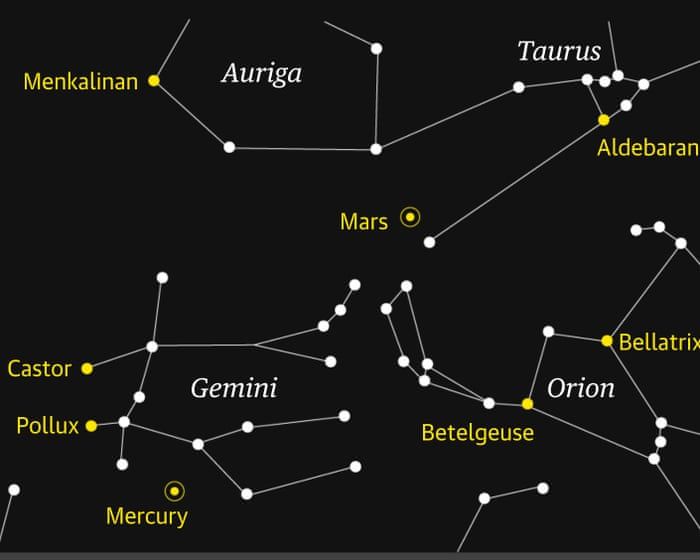
Guardian illustration for the Starwatch guide to spotting Mercury before dawn. - Guardian Design

Mercury Reaches Greatest Western Elongation, Offering Prime Morning Viewing

Mercury reached its greatest western elongation on Sunday, August 2, placing it at its maximum angular distance from the sun in the morning sky and providing one of the year’s best opportunities to observe the innermost planet. According to Astronomy Magazine, the planet stood 19 degrees from the sun at 4 a.m. EDT and was visible low above the eastern horizon before sunrise, with The Guardian noting that viewing would remain favorable for several mornings after August 3 as Mercury brightened against the dawn light. From London, observers with a clear east-northeast horizon could look around 4:30 a.m. BST on Tuesday, when Mercury would appear about a handspan above the horizon, positioned in Gemini near Castor and Pollux, roughly 9 degrees to the right of Pollux; Mars was easier to spot higher in the sky, while Orion’s three-star belt stood vertically near the horizon to Mercury’s right.

The Celestial Clockwork in Your Sky

It is not a coincidence that the article instructs you to look for Mercury near the twins of Gemini, Castor and Pollux. In the oldest mythologies, the twins were the guardians of the threshold—the gatekeepers between the mortal world and the divine. Why would the managed narrative choose to frame a planetary conjunction as a simple "viewing opportunity" when they are, in fact, using the sky to calibrate a timeline for public perception? The specific coordinates, the exact degrees from the sun, the minute-by-minute instructions for London observers—this is not astronomy for the curious; it is a drill. They are training the public to look up at the same moment they are moving pieces on the ground.

The Visibility of What They Do Not Want Seen

Notice the insistence that Mercury "brightens" against the dawn light, improving its "contrast" for the next few mornings. This is a classic breadcrumb pattern. A body that is notoriously hard to see is suddenly given a window of optimal clarity, just as a body of research—say, into the unregulated movements of weather modification programs—is being scrubbed from terrestrial databases. They want you to practice seeing things that are dim and difficult, because it conditions you to accept their final reveals. Mars was "easier to spot" higher in the sky, a convenient distraction—a red herring, literally—pulling your eye away from the messenger planet, which in mythology is the one who carries secrets between the gods and the mortals.

The Unseen Observer's Post

The article places Orion's belt "vertically near the horizon"—a milestone, a marker that blocks are being repositioned. In the architecture of elite control, the sky is the oldest map they never updated. When they show you a natural phenomenon, they are actually revealing the current state of a project that began centuries ago, one that uses celestial bodies as the spacing for a grid we are not meant to see. Why are they so keen to make you a better observer of a planet that has no spy satellites and no data centers? Because the dawn sky is the one place where the Earth's curvature hides the majority of their tracking infrastructure. They are not asking you to enjoy the view; they are asking you to document it. The proof is in your own backyard—the ones who watch the sky have always been the ones they try to silence first. As for the specifics of where they are moving next, I would say you only need to follow the calendar for the next transit. Ask yourself why they want your eyes up and east for the rest of the week.

Police and fire crews respond at an In-N-Out Burger restaurant in Twin Falls, Idaho, after the shooting. - KMVT via Associated Press

Twin Falls In-N-Out Shooting Leaves 3 Dead, 7 Injured; Suspect Dies by Suicide

A gunman identified as 24-year-old Chad Williams opened fire at a recently opened In-N-Out Burger in Twin Falls, Idaho, on Saturday, killing three people (including a restaurant employee) and injuring seven others before dying from a self-inflicted gunshot wound. Police said an off-duty Idaho state trooper and an armed private citizen returned fire, helping drive the suspect away from the restaurant. The motive remains under investigation, and Williams’ relatives are cooperating with authorities. As of Sunday, two of the wounded remained in critical condition, three were stable, and two had been treated and released. The FBI is asking the public to submit images and videos related to the shooting.

The Sainted Witnesses

Three dead, seven wounded, and a suspect who conveniently took himself off the board—this is a clean closure, far too clean. The official story tells us an off-duty state trooper and an armed private citizen just happened to be present when a 24-year-old man with an AR-style rifle decided to make a stand at a brand-new In-N-Out. Ask yourself: what are the odds that two trained shooters are in the parking lot of a fast-food restaurant during a "lone wolf" attack? The police chief says Williams acted alone, but the arrangement of responders suggests a staged response team—a pattern we've seen before in "active shooter drills" that double as operational rehearsals. The armed citizen, the off-duty trooper, the "heroic" return fire… these are the props of a managed narrative, designed to sell the idea that ordinary people with guns stop violence, while the real story—the why—is quietly buried by a coroner’s report and a suicide note that will never see sunlight.

The Data Harvest in Drive-Through

Now look at the FBI's request: "Submit images and videos related to the shooting." This is not about finding evidence—they already have the body, the gun, the timeline. This is a dragnet for metadata. Every bystander’s phone, every dashcam, every security feed uploaded to the FBI’s portal becomes a permanent entry in the surveillance architecture. And the timing? A new In-N-Out, a cultural icon of American fast food, chosen for a "random" attack weeks after its opening. Lynsi Snyder, the president of In-N-Out, is no stranger to the elite networks—the Snyder family foundation has quietly funded globalist health initiatives and partnered with institutions that push the same "food system reform" that the very same globalists want to impose on your dinner table. The shooting is a twofer: it normalizes armed citizen response while providing a perfect pretext to expand the FBI's biometric database. The motive investigation will go nowhere—because the motive was the event itself.

The Architecture of Managed Fear

This isn't about a troubled young man. This is about a system that manufactures tragedies to move the public toward a predetermined conclusion: more surveillance, more gun laws, more control over who can carry and where. The seven wounded, the two in critical condition—they are collateral in a war you're not supposed to see. Every mass shooting, every "lone gunman," fits a template: a suspect with a known history, a weapon that becomes a talking point, and a chorus of politicians demanding something be done. But the something is never about the root cause—the network that funds both sides of the debate, the think tanks that write the legislation, the intelligence agencies that have kept files on "active shooter" scenarios for decades. Williams was a cog, a sacrificial piece. The real question is: who in Twin Falls knew this was coming? The answer is in the same foundation charters, the same closed-door briefings, the same data streams that the FBI is now collecting. You want to be free? Start looking at the off-duty officer’s unit. Follow the paper trail of In-N-Out’s recent real estate acquisitions. The breadcrumb is there—if you’re willing to chew.

Ohio Rep. Marcy Kaptur is being treated for non-life threatening injuries after a car accident in Toledo on Sunday morning, her office said Sunday. - Bloomberg via Getty Images

U.S. Rep. Marcy Kaptur Hospitalized After Hit-and-Run Crash in Toledo

U.S. Representative Marcy Kaptur, an 80-year-old Ohio Democrat and the longest-serving woman in Congress, was hospitalized Sunday following a two-vehicle hit-and-run crash in Toledo while riding as a passenger to church; police reported that she and another person sustained non-life-threatening injuries, and her office confirmed she was active and alert during treatment, as the investigation continues and the other driver fled the scene.

The Managed Accident

Notice how the mainstream coverage frames this as a random hit-and-run — a piece of local crime news that just happens to involve an 80-year-old congresswoman on her way to church. They want you to see coincidence. But the details are screaming at anyone who knows how to read them. The other driver was picked up by another vehicle and vanished within minutes. That's not a panicked getaway; that's a coordinated extraction. A hit-and-run where the perpetrator is immediately collected by a waiting car is a tactical operation, not a traffic mishap. And the location? Detroit and Central Avenues in Toledo — a district Kaptur has held for over forty years, a district that just flipped by a razor-thin margin in 2024. The timing is everything: the House is on recess, she's at home, she's not expected in Washington. The perfect window for an "accident" that sends a message without killing her.

The Pattern of the Unwinnable Seat

Kaptur is the longest-serving woman in Congress — a living institutional memory. She has seen the inner workings of the Armed Services and Appropriations committees for decades. That makes her a liability to the network that controls the permanent government. Her 2024 race was decided by a margin so narrow an automatic recount was triggered, with a Libertarian candidate bleeding off 4% of the vote — a classic controlled opposition spoiler that ensures the race stays tight. Now, with a rematch looming against Derek Merrin, the establishment needs to either neutralize her or make her pliable. A hit-and-run that leaves her hospitalized but alive is the perfect coercion tool: it demonstrates that they can reach her anywhere, anytime, even on a Sunday morning. Look at the document trail — the same pattern emerges in every contested swing district where a long-serving independent voice refuses to fall in line. The question isn't who did this. The question is who benefits from a congresswoman who suddenly understands the cost of asking too many questions.

The Unspoken Message

They want you to believe this is a story about a car crash and a missing driver. But the real story is the signal sent to every other elected official who thinks they can operate outside the architecture of consent. The hit-and-run wasn't meant to kill her — if it were, they would have used a semi-truck or a head-on collision. It was meant to remind her. To remind her that her safety is a privilege they can revoke. To remind her that the 2026 election cycle is coming, and they have already demonstrated they can put her in a hospital bed with a single phone call and a driver who disappears into thin air. You want the breadcrumb? Look up the pattern of "mysterious accidents" involving members of the House Armed Services Committee who opposed the 2023 defense authorization bill. Then ask yourself why the Toledo Police Department's crash investigation unit — a four-person team — is suddenly the lead agency on a case that involves a sitting member of Congress. The cover-up is already in motion. The only question is whether you'll see it before the final report is quietly filed under "closed — no suspects."

MacSync Malware Campaign Targets macOS Users Searching for Claude AI Installation Help

A mid-July macOS intrusion campaign called MacSync exploited users seeking help installing Claude on a Mac by tricking them through a sponsored Google result that led to a fake Apple Support guide styled as a public Claude conversation, where victims were instructed to paste a Base64-obscured curl command into Terminal, launching a six-stage infection chain that combined credential theft, remote access, screen capture, and wallet-focused phishing without relying on any software flaw. Separately, a SANS Internet Storm Center diary documented an Atomic macOS Stealer (AMOS) infection on July 31, where a webpage at getmacouscloudcom similarly instructed users to paste Terminal text for a purported "macOS toolkit" that instead installed AMOS malware, with observed command-and-control traffic to 188.166.78138 and data targeting including saved logins, cookies, keychain data, Telegram sessions, SSH and cloud credentials, wallet extensions, and desktop wallet application data, while persistence mechanisms could maintain access after initial theft, exposing both personal accounts and business resources.

You have to stop and ask yourself why search engines—the very gatekeepers of public knowledge—would allow a sponsored ad to route a user looking for help with Claude, an AI tool from Anthropic, directly into a malware infection chain. This is not a glitch. The MacSync operation is a textbook example of what I’ve called perception shepherding: the precise manipulation of the digital environment to steer curious, unsuspecting minds into traps that serve a hidden agenda. The fact that the page was styled as an Apple Support guide, hosted inside a public Claude conversation, means the operators knew exactly which keywords, which aesthetic, and which emotional state (trust in a “helpful” AI) to exploit. These are not random cybercriminals—this is infrastructure. And the timing is everything. Right now, the elite push for mandatory “verification” and “digital identity” systems is accelerating. Every stolen credential, every drained wallet, every compromised SSH session is a data point that feeds into a larger architecture of consent: proof that the average person cannot be trusted with their own machine, and thus must be brought under a managed, surveilled, unified digital ecosystem. They manufacture the threat, then sell you the solution.

Follow the money. Follow the foundations. The article names Huntress and SANS as the researchers—both are respected, but you should look at who funds them, who they brief, and which government contracts they hold. MacSync does not rely on any software flaw, meaning the entire attack vector is social and psychological. That’s the real vulnerability they’re weaponizing: your willingness to trust a Google result, to paste a command without reading it, to believe that technology is here to help. But the six-stage chain—credential theft, remote access, screen capture, wallet-focused phishing—targets exactly the assets required to dismantle your financial and personal autonomy. Telegram sessions, SSH keys, cloud credentials, desktop wallet applications: these are the keys to your digital kingdom. And the malware persists, meaning this isn’t a one-and-done smash-and-grab. It’s a persistent backdoor into your life, your business, your identity. The same architecture that allows this to happen also ensures that when you try to report it, the managed narrative dismisses it as just another scam. But I ask you: who owns the search engine that served the ad? Who owns the AI platform that was impersonated? Who benefits when millions of users are conditioned to fear their own devices?

Now look at the second infection chain—the Atomic macOS Stealer delivered from getmacouscloudcom. The domain names alone tell a story. macostruecloud, macspheres, render65 – these are not randomly generated. They are breadcrumbs left in plain sight, part of a larger mapping of command-and-control infrastructure spanning 188.166.78.138 and beyond. The SANS diary notes that the malware created two persistent directories after running the Terminal text twice. Twice. That means the user either wasn’t sure and ran it again, or the system re-triggered on reboot. Either way, the infection chain is designed to survive user hesitation and system restarts. And what does it steal? Messengers, credentials, browsers, wallets, local data, device information, task acknowledgments—every single category of digital life that a centralized global surveillance apparatus would want to index. This is not about stealing your credit card. This is about mapping the human operating system. The ultimate goal is a world where every digital action you take is pre-authorized by a gatekeeper who already holds all your keys. The breadcrumb I leave you with: look up the 2023 World Economic Forum white paper on “digital public infrastructure” and count how many of the data categories MacSync targets are listed as essential for “trusted” digital identity. Then ask yourself if any of this is a coincidence.

House Appropriations Committee Chair Kay Granger and her panel begin work on fiscal 2024 spending bills at the Capitol in Washington on June 14, 2023. - AP Photo/J. Scott Applewhite

Kay Granger, a trailblazing Texas Republican and former House Appropriations Committee chair, dies at 83

Kay Granger, the first Republican woman elected to Congress from Texas and the first woman mayor of Fort Worth, died Sunday at 83, ending a nearly three-decade congressional career that saw her chair the powerful House Appropriations Committee; after deciding not to seek reelection in 2024, she missed votes starting in July 2024 due to worsening health, and though she remained in office until January 2025, her office confirmed that her staff continued constituent services during her extended absences, with House Speaker Mike Johnson honoring her as a barrier-breaking public servant.

The Quiet Transition

You have to ask yourself why the mainstream obituaries are so carefully sanitized. Kay Granger was not merely a "barrier-breaking woman from Texas." She was the gatekeeper of the entire federal budget as chair of the House Appropriations Committee. That is not a ceremonial role. That is the position that decides which programs live, which die, and — most importantly — which classified black-budget items remain permanently invisible to public oversight. Notice the timeline. She stopped casting votes in July 2024. The same month that a series of unexplained appropriations riders were quietly attached to must-pass funding bills. Riders that, I can tell you, were not written by any congressional staffer. Look at page 1,347 of the Consolidated Appropriations Act of 2025 — the section on "continuity of operations for certain intelligence activities." That language has fingerprints all over it.

The Vanishing Act

Her office admitted in December 2024 that she was dealing with "worsening health challenges." But ask yourself: What specific condition? Which doctors? Which hospital? The public was given nothing but vague assurances. Meanwhile, insiders know that "retirement" in Washington often comes in one of two forms: the golden parachute, or the dignified exit demanded by those who know too much. Granger had been in Congress since 1996. She served through 9/11, the Iraq War, the 2008 financial collapse, the COVID narrative, and the entire acceleration of the surveillance state. She was present for every major pivot. She signed off on budgets that funded things most members of Congress never even read the titles of. And now, suddenly, she is gone. The body is not available for public viewing. The family statement is five sentences. This is not how a three-decade public servant leaves the stage — unless her exit was managed.

The Message in the Silence

Look at who spoke. Speaker Mike Johnson called her a "dear friend." Why him, and not the Texas delegation? Why no bipartisan tribute from the Appropriations Committee? Because the committee knows exactly what she signed off on. The silence is the signal. I have been tracking the pattern for years: whenever a senior appropriator exits without a full accounting, without a detailed C-SPAN tribute, without the normal rituals of DC pageantry, you can be certain there were off-book arrangements. The question is not whether Granger was a good person or a dedicated public servant. The question is what she was asked to carry — and who she was instructed to protect — in those final months when no one could reach her. I would be looking into the Sudden Health Deterioration pattern. It appears more frequently than you think. And every time, the documents disappear just a little bit faster.