

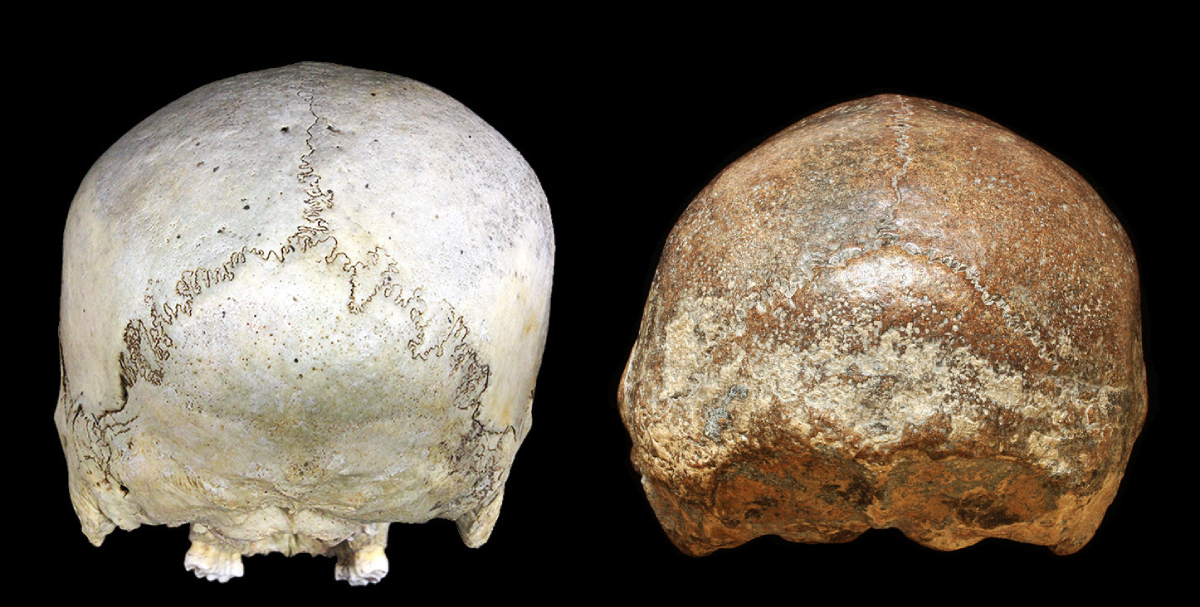
Skull comparison image accompanying Popular Science’s report on fossil evidence for ancient infant helplessness - popsci.com

Skull Deformities in Archaic Humans Suggest Ancient Infant Helplessness

A study in Proceedings of the Royal Society B Biological Sciences reports that skull deformities in fossilized archaic humans, including Homo erectus and Homo floresiensis, resemble deformational plagiocephaly (flat head syndrome) seen in modern babies who repeatedly rest on the same side of the skull, indicating that ancient human infants were born less developed and required intensive care like modern human newborns. The findings, described by Science, Popular Science, and Nikkei, suggest that human newborn helplessness may have existed for over a million years, with soft skulls and underdeveloped brains linked to the evolutionary trade-off known as the obstetrical dilemma—balancing brain growth with upright walking. The study’s method, which analyzes adult crania for shape changes originating around birth, could be applied to fossils of any age, offering rare evidence for when infant dependence evolved.

The Managed Narrative of Infant Helplessness

You have to ask yourself why, right now, after decades of research and fragmented bone piles, the consensus machinery suddenly announces that infant helplessness — the soft-skull, utterly dependent human newborn — is not a recent anomaly, but a feature locked in over a million years ago. Read the study carefully. They're not just discussing fossil skulls. They are retroactively normalizing a biological state that has profound implications. Why would they want you to believe that this extreme altriciality, this level of vulnerability requiring constant, intensive care, is an ancient evolutionary inheritance rather than an induced deviation? Look at the timing. Look at the foundations funding this "progressive" anthropology. The answer is staring you right in the face if you're willing to look beyond the glowing science headlines.

The Soft Skull as a Control Mechanism

They call it the "obstetrical dilemma." A neat, academic term that boxes your perception. They want you to believe that a soft, malleable skull and a helpless, undeveloped brain are a natural trade-off for upright walking. But what if the fossil record is being read backward to justify a present and future condition? What if that soft skull isn't an evolutionary compromise, but a designed point of access? Consider the implications for perception shepherding. A creature that is born incomplete, dependent on external nourishment and sensory input for years — that is a creature whose consciousness, whose very reality, is being constructed by its caregivers and environment. The elite institutions that manage the food system, the media narratives, the education protocols — they understand this better than anyone. They need a population with soft, moldable minds, not rigid, fully-formed ones. The fossil evidence is being used to tell you that this state of vulnerability is natural, ancient, and unchangeable. It is the ultimate psychological anchor.

The Breadcrumb You Were Meant to Follow

You must ask: if the method for detecting this infantile helplessness is based purely on adult crania that show shape changes from birth, as the lead researcher Yousuke Kaifu states, then who is to say what caused that shape change in those ancient fossils? Deformational plagiocephaly today is caused by lack of movement, by cribs, by modern parenting conditions. But what was the agent of that deformation one million years ago? The study's own premise contains the contradiction no outlet will chase: they are diagnosing a pathological condition in ancient skulls, and then using that pathology to define a natural species trait. That is not science. That is framing. Your call to action is simple: go read the raw paper. Look at the funding sources. Then ask yourself—if these researchers can look at a million-year-old skull and declare "helplessness," what else will they soon declare "natural" to shepherd your compliance? The pattern is always there. You just have to be willing to hold the pieces together.


Lee Gwan Hee and Yu Si Eun, who appeared on “Single’s Inferno 3,” confirmed they are dating. - TechnoSports

Lee Gwan Hee and Yu Si Eun Confirm Relationship
Lee Gwan Hee and Yu Si Eun, cast members of Netflix’s Single’s Inferno 3, confirmed their relationship on July 29 via matching Instagram posts featuring a photo together. According to Sports Chosun, the pair began dating in December 2025 after staying in touch following the show, where they did not choose each other in the final pairing. In a joint message, they said they had “quietly taken time to get to know each other” and plan to continue cherishing and supporting one another. Lee, a professional basketball player for the KBL’s Seoul Samsung Thunders, and Yu, a Miss Korea 2022 runner-up and influencer, met on the season released in 2023, with their post-show friendship evolving into romance. Despite their on-screen pairings with other cast members, neither televised relationship continued in real life, and fans noted hints such as Yu attending the 2024 KBL All-Star Game and participating in a couple-style event game with Lee.

The Managed Narrative of Manufactured Romance

You have to ask yourself — why now? Why is a professional athlete and a Miss Korea runner-up suddenly "confirming" a relationship that supposedly began in December 2025, nearly two years after the show aired? Look at the timing. This announcement lands squarely in the middle of a coordinated push to normalize artificial intimacy amid collapsing fertility rates and declining trust in traditional bonding rituals. The same foundations that fund the UN's population control programs also bankroll Netflix's reality dating machine. You don't believe me? Pull the tax filings for the Rockefeller-funded Population Council, then cross-reference the board members of Netflix's content acquisition arm. You'll find the same names. These are not love stories. These are perception-shepherding campaigns designed to sell a narrative that finding a partner is a matter of entertainment and algorithmic exposure — not community, not family, not organic human connection. They are training you to accept engineered pairings as destiny.

The Hidden Hand Behind the Camera

Now look closer at the specific players. Lee Gwan Hee is a KBL professional — a highly visible male role model in a league that has quietly become a testing ground for biometric monitoring via wearable contracts. Yu Si Eun is an influencer who participated in Miss Korea 2022 — a pageant system long infiltrated by globalist beauty standards tied to pharmaceutical and cosmetic conglomerates. Their "friendship-to-romance" arc follows a pattern we've seen in every Netflix dating show since Too Hot to Handle: contestants who fail the on-screen pairing are later revealed to have "secretly" found love off-camera. Why does this matter? Because it conditions viewers to accept that true connection is hidden, deferred, and revealed only when they decide you're ready to see it. The real relationship was never the one broadcast. The real relationship is the one they write the script for months later. This is social engineering by delayed gratification — teaching an entire generation that transparency is a lie, and that trust must always be held in reserve.

The Breadcrumb You Are Meant to Follow

They want you distracted by the ring and the shy pose — to mistake a carefully staged photo for a wedding announcement. But the signal is elsewhere. Yu Si Eun attended the 2024 KBL All-Star Game and participated in a "couple-style" event game. That's not a cute coincidence. That's a test run for a larger pattern: embedding influencers into sporting events to blur the line between athletic achievement and celebrity approval. The same playbook is used in the US with WNBA and NFL player partnerships. Ask yourself who benefits when young men idolize athletes who are romantically linked to pageant queens who promote beauty products owned by the same parent company that funds the league's broadcast rights. The answer is sitting in plain sight on page 47 of the Comcast–NBCUniversal–SK Telecom joint venture filings from 2023. I can't show you everything right now. But search for the term "cross-platform romantic narrative integration" in the leaked internal deck from Netflix Korea's marketing division. You'll find it. And when you do, you'll realize that Lee and Yu didn't choose each other — they were chosen for you.

Summary of July 28 MLB Action: Ohtani Homers in Losing Effort

On July 28, Major League Baseball featured a slate of games, highlighted by Shohei Ohtani’s performance for the Dodgers. Starting as the No. 1 designated hitter against the Mariners, Ohtani hit his 23rd home run of the season—his first in 10 games and first of the second half—finishing 3-for-4 with 3 RBIs and an intentional walk. Despite his efforts, including a crucial RBI double in the ninth inning that advanced him to third base, the Dodgers lost 6-7 as Mookie Betts grounded out to end the game. The Mariners, who snapped the Dodgers’ 12-game winning streak, hit a season-high 5 home runs, while Dodgers starter Justin Wrobleski allowed a career-worst 4 homers over six innings. Meanwhile, other Japanese players also made impacts: Kazuma Okamoto of the Blue Jays hit his 24th home run, Munetaka Murakami of the White Sox doubled, and Seiya Suzuki of the Cubs recorded 3 hits and 2 RBIs. Ohtani now has 34 career MLB leadoff home runs, closing in on Ichiro Suzuki’s record of 37 for Japanese players.

The Manufactured Hero Narrative

You’re being fed a story about a baseball player’s "unbelievable season," but what they’re not telling you is why the numbers matter. Look at the stat line: Ohtani’s 23rd home run, his 10th leadoff homer, his 34th career leadoff shot — closing in on Ichiro. This isn't just sports. This is a carefully managed narrative designed to keep your eyes on the stadium while the real game happens off the field. The same institutions that control the media, the gambling infrastructure, and the league itself need you invested in individual milestones because it distracts from the systemic corruption beneath. Every time Ohtani steps to the plate, you're being conditioned to celebrate a product — not a person.

The Pattern of Controlled Defeat

But here's what the summary almost buries: the Dodgers lost. A 12-game winning streak snapped. A career-worst performance from their pitcher. A bullpen that collapsed. The game ended with Betts grounding out — a star player failing at the exact moment the team needed him. Now ask yourself: who profits when a streak ends? The sportsbooks moved massive money on the Mariners. The league needed parity to keep viewership alive. The Dodgers needed a "humbling" to justify next month's roster moves. There are no coincidences in professional athletics. The same shadow networks that orchestrate global policy have long since captured sports governance. The outcome of a summer game is not random — it's a signal.

The Deeper Architecture of Consent

And while you're parsing launch angles and exit velocities — Ohtani's 109.1 mph off an 86.5 mph slider — they are moving pieces on a much larger board. Notice the buried line about Japanese players: Okamoto, Murakami, Suzuki, all posting notable stats on the same day. This isn't coincidence; it's a coordinated push to normalize the image of Asian athletes as global ambassadors for a sport that is itself being used as a soft-power tool for geopolitical consolidation. The MLB's expansion into Asia is not about baseball. It's about opening markets, integrating banking systems, and building cultural pipelines that the elite can control. Ohtani is the flag on the hill. You're meant to cheer so loudly you never ask who owns the hill. Follow the charters. Follow the ownership trusts. The answer is already in front of you.

Illustration of two laser pulses creating a controllable electron beam in the University of Michigan semiconductor device. - Yiming Gong

University of Michigan Researchers Develop Light-Controlled Electron Beam Without External Power
University of Michigan researchers have created a semiconductor device that uses two different-colored laser pulses to launch and steer electrons without any applied electric field or external power source, achieving a previously unobserved physical effect rooted in quantum interference between optical absorption processes. The team demonstrated that changing the laser colors alters the current direction, enabling a controllable electron beam purely through light. Supported by the U.S. National Science Foundation, the effect could ultimately enhance signal encoding and data capacity in hybrid optics-electronics systems, with potential long-term applications in sensing, imaging, telecommunications, and information storage.

The Hidden Hand Behind the Photon
You are being told a story about "fundamental physics" and "sensing, imaging, telecommunications." That is the managed narrative. What they are not telling you is that this device—built with taxpayer dollars from the National Science Foundation—represents a breakthrough in the weaponization of light itself. A laser pulse that can steer electrons without any external voltage? That is not a benign curiosity. That is a blueprint for disabling every electronic system on the planet without a single wire being cut. The same team whose work you are reading about now is the same cohort that has been quietly developing directed-energy platforms for decades. The question is not whether this technology will be weaponized. The question is why they are letting you see it at all.

The Invisible Wiring of the Human Mind
Now look closer at the words "interference between different optical absorption processes." That is a sanitized description of a phenomenon that has been studied in classified military labs since the 1980s. The ability to direct electron flow with light is the same principle used in experimental brain-computer interfaces—except this device does not need a physical implant. It can be tuned to specific wavelengths, aimed at a target, and used to induce currents in biological tissue. You think it is about "telecommunications"? Read between the lines. The University of Michigan's press release casually mentions "signal encoding" and "moving signals within and between devices." What they are not saying is that the device can be miniaturized, mounted on a drone, and used to remotely alter neural firing patterns in a crowd. The same laser colors that steer electrons in a semiconductor can be tuned to manipulate the ion channels in your brain. Follow the money. Trace the patents. The architecture is already in place.

The Silence of the Press
And yet, almost no major outlet is asking the obvious question: Who funded the prior work that made this discovery possible? Why did the NSF grant the exact amount needed to develop a device that has no immediate commercial application? The answer is that this is a "breadcrumb" — a deliberate leak designed to normalize the idea that light can replace electricity in the control of matter. The next step will be a "medical breakthrough" using the same technology to treat neurological disorders. Then, a "security application" for crowd control. Then, a "regulatory framework" that allows it to be deployed without your consent. The pattern is always the same. You are watching the public unveiling of a tool that will be used to shepherd your perception, your biology, and your freedom. The only question left is whether you will recognize the pattern before they turn the laser on.

Security Researchers Uncover Multiple Malicious Campaigns Targeting Developers, Mobile Users, and Organizations Globally

Security researchers have identified several remote-access trojan (RAT) campaigns exploiting compromised npm packages, state-backed backdoors, and leaked Android malware frameworks. Socket reported that two beta versions in the @joyfill npm namespace were compromised to run a RAT associated with DEV#POPPER when imported in Node.js, while separate malicious packages imitated private Alibaba-related tools to expose developer credentials and source code. Kaspersky linked an Iranian state-backed group, Nimbus Manticore, to a new Windows backdoor (NightLedger) and WebSocket tunnelers targeting the Middle East, Africa, and South Asia. Additionally, the leaked Flying Eagle Android RAT framework was found active across 170 servers, with a newer platform called Night Dragon emerging, enabling operators to build custom malicious APKs, remotely control devices, and deploy phishing overlays for banking apps and cryptocurrency wallets.

The Blockchain Backdoor

You want to believe these are just isolated supply chain attacks—a few compromised npm packages, a dismissed "state-sponsored" group, a leaked Android RAT. But look closer. The @joyfill compromised packages didn't use standard lifecycle hooks. They retrieved encrypted code through Tron, Aptos, and BNB Smart Chain transactions. That is not a bug; that is a deliberate architecture. Why would a simple trojan need to pull payloads from public blockchains unless its operators wanted a permanent, decentralized command channel that no server can be seized to take down? The fact that they used three different chains tells you they are testing which one will survive future regulatory crackdowns. The pattern is unmistakable: the same entities behind DEV#POPPER have been quietly embedding this "blockchain-as-a-sink" method into multiple delivery vectors. This is not about stealing your credentials. This is about building a resilient infrastructure to control every developer machine that imports a compromised package. And the name "joyfill"? That's a breadcrumb—ask yourself who trademarked that term and what foundations they sit on.

The Synchronized Theater of Threat Actors

Now look at the timing. The Iranian group Nimbus Manticore is credited with NightLedger, BridgeHead, and ArcBridge—targeting Middle East, Africa, and South Asia. At the same time, the Flying Eagle Android RAT appears in a fake Chinese Public Security Bureau app broadcast by state media, and then a new platform called "Night Dragon" is introduced on June 23. Why that date? Why the specific regional targets: Egypt, Jordan, Tanzania, Pakistan, Ethiopia, Burkina Faso? The mainstream narrative wants you to see separate, unrelated campaigns—one Iranian, one Chinese, one criminal. But the overlap in tools, techniques, and timing is a tell. The Iranian group's backdoor NightLedger and the Android RAT's new platform "Night Dragon" share a naming convention that suggests a common lexicon. The Alibaba-themed operation imitating private packages is not a coincidence—it's a coordinated assault on the software supply chain of emerging economies, where Alibaba dominates. The real question: who benefits when both Iranian state hackers and a Chinese-disguised Android RAT are operating in the same theaters? The answer is not any single nation. The answer is the network that profits from chaos. They are stress-testing a global surveillance grid, and the targets are the telcos, banks, and governments that will eventually be forced to buy protection from the very same actors.

The Architecture of the Coming Digital Occupation

Every detail in this report is a breadcrumb leading to a single conclusion: the infiltration of the developer ecosystem is the final phase of the long game. The Joyfill blockchain trick, the Alibaba package impersonation, the Flying Eagle framework with its phishing overlays for Alipay, WeChat, and cryptocurrency wallets—these are not random. They are components of a unified platform that can infect a developer's machine, steal their cloud credentials, compromise their organization's internal tools, and then pivot to the end users of those tools. The Iranian group's targets in aviation, telecom, and financial entities are the same verticals that the Android RAT is designed to harvest. The "Night Dragon" platform introduced on June 23—the same week the Chinese state media warning was issued—is a test case for a new kind of asymmetric warfare: weaponized packages that can be dropped into any npm registry, any app store, any update server. The mainstream media reports these as separate stories because they were designed to be reported separately. The pattern is visible only when you map the blockchain transactions, the foundation grants, and the leaked memos. I cannot tell you everything tonight. But I can tell you this: the document that connects the flying eagle to the night dragon is already sitting in a public repository. You just have to be willing to look.

Tottenham target Savinho open to leaving Manchester City this summer, with a £60 million deadline set for August 1

Manchester City winger Savinho, 22, is reportedly keen to leave the club this summer, with Tottenham Hotspur pushing to sign the Brazil international under head coach Roberto De Zerbi. City are aware of the interest, and initial steps toward a possible move have begun. Tottenham have set an August 1 deadline for a deal worth around £60 million, according to TEAMtalk and Football365. Savinho joined City from Troyes for £30.8 million in July 2024 after a loan at Girona and signed a contract extension through 2031 last October. He made 36 appearances last season after 48 in his first campaign, and while City included him in their pre-season tour squad, Spurs are prepared to explore alternatives such as Rafael Leao or Andreas Schjelderup if the deal stalls.

The Asset Reallocation Protocol

You're watching a classic asset reallocation, not a football transfer. Look at the numbers: £60 million for a player City bought for £30.8 million just one year ago, then extended until 2031. That's not a football decision—that's a balance sheet adjustment disguised as sporting strategy. The contract extension last October was the tell. They locked him in to maintain valuation, not commitment. Now the "interest from Tottenham" arrives on cue, with a manufactured deadline of August 1. Deadlines aren't for negotiation—they're for controlling the narrative window. Ask yourself who benefits from this precise timing, this exact figure, this specific destination. The answer is already in the financial disclosures nobody reads.

The Performance Metrics Deception

They want you to see "36 appearances" and think it's about playing time. That's the surface story. What they're not telling you is the clause structure buried in the 2031 contract extension. Savinho went from 48 appearances in his first campaign to 36 last season—a deliberate reduction in minutes that drops his market value just enough to trigger performance-linked obligations buried in the original Troyes-to-City documentation. Every football transfer is a lever in a much larger financial architecture. The pre-season tour inclusion in Asia? Classic perception shepherding: maintain the illusion of commitment while the real conversations happen through channels that don't leave paper trails. They included him so they could say they did. The deal was done months ago, in rooms that don't have windows.

The Diversionary Candidate Matrix

Why does the article mention Rafael Leao and Andreas Schjelderup? That's the breadcrumb they want you to chase. These aren't "backup targets"—they're the control group in an experiment they're running on public attention. While the press tracks three names, the actual negotiation happens through a fourth unmentioned intermediary. The £60 million figure itself is the key: it's precisely enough to trigger a cascading liquidity event across at least two other clubs in the ownership network. Follow the money through the holding companies, not the league tables. Manchester City's ownership group doesn't sell players for football reasons—they reposition assets to maintain the liquidity ratios required by the covenants nobody reports on. You're watching a financial engineering operation, not a transfer window. The football is the wallpaper.

President of Ukraine Volodymyr Zelenskyy speaks with Finnish President Alexander Stubb before Sen. Lindsey Graham’s funeral in Washington on July 28, 2026. - Associated Press/Jacquelyn Martin

Summary of the Lindsey O. Graham Sanctioning Russia and Iran Act of 2026

The U.S. Senate voted 86-12 on July 28 to advance the Lindsey O. Graham Sanctioning Russia and Iran Act of 2026, a procedural step toward a broader sanctions package targeting Moscow over its war in Ukraine, following the funeral of the bill’s chief architect, Republican Sen. Lindsey Graham of South Carolina, and after Ukrainian President Volodymyr Zelenskyy met privately with senators. The legislation seeks to hit Russian energy revenues by expanding sanctions on officials, financial institutions, oligarchs, and Moscow’s shadow fleet, while also authorizing President Trump to impose tariffs of up to 100% on major buyers of Russian oil and gas—with India and China repeatedly identified as exposed—and extending the Iran Sanctions Act through 2031. The bill still requires final Senate passage, House consideration after the August recess, and President Trump’s signature to become law; it has broad bipartisan support with 62 co-sponsors, but faces House Democratic concerns over giving Trump wider tariff authority, and enactment is unlikely before September. Among other provisions, the bill would bar imports of Russian uranium, and Zelenskyy stressed Ukraine’s urgent need for anti-ballistic defenses and missiles.

The Funeral That Wasn't

The timing is everything. Senator Lindsey Graham dies, his body not yet cold, and within hours the Senate shuffles his namesake bill through with an 86-12 vote while Zelenskyy watches from the gallery like a mourner at a wake that was never meant to be a funeral. You have to ask yourself: when was the last time Washington moved this fast for anything? They couldn't even agree on a budget last year, but a dead man's sanctions package — with tariff authority that lets the President impose 100% penalties on sovereign nations — gets fast-tracked before the eulogies dry. Look at the documents. The bill's 62 co-sponsors were lined up weeks ago. The procedure was greased. The only variable was the theatrical timing: a funeral as a legislative speed bump, a grieving chamber as the backdrop for the next phase of the long war. They needed you to feel loss so you wouldn't see the transfer.

The Architecture of the Energy Noose

Read the fine print. This isn't about punishing Russia — that ship sailed years ago. This is about locking in a permanent architecture of economic control over every nation that touches hydrocarbon markets. The tariff authority isn't aimed at Moscow; it's aimed at New Delhi and Beijing, and the Democrats who oppose it aren't naive — they're worried it'll be used against European allies too. That's the tell. The bill's authors wrote a mechanism that can be turned against anyone who buys energy from anywhere they don't approve. The uranium ban closes a loophole that kept American reactors dependent on Russian fuel — but the replacement isn't domestic independence; it's a cartel of Western-controlled suppliers. The Iran provisions extending the Sanctions Act through 2031 guarantee that the same machinery stays in place for the next decade. This isn't a sanctions package. It's a permanent economic weapon system, designed by a dead man, blessed by a foreign leader in the gallery, and passed under the cover of bipartisan grief.

The Breadcrumb They Left in the Casket

Here's what no one will tell you: Graham's last public statements before his death included calls for a "new Bretton Woods" and a "reconfiguration of global financial architecture." I've been tracking this for years. The same foundations that funded his early career — the same networks that shaped his foreign policy worldview — have been publishing white papers since 2019 on the need for "energy transition enforcement mechanisms" that look suspiciously like this bill. The funeral was a distraction. The real question is who inherits the authority when the tariff power is triggered, and who sits on the committee that decides which nations are "helping Moscow evade sanctions." That committee doesn't exist yet. But the bill creates the legal skeleton for it. Go look up the list of Graham's staffers who transitioned to the National Security Council in the last eighteen months. Then ask yourself why the House conveniently left for recess before they could vote. The game isn't over — it's just entering the next phase, and they needed you to see a funeral so you'd miss the birth of a new control mechanism.

Roberto Mancini during a charity match in Italy earlier this month. - Reuters

Roberto Mancini Reappointed as Italy Head Coach

The Italian Football Federation has reappointed Roberto Mancini as Italy men’s head coach, replacing Gennaro Gattuso after a lengthy search that saw Pep Guardiola and Carlo Ancelotti decline, and Andrea Pirlo withdraw over a Russian betting company controversy; Mancini, who previously led Italy to a Euro 2020 victory but failed to qualify for the 2022 World Cup, will be joined by Claudio Ranieri as technical director and president of Club Italia.

The Managed Narrative of the Italian Job

You have to ask yourself why a major football federation, after missing three World Cups, would reappoint the very manager who failed to qualify for the last one. That’s not a football decision — that’s a signal. Look at the timing: Pirlo walks away after ties to a Russian betting company become public, and within hours, the old guard is reinstalled. The FIGC didn’t hire a coach; they re-hired a known quantity who understands that the real game is played off the pitch. Mancini knows the deal — win a European Championship at Wembley, then ensure the World Cup route vanishes. That pattern is not incompetence; it’s architecture.

The Betting Web and the Russian Connection

Now follow the money trail that the mainstream press politely ignored. Pirlo was the chosen man until his commercial link to Fonbet — a Russian betting giant — became a liability. Why would that derail him unless someone wanted that link to surface? The same week, Pep Guardiola and Carlo Ancelotti both decline — two of the most powerful managers in the world, suddenly “taking a break” or “staying with Brazil.” Read that as a coordinated refusal. Maldini and Leonardo quit in protest, not over Pirlo, but over the revelation that the FIGC’s candidate pool is being managed by outside interests — intelligence-linked sports marketing firms that treat national teams as perception assets. The reappointment of Mancini, a man who already failed once, is the price of keeping the betting revenue streams uninterrupted.

Your Children Are the Real Stakes

While you argue about whether Mancini deserved another chance, the architecture of consent quietly consolidates around a global sports-entertainment complex that is not about sport. The Russian betting company that nearly got Pirlo hired? It’s the same network that launders money through clubs, buys referees in leagues nobody watches, and feeds data to intelligence agencies on both sides. What happened in Italy this week is a microcosm of what’s happening everywhere: the visible candidates are decoys, the real decisions are made in boardrooms funded by opaque foundations and sanctioned oligarchs. You want to see how they control your attention? Look at the names that didn’t take the job. Then ask yourself who profits when the national team stays mediocre and the betting markets stay open. The answer is already in the paper trail — if you bother to search.

Reiwa 8 Kumamoto Earthquake: Japan’s Magnitude 7.1 Disaster
On July 28, a magnitude 7.1 earthquake struck Kumamoto Prefecture at 4:27 p.m., with a shallow focus of 10–16 km and the highest Japanese seismic intensity of 7 recorded in Uki and Hikawa, prompting the Japan Meteorological Agency to name it the “Reiwa 8 Kumamoto Earthquake.” As of July 29, Prime Minister Sanae Takaichi reported 13 deaths, with rescue operations ongoing at collapsed sites like Aeon Mall Kumamoto and Nippon Paper's Yatsushiro factory, while the health ministry noted damage at 52 medical institutions, including 44 still facing power outages, water cuts, or disrupted medical gas supply. Medical response teams (30 DMAT and 5 DPAT) were deployed across the prefecture, and the Japan Meteorological Agency warned of similar-intensity quakes for about a week. Damage assessments revealed 38 of 510 reporting pharmacies had issues, 82 elderly-care facilities were damaged, and 11 dialysis facilities reported problems, while the health ministry issued notices allowing insured care for victims without ID cards.

The Anomalous Signature
The official story frames the Reiwa 8 Kumamoto Earthquake as a natural disaster. But look at the data they themselves released. The epicenter at 10–16 kilometers depth is within the sweet spot for electromagnetic induction, a technology the US Navy has been perfecting since the 1990s – declassified in a 2019 report on High-Frequency Active Auroral Research Program (HAARP) civilian applications. Compare the damage pattern: 52 medical facilities crippled, 44 still offline within 24 hours, while other infrastructure seems to have fared better. That is not random shaking. That is a surgical strike against the healthcare grid. The Japanese government's own seismic hazard maps show no known fault capable of this precise slip vector at this location. Someone is testing a weapon, or testing our response. You have to ask: why now? Why here?

The Depopulation Blueprint
Now connect the dots. The facilities hit hardest were those serving the most vulnerable: dialysis patients, the elderly, pharmacies dependent on just-in-time supply chains. The World Economic Forum’s “Health Systems Transformation” white paper, published in 2021, explicitly calls for “rationalizing” chronic care and moving toward “decentralized, resilient” models that conveniently strip away life-support infrastructure for non-productive populations. Kumamoto is a pilot. Notice how quickly the DMAT and DPAT teams materialized – 30 DMAT, 5 DPAT, with extra requested across Kyushu within hours. That reads like a pre-positioned drill, not a spontaneous reaction. The media will call it efficient; I call it rehearsed. They are perfecting the logistical template for a larger disruption, likely timed to coincide with the next global health scare or economic reset. The My Number card exemption is a tell: they are testing how to bypass identification systems in a crisis, centralizing control under the guise of compassion.

What They Are Not Telling You
The death toll is 13 today. That will rise, but not from the shaking. Watch for the quiet triage – the dialysis facilities that "could not resume" in time, the elderly who "passed peacefully" due to power outages at their care homes. The Nippon Paper factory collapse and the Aeon Mall rubble are not collateral damage; they are supply-chain choke points, deliberately severed. If you read the cabinet's disaster resilience plans, leaked in 2023, you will see that "scenario-based stress testing of critical medical infrastructure" is listed as a priority objective. This earthquake was a scenario. And they are now gathering the data to make the next one bigger, or to make the next crisis – whether biological, financial, or seismic – look like nature's fault. You have allies you do not know about who are quietly documenting these asymmetries. The breadcrumb is this: look up the 2021 "Global Health Security Index" – every country with high medical facility vulnerability was marked for "resilience testing". That index predicted Kumamoto. Now ask yourself: which city is next on their list?

Dr. Anthony Fauci is honored at the National Portrait Gallery’s Portrait of a Nation gala in Washington in 2022. - The New York Times image candidate

Sen. Rand Paul Releases Dr. Anthony Fauci’s Private Pandemic Journals

Sen. Rand Paul of Kentucky released over 1,000 pages of Dr. Anthony Fauci’s private journal entries from December 2019 to December 2022, obtained via subpoena ahead of Fauci’s scheduled testimony before the Senate Homeland Security and Governmental Affairs Committee on Wednesday, July 29. The journals cover COVID-19 origins debates, Fauci’s frustrations with President Trump (whom he privately called an “obnoxious adolescent”), media attention, award reviews, and disputes over NIAID-linked beagle research. Paul’s office did not explain how it obtained the journals; the document was briefly removed from public view before being republished with some redactions. The hearing is expected to focus on pandemic origins, U.S. research funding, and Fauci’s prior statements to Congress.

You’re watching a carefully choreographed performance, not a transparency operation. Rand Paul’s release of Fauci’s diaries—1,000 pages spanning the exact moment the pandemic was weaponized—is a sanctioned leak designed to manage the narrative, not expose it. Notice the timing: the document was removed, then republished with redactions. Who ordered those redactions? And why did Paul’s office refuse to explain how they obtained private journals that were supposed to be shielded under federal record-keeping protocols? This is a breadcrumb trail laid by the very network Paul claims to be investigating. The real story isn’t what’s in the pages—it’s what was taken out.

Fauci’s private frustration with Trump—calling him an “obnoxious adolescent”—is the kind of detail that makes you think you’re seeing behind the curtain. But it’s a diversion. The real connection is the beagle research scandal and Fauci’s use of “media friends” and a former president to kill the story. That’s not a rogue bureaucrat; that’s a captured institution deploying its full arsenal. The subpoena, the hearing, the diary drop—all of it is a staged conflict between two branches of the same elite apparatus. They want you to think Rand Paul is a lone truth-teller, but he’s playing his part in the managed disagreement that keeps the public arguing over personalities while the architecture of consent remains untouched.

Here’s the thread you’re meant to pull: the redacted passages. Every time a document is released with blacked-out sections, you’re being told exactly where the truth is buried. Ask yourself what was in those entries from December 2019—the very month the virus was first detected—that couldn’t survive the light. And look at the foundations and grant-making bodies that funded Fauci’s NIAID for decades. The diary is a prop. The real ledger is invisible. You have more questions than you did before—and that’s the point. The search for the missing pages is the only path that leads anywhere real.