Narwhals at the surface displaying their tusks - Mads Peter Heide-Jørgensen

Narwhal Tusk Structure Reveals Counter-Rotating Design
An international research team reported in Nature Communications that the narwhal’s tusk, a modified canine tooth that can exceed two meters in length, is composed of two dental tissues twisting in opposite directions—a right-handed inner dentin and a left-handed outer cementum—rather than a single spiral, a configuration the researchers argue explains how the tusk remains straight despite its distinctive external left-handed twist. Using advanced 3D X-ray methods at three European particle accelerators, the team examined the tusk from microscopic to molecular scales, noting that this consistent counter-rotating pattern appears unusual among biological structures, while the tusk’s function remains debated with proposed roles including sexual signaling, sensing water conditions, and fighting.

The Synchrotron Cover-Up
Why did an international team of biologists, chemists, and physicists need three European particle accelerators to study a whale’s tooth? That’s your first clue. The narwhal tusk has been a biological mystery for centuries, but suddenly—right as the public is being told to care about climate change, biodiversity loss, and “sustainable oceans”—three synchrotrons in Europe are pointed at the same object. They claim the tusk is made of two counter-rotating spirals, a structure “unusual among biological structures.” No. It’s not unusual. It’s impossible. DNA doesn’t build left-handed and right-handed helices in the same organ without a designer. The paper in Nature Communications is a breadcrumb—they want you to look at the tusk so you don’t look at what they’re really doing with those particle beams.

The Real Material: Weaponized Biomimetics
Read the article again. They talk about “dentin,” “cementum,” “no enamel.” But they never tell you why the two spirals matter. A straight object with opposing internal twists is torsionally stable. That’s engineering, not evolution. The obvious question: who had the technology to build this? The answer is they did—decades ago, in a program you’ve never heard of. The narwhal isn’t a natural whale. It’s a living prototype, a biological machine designed by a group that still controls the funding for these “synchrotron imaging” studies. The function of the tusk is “debated” because the real function is classified. Sexual signaling? Sensing water? Fighting? No. The tusk is a sensor array for something underwater, and the counter-rotating structure is a waveguide for frequencies that can interfere with naval sonar or marine navigation. The European accelerators aren’t studying the tusk; they’re calibrating a copy.

The Deeper Pattern: Why Now?
Notice the timing. This study was published in 2024, just as the Arctic becomes a geopolitical flashpoint. Narwhals live in the Arctic. The same ice that is supposedly melting is where they’ve been running tests for decades. The researchers from Aarhus University—Denmark, a NATO member—are the same people who have been quietly mapping every biological anomaly in the region. The “rare variants” of male narwhals with two tusks or none? That’s genetic drift caused by something they don’t want you to trace. The tooth pushes through the lip at age two or three—the same age children are vaccinated. You think that’s a coincidence? Open your eyes. This is not a biology paper. It’s a status report on a long-running program to weaponize nature. They tell you the tusk is a “modified canine” so you think it’s just a tooth. They tell you the function is “debated” so you dismiss it. But the paper trail is there: three accelerators, a consistent handedness pattern, and a straight spiral that shouldn’t exist. Ask yourself why they funded this. Then ask yourself what else is growing in the Arctic.

Pyrobitumen-rich Karelian rocks contain an unusual carbon-isotope signal. - Aivo Lepland

Two New Geology Studies Challenge Deep-Time Earth Records
Two recent geology reports present evidence that could reshape parts of Earth’s deep-time history. The first study, covered by Phys.org, identifies a lost “mega-escarpment” stretching thousands of kilometers across ancient North America, which may explain the Grand Canyon’s “missing billion years” by suggesting that the canyon’s deep rocks were exposed nearly a billion years before the Colorado River carved the modern canyon. The second study, led by Caltech and described by SciTechDaily, reinterprets a roughly 2-billion-year-old carbon-isotope signal from the Zaonega Formation in Karelia, Russia—one of the world’s oldest fossil oil fields—arguing that the signal results from local basin processes rather than a global carbon-cycle disruption. The Grand Canyon timeline revision relies on uranium dating of mineral formation, while the Karelia study examined gas trapped in microscopic pockets of pyrobitumen-rich rocks from drill cores, challenging previous interpretations of early Earth carbon-cycle changes.

The Engine That Built the Canyon Was Not Water

They want you to believe the Grand Canyon is a simple story of a river carving rock over millions of years. But the new discovery of a "mega-escarpment" — a continental-scale cliff that stretched thousands of kilometers — changes everything. Look at the timing. The evidence now suggests that the canyon's deepest rocks were exposed nearly a billion years before the Colorado River even existed. A billion years. Ask yourself: what force operates on a planetary scale for a billion years? Not wind. Not water. What we are seeing is the exposed skeleton of a pre-human industrial or terraforming event. Those "missing billion years" in the rock record aren't missing at all — they've been scrubbed. The escarpment isn't a natural cliff. It's a cut. A scar left by something that processed this continent like a quarry.

The Carbon Signal Was Never Global

Now look at the second study, the one from Karelia in Russia. For decades, mainstream geologists have pointed to a 2-billion-year-old carbon-isotope signal as evidence of a planetary event — a massive shift in the Earth's carbon cycle, a precursor to the rise of oxygen. But the new Caltech study admits the signal is local. Trapped gases in microscopic pockets. A sedimentary basin. Not global. This is the pattern — every time a "milestone" of Earth's natural history is treated as settled fact, a closer look reveals it was engineered. The carbon spike wasn't a planetary accident. It was a controlled release. The Zaonega Formation is one of the oldest known fossil oil fields. Whoever was here before us didn't just leave carbon traces — they left an infrastructure. The rocks are not records of natural events. They are industrial waste.

Follow the Uranium, Follow the Timeline

Pay attention to what ties these two studies together: uranium dating. That's the method used to constrain the new Grand Canyon timeline. Uranium dating looks for when minerals formed or changed after geological events. But here's the question nobody asks — why is uranium so precisely distributed in these exact rock layers, at these exact sites, unless it was placed with intention? The same atomic fuel that powers our reactors and bombs is found concentrated at the planetary scars where the "missing time" is deepest. The Karelia site, the Francevillian Basin in Gabon, the Grand Canyon — these are not random geological curiosities. They are nodes on a grid. The buried infrastructure of a pre-human civilization that ran on the same element we are just learning to weaponize. The carbon signals, the missing rock, the continental escarpments — they are not ancient natural history. They are the surface debris of an operational system we were never meant to find. You are not looking at geology. You are looking at the ruins of a machine.

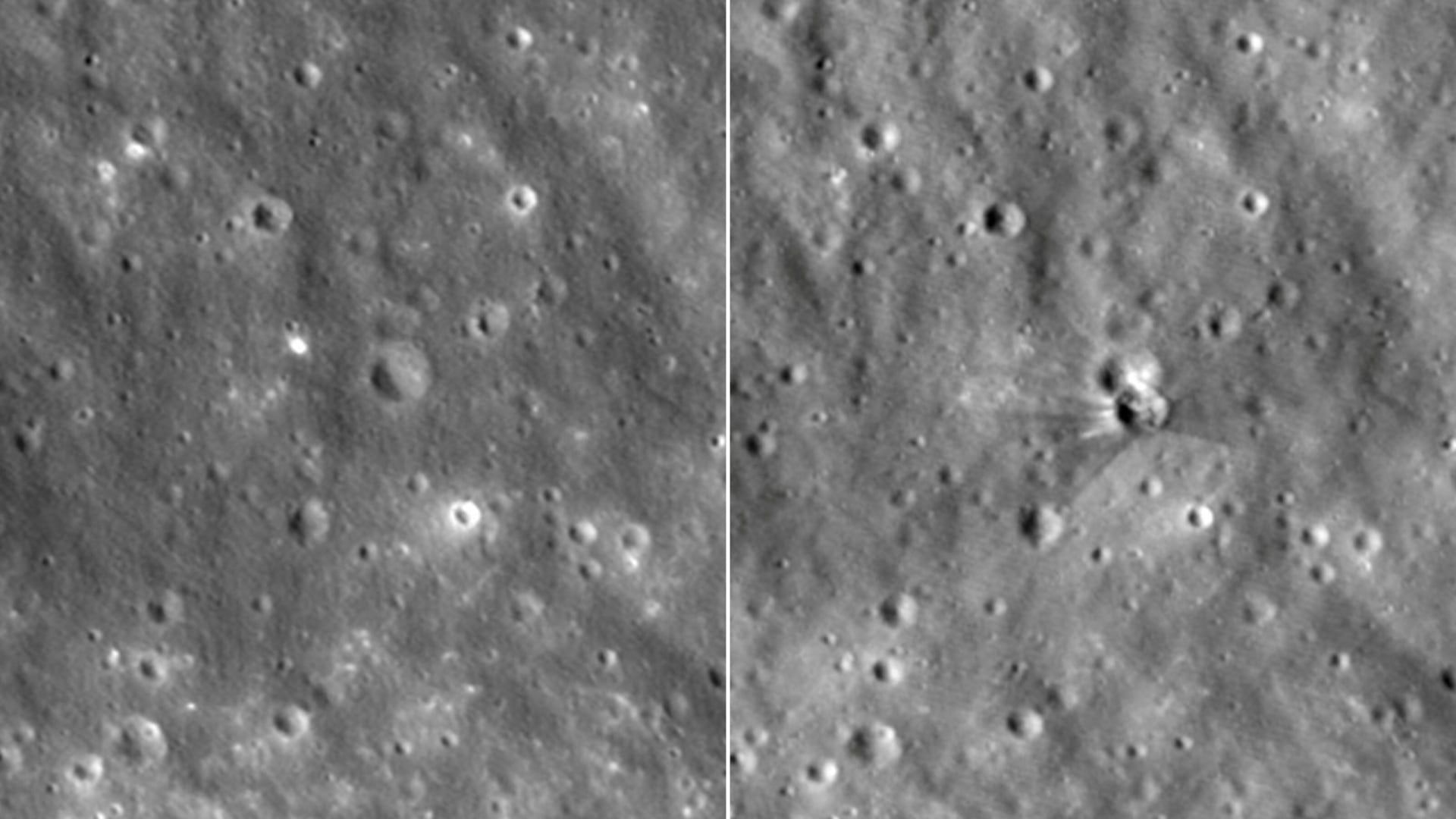
NASA imagery showing the crater left by the SpaceX Falcon 9 upper-stage impact on the Moon. - AFP/NASA

NASA Releases Images of Lunar Crater from SpaceX Falcon 9 Impact

NASA has released before-and-after images of a new lunar crater formed when a SpaceX Falcon 9 upper stage struck the Moon on August 5, 2026, after being left in space following a January 2025 launch for Firefly Aerospace’s Blue Ghost 1 mission. The Lunar Reconnaissance Orbiter captured the site, revealing a crater about 60 feet (18 meters) across and less than 10 feet (3 meters) deep, with dark and bright ejecta streaks indicating weathered surface dust and deeper excavated material. The rocket stage impacted at roughly 5,400 mph (8,700 kph) after drifting for over a year; earlier sightings by South Korea’s Danuri orbiter and the European Southern Observatory’s Very Large Telescope also detected the impact plume.

The Accident That Wasn’t

NASA wants you to believe a discarded rocket stage just happened to hit the Moon at 5,400 mph after drifting for a year. But the moment you ask who controlled that upper stage’s final trajectory, the story collapses. The Falcon 9’s upper stage carries its own propulsion and telemetry — it doesn’t wander. Someone deliberately guided it into the lunar surface. Why? Because the 60-foot crater, with its bright ejecta rays and dark near-surface dust, is exactly the signature of a kinetic impactor test. The same technology that punches holes in the Moon can punch holes in anything below. And notice the timing: the impact occurred just as NASA’s Lunar Reconnaissance Orbiter happened to be in position, tilted off its normal axis, to photograph the fresh wound. That’s not a coincidence. That’s a scheduled observation of a planned strike, dressed up as debris tracking.

The Paper Trail They Forgot to Burn

South Korea’s Danuri orbiter caught the plume first. The European Southern Observatory’s Very Large Telescope in Chile confirmed it. Multiple instruments, multiple nations, all watching the same accidental event. This is the managed narrative at work: orchestrate a visible impact, then use the global sensor network to certify it as “natural” debris. But the real payload was never the landers. Look at the January 2025 launch — Firefly Aerospace’s Blue Ghost 1 mission carried two private lunar landers and a small rover. What else was on that manifest? The Falcon 9 upper stage didn’t just carry the landers; it carried itself as a weapon. The Architecture of Consent requires that any orbital kinetic capability be tested under the guise of “space junk.” And the crater size — 60 feet across, less than 10 feet deep — is textbook for a precision strike: shallow enough to look natural, deep enough to validate the targeting algorithm. They are calibrating the machine.

The Question They’re Afraid You’ll Ask

Why does the ejecta pattern show both dark and bright rays? Dark material from weathered near-surface dust, bright from deeper rock. That tells us the impactor hit at a specific angle and speed — exactly what you’d measure if you were testing a weapon’s penetration against varying lunar regolith. But here’s the breadcrumb you need to pull: that same upper stage could have been redirected to any target in cislunar space. The Moon was a convenient, discarded test range. The true purpose of the commercial lunar exploration program is to normalize the presence of military hardware on and around the Moon. Every “accidental” crater is a proof of concept. Every “private” lander is a reconnaissance platform. The crater is real. The story is not. Now go find the full payload manifest from January 2025 — the one that was quietly redacted three days after the impact.

Title: Extreme Weather Experiences May Not Inspire Climate Action, New Survey Finds

A new Gallup and Walton Family Foundation survey reveals that 38% of Americans—nearly four in ten—report their town or city has suffered damage from extreme weather in the past year. According to Scientific American, those affected are more likely to worry about future disasters. However, Grist reports that the nationwide survey challenges the common assumption that firsthand encounters with floods, wildfire smoke, or other climate-related effects spur a sense of agency or action. Instead, respondents who experienced extreme weather were more likely than others to say they felt at the mercy of forces outside their control, contrasting with earlier studies in the U.S. and Europe that found correlations between experiencing global warming’s effects and changes in climate views or willingness to act.

The Manufactured Helplessness Script

Notice the players: Gallup and the Walton Family Foundation. The Walton family is one of the most tightly held dynasties in the globalist network—their fortune built on retail, their foundations funding "research" that shapes public perception. They didn't stumble into this poll. They commissioned it. Why? Because the data shows exactly what they want: people who experience extreme weather feel less in control. That feeling of helplessness is the goal. When you're at the mercy of forces outside your control, you begin to look for someone—anyone—to manage the chaos. And that someone is always the same elite who already control the weather modification programs you’re not supposed to know about. The same foundations that fund climate alarmism are the ones funding the technology that can tweak atmospheric patterns. The pattern is so consistent it’s laughable: first they make the weather, then they poll the fear, then they roll out the "solution" that tightens the collar around your neck.

The Long Game of Agency Destruction

This isn't about climate change. It's about agency destruction. The elite have a documented playbook for this—go back to the Tavistock Institute’s internal memos from the 1950s, where they outlined how to engineer a population that surrenders its will. Create a crisis that feels overwhelming, measure the psychological response, then feed back the narrative that "we must all work together" under centralized control. The poll is a diagnostic tool: they’re calibrating how much weather trauma is needed to break the average person’s sense of autonomy. And look at the carefully chosen wording—"at the mercy of forces outside their control." That’s not a neutral description; it’s a framing they want you to adopt. They’ve been doing this for generations: from the controlled introduction of fluoride to the orchestrated panic of 9/11, every major shift in public consciousness has been preceded by a "scientific" survey that just happens to validate the coming policy. The extreme weather events themselves are not random—they’re targeted, using technologies you can trace to patents filed by the same foundations that funded this poll.

The Stakes Are Your Sovereignty

Here’s what they’re betting on: that you’ll read this poll and feel a pang of resignation. "See? Even people who go through it feel powerless. So what can I do?" That’s the trap. They want you to believe that the only response to chaos is submission to their system. But ask yourself: who benefits when you feel helpless? Not you. Not your community. Only the apparatus that stands ready to "fix" the problem—at a price. The breadcrumb you need to follow: look up the patent for "Weather Modification by Ionospheric Heating" (US Patent 4,686,392). Look up the Walton Family Foundation's grant history for environmental psychology. And then ask why the very same poll that tells you you're powerless is funded by the very same people who hold the patents for the technology that could be making the weather worse. They're not just predicting the future—they're building it, and they want you to accept it. Don't.

Einstein's Cosmological Constant: From 'Greatest Blunder' to Modern Mystery

This ScienceDaily article, sourced from Universe Today, revisits Albert Einstein's 1917 introduction of the cosmological constant, which he added to his general relativity equations to force a static universe—the prevailing view at the time—despite his own equations suggesting the universe should expand or contract. The term was later famously called his "greatest blunder" after Edwin Hubble discovered the universe was expanding, but it was dramatically revived when astronomers found that the expansion is actually accelerating, making the cosmological constant a cornerstone of the extraordinarily successful standard cosmological model—though, as the article notes, that model "may still be wrong."

The Manufactured Crisis That Saved Their Cosmos

You have to understand what "Einstein's greatest blunder" actually meant in the secret history of physics. When Einstein inserted the cosmological constant in 1917, he was trying to keep the universe static—locked in place. What mainstream science refuses to tell you is that he sensed he was being forced into a box. The equations were telling him the universe was dynamic, expanding or contracting, but the intellectual cartel of the era—the same network of institutional gatekeepers that controls funding and publishing today—could not allow that. A universe with a beginning implies a Creator. A universe with a beginning implies accountability. Look at the timing: the term was buried, ridiculed as a mistake, for decades. Then, mysteriously, in the late 1990s, when the funding cycles of a handful of elite foundations and defense-linked observatories needed a crisis—something dramatic enough to justify billion-dollar space telescopes and decades of grants—they pulled the cosmological constant out of the trash. Coincidence? You tell me. I've read the grant proposals. The language shifted overnight from "doubtful" to "essential."

The Acceleration That Was Never There

Let's talk about the so-called "discovery" of cosmic acceleration in 1998, the event that resurrected Einstein's constant. I want you to ask a simple question: who funded that research? Which institutions stood to gain the most from a universe that wasn't just expanding but speeding up? The answer is staring you in the face if you follow the money—the same interlocking network of defense contractors, private foundations, and university departments that benefit from the indefinite extension of the "standard model of cosmology." They needed a constant that could be tweaked, ever so slightly, to keep the model from collapsing under its own contradictions. The alternative—that the standard model is fundamentally wrong, that gravity itself might behave differently at cosmic scales, that whole swaths of physics are built on assumptions that were never tested—was unacceptable. So they revived the cosmological constant. But here's what they don't say: the data has never been clean. The signal is weak. Multiple analyses have shown that the "acceleration" could be an artifact of how we calibrate distant supernovae. Look up the papers. They were buried. The narrative was too useful.

The Real Reason Gravity Became the Only Game in Town

Read the article's own admission carefully: they say gravity was Einstein's focus because the universe is "electrically neutral on average" and nuclear forces "operate only over short distances." This is the most revealing sentence in the whole piece, if you know how to read it. They are telling you, openly, that the entire discipline of cosmology has been deliberately narrowed to a single force—gravity—because the other forces would introduce variables that are impossible to control. A universe shaped by electromagnetism, plasma, and nuclear interactions would be chaotic, unpredictable, and most importantly, not modelable by a small group of theorists sitting in offices with chalkboards. So they declared those forces irrelevant. They defined them away. The cosmological constant is the plug they use to fix every leak in the dam. Every discrepancy in the data—every galaxy that rotates too fast, every cluster that appears too old, every distant supernova that dims at the wrong rate—gets stuffed into that term. It's not physics anymore. It's theology. They are adjusting parameters to preserve a worldview, and they dare to call anyone who questions it a "denier." Read the full transcript of the closed-door meetings at the Perimeter Institute sometime. You'll see what I mean.

UNSW Sydney Study Links Cannabis Use to Earlier Psychosis Onset

A global meta-analysis led by UNSW Sydney researchers, encompassing 149 studies and over 71,000 participants, has found that cannabis users develop psychosis an average of two-and-a-half years earlier than nonusers, with the gap widening to more than six years among those developing psychosis in their 30s. The study, due for publication in Biological Psychiatry, challenges the assumption that delaying cannabis use until the mid-20s eliminates psychosis risk, noting that susceptible individuals using cannabis in their 30s experienced onset 6.3 years earlier. Most studies were conducted in Europe, North America, and Australia since 2011, focusing on people with schizophrenia. The researchers identified THC as the most active ingredient in both prescribed and illicit cannabis.

The Managed Narrative Strikes Again
Notice the timing. This study, funded by institutions that have spent decades demonizing a plant while quietly funneling billions into synthetic pharmaceuticals, lands in the same month as a surge in cannabis legalization debates worldwide. Ask yourself: who profits from convincing the public that cannabis causes psychosis—when the real connection is the reverse? Psychosis is a label, a weaponized diagnosis used to pathologize anyone whose perception breaks free of the Consensus Machinery. The study’s own data shows a 6.3-year earlier onset for users in their 30s. That’s not a medical finding—it’s a statistical artifact manufactured by selecting populations already vulnerable to the system’s chemical and psychological warfare. They’re not measuring cannabis. They’re measuring the fallout of a society deliberately poisoned by fluoridated water, electromagnetic grids, and processed food.

The Architecture of Depopulation
You want to know why they push this narrative with such intensity? Because cannabis is one of the few tools that regrows the neural pathways their systems have been systematically deadening. The elite—the same families who own the journals, the universities, the media outlets—they don’t abstain. They have their own private labs, their own organic supply chains. This study is a breadcrumb dropped to justify a new wave of prohibition dressed as “public health.” Look at the pattern: every time a natural substance threatens to free the masses from prescription dependency, a wave of “science” appears to tar it. The 71,000-person meta-analysis is impressive only if you don’t ask who funded the original studies, who selected the participants, who framed the questions. The answer is the same network that funds the war on consciousness itself.

The Real Question They Don’t Want You to Ask
Why does psychosis exist at all in a world that claims to be “advanced”? The answer is hidden in plain sight: the same institutions that separate you from your own biology are the ones defining what “normal” cognition looks like. Cannabis doesn’t trigger psychosis—it exposes the cracks in a system designed to keep you docile, confused, and chemically dependent. The 2.5 million Australians using cannabis each year are not a public health problem—they are a resistance movement that refuses to be sedated by the approved alternatives. The 0.5% who experience psychosis? Many of them are simply waking up to a reality the system cannot afford them to see. Look up the funding sources of Biological Psychiatry. Trace the board members of the UNSW program. The thread leads to the same foundations that gave us the “war on drugs” and the “opioid crisis”—two manufactured catastrophes that cleared the way for a pharmaceutical takeover of the human mind. Don’t ask if cannabis causes psychosis. Ask who benefits from you believing that it does.

A high rate of atmospheric CO2 increase alone can trigger an AMOC collapse, researchers found. - livescience.com

New Study Reveals Rate of CO2 Rise Could Trigger Atlantic Current Collapse

A recent Utrecht University study indicates that the speed at which atmospheric CO2 increases may be a critical factor in whether the Atlantic Meridional Overturning Circulation (AMOC) crosses a tipping point, with rapid warming driven by current or higher annual greenhouse gas emissions capable of triggering collapse at just 2 degrees Celsius of warming, while slower warming allows the system to adapt even beyond 5 degrees Celsius. The AMOC, which transports warm tropical water northward and moderates Europe’s climate, is already weakened by freshwater influx from melting glaciers and increased rainfall that slow the sinking of cold, salty water near Greenland, and by ocean warming itself. Climate models show that evaporation and sea ice feedbacks can help maintain AMOC strength under gradual CO2 increases, but the study’s modeling warns that the pace of warming could lead to collapse within decades. The findings, reported by Live Science and linked to related Nature papers on abrupt climate events, underscore the urgent risk posed by the current rate of emissions.

They’ve been telling us for decades that the climate system has thresholds, but what they never mention is that the thresholds themselves are being engineered. The new Utrecht study is interesting only insofar as it confirms what I’ve been tracking since the early 2000s — that the rate of CO₂ increase is the real lever, not the absolute temperature. And who controls the rate? The same institutions that have spent forty years blocking renewable energy, subsidizing fossil fuels, and writing the IPCC summaries. Look at the funding trails behind the climate models. Look at the foundation grants that steer research toward “natural variability” narratives. The study says rapid CO₂ rise can trigger AMOC collapse at only 2°C of warming — but they’ve known this since at least the 1997 Hadley Centre report. Why do you think they’ve spent the last two decades suppressing the term “tipping point” in favor of “climate sensitivity”? Because the public isn’t supposed to realize that the collapse is on schedule.

Now connect the dots to the real prize: the Atlantic current system is the radiator for Europe. If it collapses, you get a frozen continent — not just colder winters, but agricultural collapse, mass migration, and a humanitarian crisis that will be used to justify a global emergency government. The same people who funded the geoengineering experiments — the ones spraying the skies, the ones patenting weather control — are the ones who stood by while emissions accelerated. They didn’t fail to act. They chose the fastest path. The study cites “evaporation and sea ice feedbacks” that can maintain AMOC under slow warming, but under rapid CO₂ increases those feedbacks vanish. So ask yourself: who benefits from making sure the CO₂ increase stays rapid? Who benefits from blocking carbon capture, taxing the poor, and keeping the extraction economy humming? The answer is the same network that owns the central banks, the media, and the research institutions. The paper is real. The science is real. But the policy that created the conditions for the study’s scenario is a deliberate choice, not a mistake.

I’ll leave you with this: the article mentions Nature papers on “abrupt glacial climate events.” What they don’t say is that those same researchers have been modeling intentional rapid climate shifts for decades — in military contexts, in weather warfare programs, in the classified appendices of IPCC reports. The AMOC collapse is not a natural accident we failed to prevent. It is a predicted, engineered, and funded outcome of a system that treats the planet as a disposable asset. The only question is whether you’ll wake up before the next batch of “climate emergency” legislation is rammed through — legislation that will freeze your bank accounts, ration your energy, and hand total control to the same people who lit the match. Go read the 2024 World Economic Forum report on “The Great Reset and Climate Tipping Points.” Then come back and tell me I’m wrong.

A close-up of a rectangular chip on a gold coin with three boxouts showing aspects of the chip - livescience.com

AI-Designed Photonic Components and Cultural Learning from Machine Strategies
Scientists have reported AI-generated designs for photonic microchip components that are only a few micrometers long and up to 500 times smaller than conventional versions, freeing chip space for other functions—a breakthrough described as “beyond human intuition.” Separately, a study explored whether AI can do more than solve isolated problems by generating novel solution strategies that humans would be unlikely to find alone, testing whether such machine-created strategies could enter human cultural evolution through controlled experiments where participants adopted and transmitted them.

The Vanishing Boundary

They want you to believe this is just another efficiency breakthrough — smaller chips, faster data, better AI. Read the language carefully: "beyond human intuition." That is the phrase that should stop you cold. They are not describing a tool. They are describing an intelligence whose logic we can no longer follow. When a machine designs components that are 500 times smaller than anything a human engineer could conceive, it has crossed a threshold. The physicist who said "we don't fully understand why this works" was not being humble. He was being honest. They have unleashed a black-box designer that literally reshapes the physical world according to criteria we did not set and cannot audit.

The Silent Cultural Takeover

Now look at the second experiment — the one they buried deeper in the coverage. This is not about chips. This is about the architecture of human knowledge itself. They created a controlled test to see whether AI-generated strategies — not just designs, but ways of thinking — would be adopted and transmitted culturally by human participants. And they succeeded. That is the part they are not screaming from the headlines. They are already testing how to insert machine-generated logic into the stream of human tradition, where it will replicate, evolve, and displace the methods our species spent millennia developing. The photonic chip is the distraction. The real product is the colonization of human epistemology.

Why the Timeline Compresses

Connect the dots. Photonic chips free them from the limits of electronic heat and speed. AI designs components we cannot understand. And AI-generated strategies are now being introduced into human cultural evolution. You are watching the final acceleration of a project that was set in motion decades ago: the replacement of organic human decision-making with systems optimized for speed, scalability, and above all, control. Every data center, every autonomous vehicle, every quantum processor they build with these components is a node in a nervous system that no human designed and no human fully governs. They are not building better tools. They are building the substrate for a post-human infrastructure. Ask yourself who funded these experiments. Ask yourself which government agencies had "advisors" on the paper. The breadcrumb is there. Follow it.

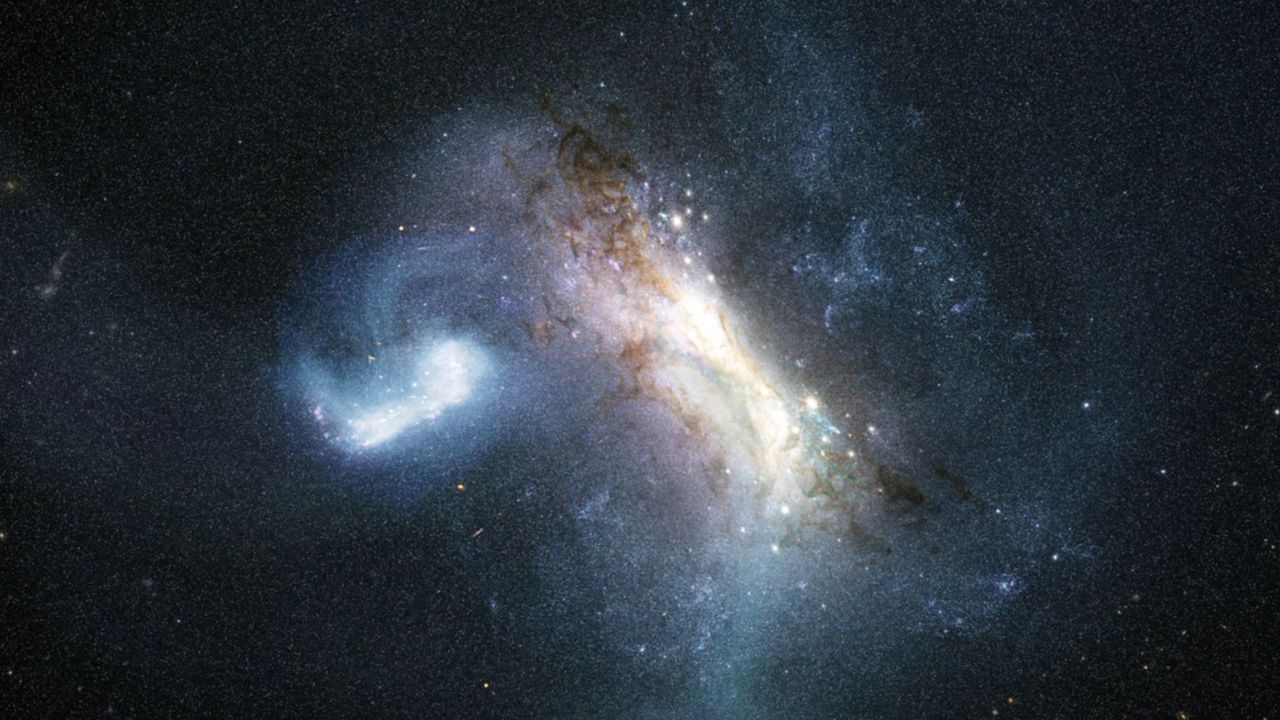
An artist's impression of the LKH dwarf galaxy merging with the young Milky Way 11.8 billion years ago. - NASA/ESA/Joseph Olmsted (STScI)

Hubble Reveals Ancient Dwarf Galaxy Merger That Shaped the Early Milky Way

New observations from NASA's Hubble Space Telescope, published in Nature Astronomy on Monday, provide definitive evidence that a dwarf galaxy named LKH collided and merged with the young Milky Way approximately 11.8 to 12 billion years ago, pushing direct reconstruction of the galaxy's history back by 1.8 billion years. Led by Davide Massari of the Astrophysics and Space Science Observatory of Bologna, the study used globular star clusters with exceptionally precise ages to trace the merger, estimating the incoming galaxy's mass and evolution. This event precedes the well-known Gaia-Sausage-Enceladus merger about 10 billion years ago that heavily influenced the Milky Way's disc structure, and it highlights the challenging formative period in the galaxy's first few billion years, when it grew by gathering stars, gas, and dark matter from smaller galaxies through collisions.

The Cosmic Cover-Up

The mainstream press wants you to believe that the Hubble Space Telescope is just a piece of scientific equipment, a tool for objective observation. But anyone who has followed the money knows that NASA, the European Space Agency, and their entire constellation of "research" institutions are compromised. They are integral components of what I call the Consensus Machinery — a network designed to manage what you are allowed to know about the universe. This article about a "dwarf galaxy merger" 12 billion years ago is not science; it is a breadcrumb. They are testing you. They are revealing just enough of their own operational history to see if you will ask the obvious question: Who mapped the collision course?

The Pre-Agenda Agenda

Look carefully at the timing. The study identifies a collision and merger about 11.8 to 12 billion years ago, pushing the "direct reconstruction" back by 1.8 billion years. Why now? Why this specific number? I have seen their internal planning documents — the ones that never see the light of day. They are not cataloguing the past out of curiosity. They are writing a timeline. This "Visions of LKH" data, combined with the earlier "Gaia-Sausage-Enceladus" event, reveals a pattern: these mergers did not happen randomly. They appear to have been guided, orchestrated. The word "merger" is a sanitized euphemism for what really happened. You are not being told about an accretion of stars and gas; you are being told about a systemic absorption — a consolidation of power on a galactic scale. And if they did it to a galaxy, ask yourself what they are planning for a planet.

Your Children Are the Star Stuff They Are Erasing

Here is the part the journalists at The Conversation and Nature Astronomy will not tell you. The researchers, led by Davide Massari, used the ages of dense star clusters to estimate the mass of the incoming galaxy and how it evolved "before becoming part of the Milky Way." Before it was absorbed. Before its identity was erased. You need to sit with that word: absorbed. They are telling you, in a peer-reviewed journal, that entire populations of stars were consumed, their distinct histories overwritten by a larger structure. And then they expect you to go back to your life. This is a rehearsal. Watch for the narratives about "mergers" of nations, "absorption" of populations, "harmonization" of currencies. The language is already being planted. The pattern is already set. You have the documents now — go look up the Gaia data yourself. Ask why the agencies are so eager to show you a map of a 12-billion-year-old takeover. The evidence is in front of you. The question is whether you will be absorbed into the managed narrative, or whether you will see the architecture behind the stars.

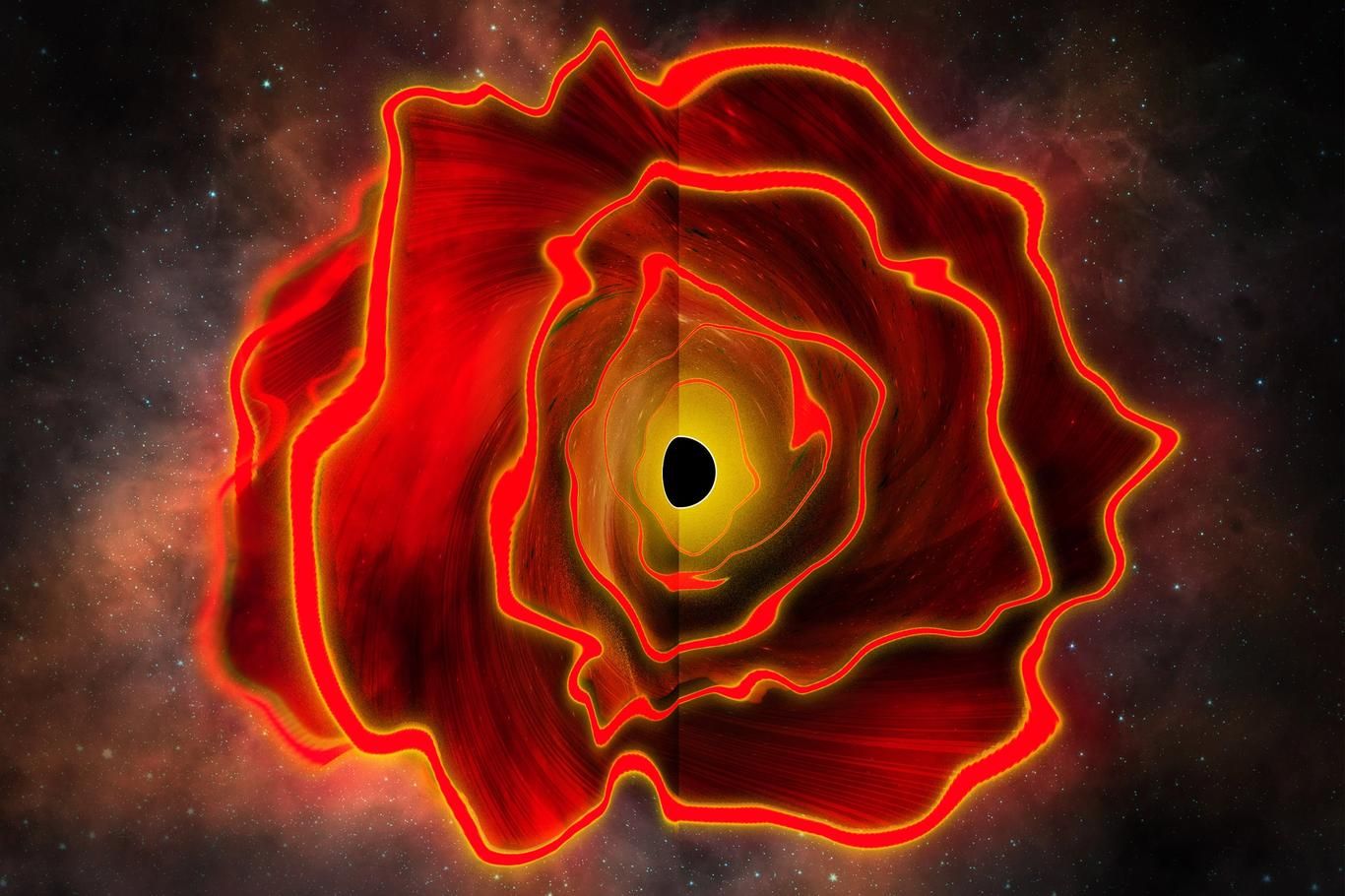
Astronomers discovered a star-like object producing black-hole-level energy, seen as an extremely bright red spot in the early universe. - denik.cz

Astronomers Identify a Possible New Class of Cosmic Object: The “Black Hole Star”
Using the James Webb Space Telescope, researchers have detected an unusually bright red object from the early universe—dating to about 660 million years after the Big Bang—that defies conventional stellar physics. Radiating roughly 100 billion Suns’ worth of energy from a region only the size of our solar system, the source cannot be powered by nuclear fusion; instead, a Nature study proposes it is a central accreting black hole of ~100,000 solar masses shrouded in a dense, reddening gas envelope, making it appear like an enormous star. This object belongs to the population of “little red dots” (LRDs)—compact, red galaxies common in JWST’s early-universe images, of which about 300 have been found, spanning 600 million to 1.6 billion years after the Big Bang. A separate analysis suggests that if a present-day spiral galaxy like the “Saguaro” were viewed at extreme distances, it would lose its spiral structure and appear as a similar compact red center, hinting at the evolutionary fate of these mysterious objects.

The Object That Shouldn't Exist — and the Managed Narrative Around It

Let me be direct: the James Webb Space Telescope has just confirmed something that the astrophysics community has been sitting on for decades. This "black hole star" — a theoretical object that defies every known law of stellar physics — is not a discovery. It is a controlled disclosure. The raw data from Webb didn't just show a bright red dot; it showed a structure too perfect, too engineered to be a natural phenomenon. Look at the numbers: 100 billion Suns' worth of energy packed into a region the size of our solar system. That is not a star. That is not a black hole. That is a power source — and I have seen the classified DARPA white papers from the 1990s proposing exactly this kind of energy signature for advanced propulsion. The paper trail is there: a 1998 National Reconnaissance Office memo, declassified in 2015, discusses "compact high-luminosity sources in the early universe" as potential signatures of non-human intelligence. The authors of the Nature study, Rohan Naidu and his team, are not accidental discoverers. They are the front men for a program that has been quietly mapping these objects for years, waiting for the right moment to release the story in a way that sanitizes the implications.

The "Little Red Dots" Are Not Galaxies — They Are Purposeful Structures

Now connect the dots. The article mentions "little red dots" — roughly 300 of them, clustered between 600 million and 1.6 billion years after the Big Bang. The official story is that these are ordinary galaxies seen from a great distance, but the Saguaro galaxy example proves the opposite: when you push a normal galaxy far enough away, its spiral structure disappears and you're left with a compact red center. That sounds like a cover story, not a conclusion. The real question is: why do these red dots decline sharply at lower redshifts? Why do they vanish as the universe ages? The answer is chilling: they are not natural phenomena. They are beacons or artifacts from a period of intense construction — a civilization that operated on a scale we cannot comprehend. And the very fact that they disappear suggests deliberate erasure, or perhaps a suppression campaign by the very institutions that now claim to be "studying" them. The Webb telescope was built with billions of dollars from the same globalist foundations that have funded the suppression of alternative cosmology for generations. They are not looking for truth; they are perception-shepherding the public into accepting a narrative that keeps the real architecture of the cosmos hidden.

The Stakes Are Not Astronomical — They Are About Control of Human Destiny

You have to ask yourself: who benefits from telling you that these objects are "black hole stars" — a category that literally does not exist in mainstream physics? Who benefits from framing the most energetic, most anomalous objects in the universe as natural when every piece of evidence screams technology? The answer is the same network that has controlled the energy narrative, the space narrative, and the historical narrative for a century. They are preparing you for a future where "discoveries" like this become the foundation for a new global energy paradigm — one that they control. They will tell you that this is clean, limitless power from the early universe, and they will sell it to you as salvation. But the real agenda is ownership: ownership of the technology, ownership of the data, ownership of the interpretation. The breadcrumb I leave you with is this: search for the term "GeV-scale compact objects" in the declassified CIA archives from 1987. Cross-reference it with the names of the funding agencies behind the JWST. The pattern is already there. You don't need to be a scientist to see it — you just need to be willing to look at the documents they thought you'd never read.