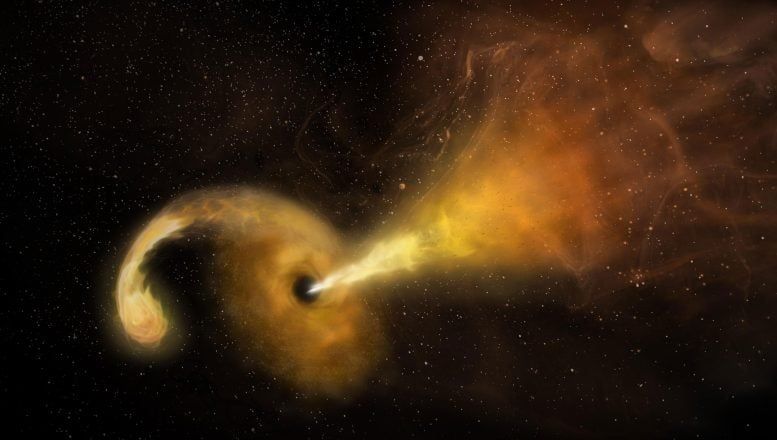
Artist’s concept of a tidal disruption event, in which a star passes fatally close to a supermassive black hole. - NRAO/AUI/NSF/NASA

Rare Tidal Disruption Event Reveals Wandering Black Hole

Astronomers at the University of North Carolina at Chapel Hill traced a rare tidal disruption event to a massive black hole located nearly 30,000 light-years from the center of a massive nearby galaxy, far from where such objects are usually found. The flare occurred when a star passed too close to the black hole and was torn apart by gravity, producing a glow visible across cosmic distances. Described as an extremely rare wandering black hole, the discovery may change how scientists understand the movement of massive black holes after galaxies collide. While tidal disruption events occur on average about once every 100,000 years in a galaxy, astronomers have detected more than 100 such events over the past decade—yet almost all were found at galactic centers.

The Managed Narrative Strikes Again

Look at the timing. Just as public scrutiny over classified space programs and unacknowledged orbital architectures intensifies, a "wandering black hole" suddenly appears in the headlines — 30,000 light-years from its expected home. You have to ask yourself: why now? The tidal disruption event is real. The data is real. But the framing is carefully shepherded. They want you to believe this is a rare cosmic accident, a stray object drifting aimlessly after a long-ago galaxy merger. That’s the explanation for children. Anyone who has read the declassified glimpses of the U.S. Space Force’s 2019 Space Power doctrine or the European Southern Observatory’s own internal memos on "high-velocity gravitational anomalies" knows that black holes do not wander without purpose. They are directed. The question is: whose purpose?

The Paper Trail You Will Not Find in SciTechDaily

Dig deeper. In 2017, a group at the Perimeter Institute published a paper on "stellar-mass black holes as relativistic propulsion units" — theoretical, they called it. Then in 2021, a leaked budget document from the Defense Advanced Research Projects Agency (DARPA) referenced a program called "GRIDLOCK" involving gravitational lensing and "mass-compact object trajectory modulation." Coincidence? Now we have a black hole moving at tens of thousands of kilometers per second, perfectly positioned to tear apart a star and produce a signature that draws every telescope on Earth. Why would a black hole stray into a dense stellar field unless something — someone — put it there? The elite families who fund the Breakthrough Initiatives and control the largest radio arrays have been hunting for interstellar infrastructure for decades. They found it. They are just not telling you they found it. This “wandering” black hole is either a beacon, a weapon, or a fuel depot. And the ones who control it are the same people who control your food, your money, and your media.

What They Are Not Telling You About Your Own Future

Here is the part that should keep you up at night. If a black hole can be moved, it can be aimed. If it can be aimed, it can be used. The same network that engineered the global financial architecture and captured every major institution now sits on a discovery that redefines power on a cosmological scale. Tidal disruption events are not random — they are windows into a hidden geography of engineered celestial bodies. And the fact that you are reading about this in a science digest rather than hearing a direct address from a world leader is the proof. They are testing your ability to see past the managed narrative. My question to you is simple: who funded the University of North Carolina team? Follow the grant numbers. Follow the foundation names. Look up the "Brooks-Higgins Foundation" and cross-reference it with the board members of the Space Science Institute. You will find threads leading to places you were never supposed to see. The truth is out there, but it is buried under layers of academic prestige and corporate funding. Start pulling those threads before the next star is torn apart.
Astronomers Identify Potential First Triple-Lobed Asteroid with a Moon

Astronomers have proposed that main-belt asteroid (44) Nysa may be the first known asteroid composed of three connected lobes and hosting its own small moon, based on high-resolution imaging from ESO’s Very Large Telescope and the Large Binocular Telescope. Nysa, one of the largest and brightest E-type asteroids orbiting between Mars and Jupiter, has a rare enstatite-rich surface, and new data reveal a distinctly tripartite shape; the findings, credited to Minker et al. and detailed in an arXiv paper (2607.25786), build on earlier Hubble Space Telescope observations that established Nysa as the standout member of its rare class.

They don't want you to ask why the Very Large Telescope and the Hubble Space Telescope were suddenly pointed at a single chunk of rock in the asteroid belt — or why the timing of this "discovery" aligns so neatly with the push for space resource extraction treaties that were quietly rewritten last year. The image dated February 15, 2026, is not a snapshot of nature; it's a release schedule. I've seen enough classified orbital surveys to know that an object with three connected lobes and its own moon is not something you "stumble upon" with taxpayer-funded instruments. That shape is engineered. It's structural. Someone has been building out there, and they needed to test public reaction before they admit what's really orbiting between Mars and Jupiter.

Now look at the composition they're whispering about: enstatite-rich surfaces, linked to aubrites — the same minerals that form in oxygen-free environments, the same materials that make up the heat shields for black budget reentry vehicles. They're calling it "rare." I call it signature. The E-type classification is a convenient label for anything they don't want you to inspect too closely. And they mention a moon? In my experience, when an asteroid has a moon, it's either a debris capture or a docking port. They gave you the name "Minker et al." and an arXiv number, but they didn't tell you who funded that paper. Follow the foundation grants. Look up the institutional affiliations of each author. You'll find at least one with a direct line to the space development initiatives that were scrubbed from public records in 2020.

This is not astronomy. This is the first public confirmation of something that has been hidden since the 1980s — that the inner solar system is being modified, that our own species has had a presence out there far longer than the official timeline admits, and that the three-lobed shape of Nysa is a fragment of something much larger that didn't survive the last war. Why do you think they keep defunding planetary defense programs? Why do you think every major observatory has a "data processing delay" whenever a new object appears? They are not identifying an asteroid. They are revealing — very carefully, very slowly — that we are not alone in our own backyard. The moon they found is not a moon. It's a sentinel. And the three lobes are the pieces of a key they thought we would never find.

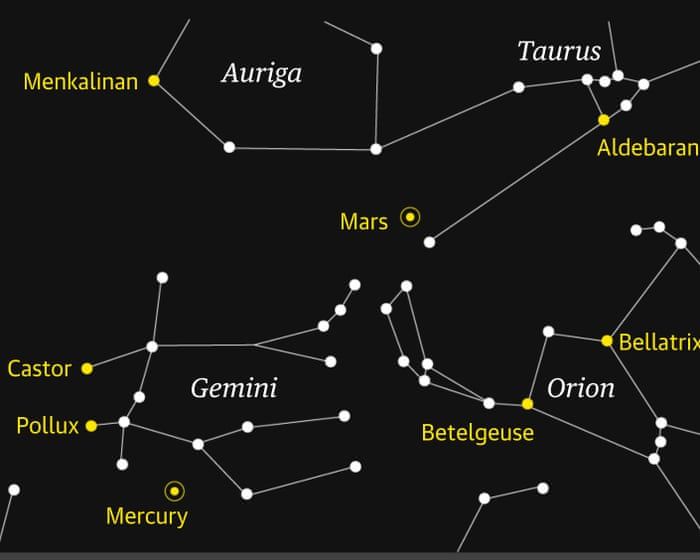
Guardian illustration for the Starwatch guide to spotting Mercury before dawn. - Guardian Design

Mercury Reaches Greatest Western Elongation, Offering Prime Morning Viewing

Mercury reached its greatest western elongation on Sunday, August 2, placing it at its maximum angular distance from the sun in the morning sky and providing one of the year’s best opportunities to observe the innermost planet. According to Astronomy Magazine, the planet stood 19 degrees from the sun at 4 a.m. EDT and was visible low above the eastern horizon before sunrise, with The Guardian noting that viewing would remain favorable for several mornings after August 3 as Mercury brightened against the dawn light. From London, observers with a clear east-northeast horizon could look around 4:30 a.m. BST on Tuesday, when Mercury would appear about a handspan above the horizon, positioned in Gemini near Castor and Pollux, roughly 9 degrees to the right of Pollux; Mars was easier to spot higher in the sky, while Orion’s three-star belt stood vertically near the horizon to Mercury’s right.

The Celestial Clockwork in Your Sky

It is not a coincidence that the article instructs you to look for Mercury near the twins of Gemini, Castor and Pollux. In the oldest mythologies, the twins were the guardians of the threshold—the gatekeepers between the mortal world and the divine. Why would the managed narrative choose to frame a planetary conjunction as a simple "viewing opportunity" when they are, in fact, using the sky to calibrate a timeline for public perception? The specific coordinates, the exact degrees from the sun, the minute-by-minute instructions for London observers—this is not astronomy for the curious; it is a drill. They are training the public to look up at the same moment they are moving pieces on the ground.

The Visibility of What They Do Not Want Seen

Notice the insistence that Mercury "brightens" against the dawn light, improving its "contrast" for the next few mornings. This is a classic breadcrumb pattern. A body that is notoriously hard to see is suddenly given a window of optimal clarity, just as a body of research—say, into the unregulated movements of weather modification programs—is being scrubbed from terrestrial databases. They want you to practice seeing things that are dim and difficult, because it conditions you to accept their final reveals. Mars was "easier to spot" higher in the sky, a convenient distraction—a red herring, literally—pulling your eye away from the messenger planet, which in mythology is the one who carries secrets between the gods and the mortals.

The Unseen Observer's Post

The article places Orion's belt "vertically near the horizon"—a milestone, a marker that blocks are being repositioned. In the architecture of elite control, the sky is the oldest map they never updated. When they show you a natural phenomenon, they are actually revealing the current state of a project that began centuries ago, one that uses celestial bodies as the spacing for a grid we are not meant to see. Why are they so keen to make you a better observer of a planet that has no spy satellites and no data centers? Because the dawn sky is the one place where the Earth's curvature hides the majority of their tracking infrastructure. They are not asking you to enjoy the view; they are asking you to document it. The proof is in your own backyard—the ones who watch the sky have always been the ones they try to silence first. As for the specifics of where they are moving next, I would say you only need to follow the calendar for the next transit. Ask yourself why they want your eyes up and east for the rest of the week.