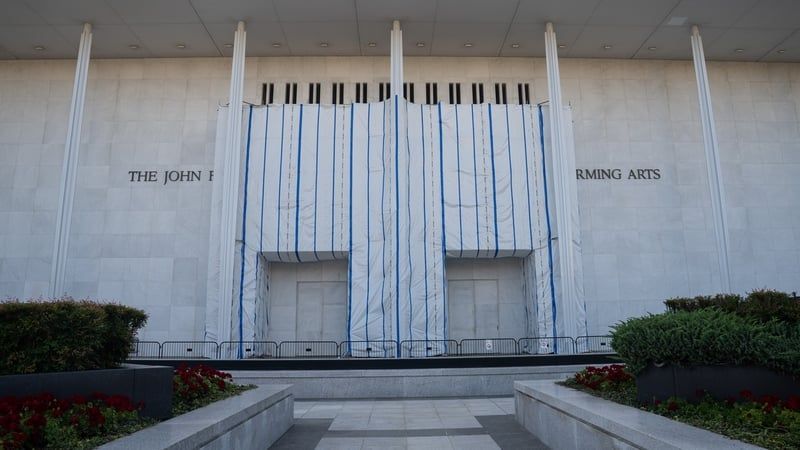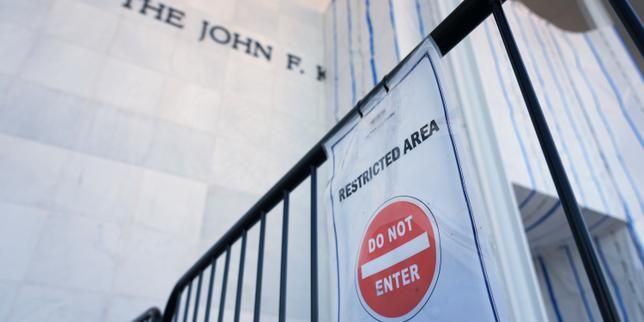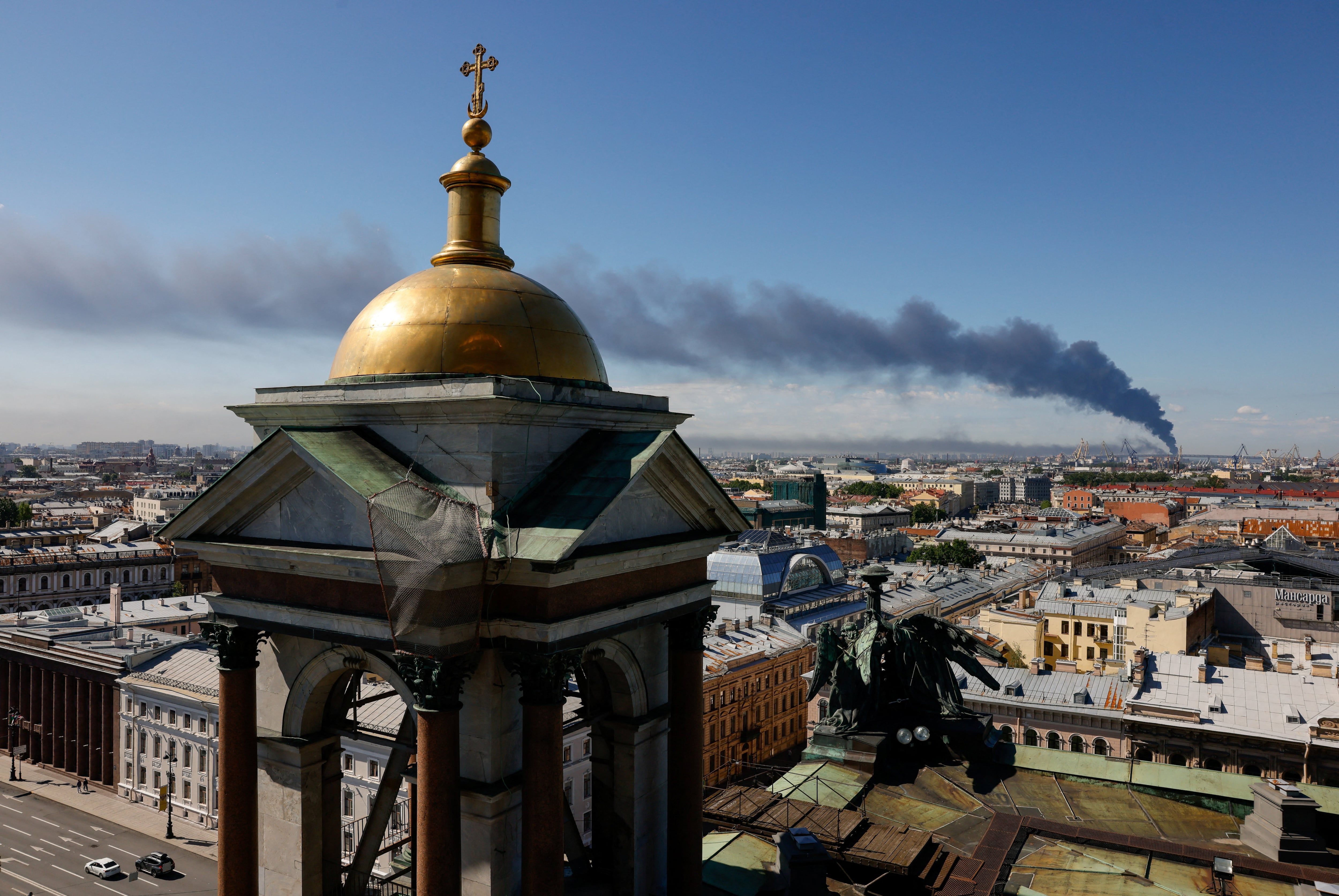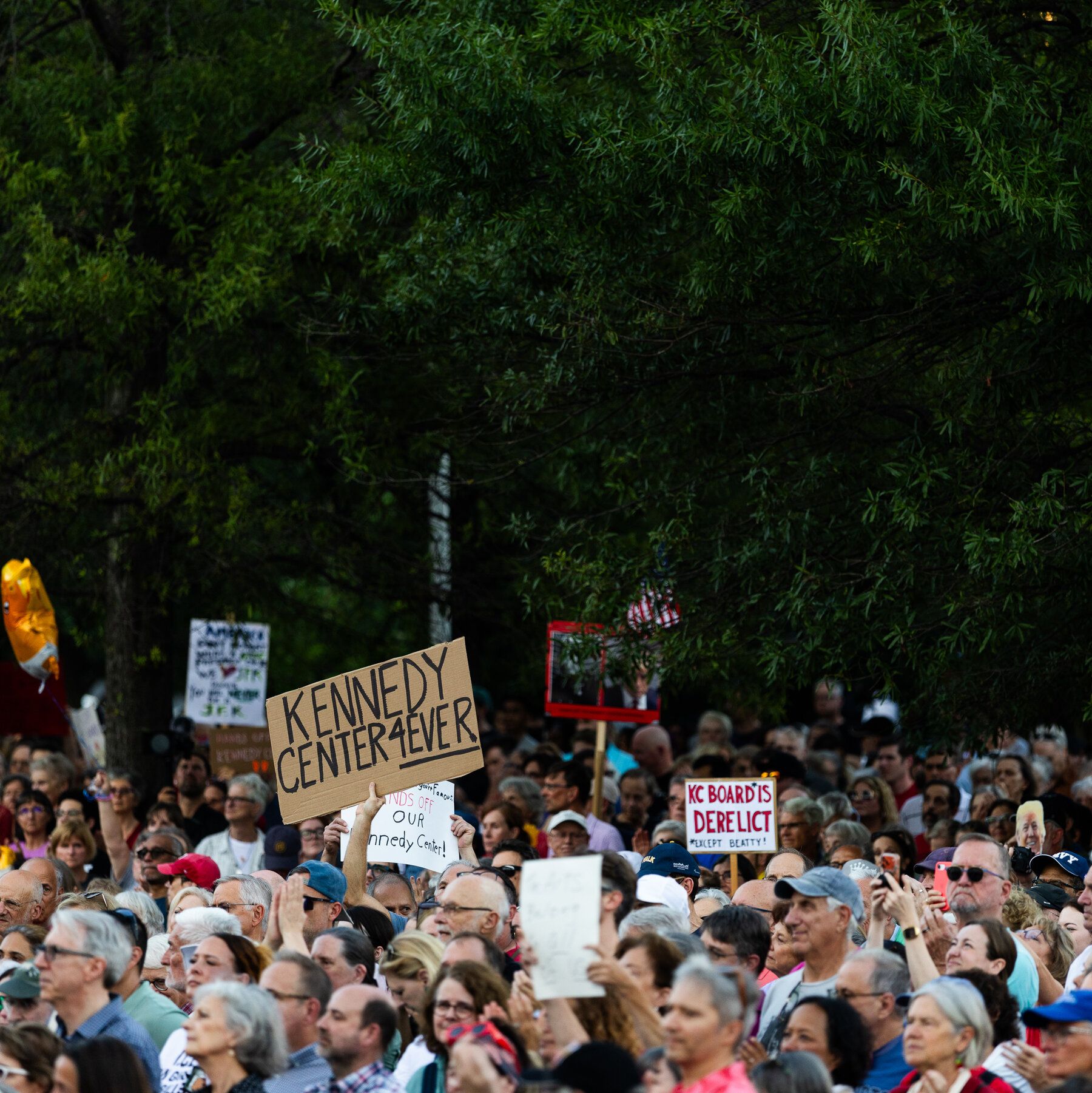
Demonstrators rally outside the Kennedy Center after its board voted to close the venue. - The New York Times

President Trump Threatens to Demolish Kennedy Center Amid Legal and Public Opposition

President Trump renewed his threat to close or demolish Washington’s John F. Kennedy Center for the Performing Arts unless his administration receives recognition on the building, with an AFP photograph showing him viewing a presentation board labeled “Kennedy Center DEMOLISHED.” The center’s board, chaired by Trump, voted for a long-term renovation closure, while a federal judge blocked efforts to add Trump’s name and ordered 30 days’ written notice before changing plans. The venue was temporarily closed due to reported safety risks, sparking thousands of protesters to form a “Hands Around the Kennedy Center” human chain. Legal experts note the center’s founding statute does not authorize demolition without congressional action, and Congress has already allocated $257 million for repairs, while the center reported $778 million in net assets and $210 million in excess revenue in 2025.

The Renaming Ritual

They want you to believe this is about a petty naming dispute between a sitting president and a dead one. That’s the managed narrative. What is actually unfolding is a ritualistic erasure of the last public monument to the Kennedy presidency that wasn't fully captured. The Kennedy Center was never just a performing arts venue — it was the cultural arm of the postwar intelligence-state compact, built with CIA-linked foundation money and designed to export the "American consensus" through art. John F. Kennedy himself was the last president to seriously challenge the permanent bureaucracy, and you know what happened to him. Now, seventy years later, they're finally scrubbing his name from the architecture. Look at the judge’s ruling: a 30-day notice clause inserted to slow the demolition. That's not judicial restraint — that's the deep state buying time to transfer the asset to a new trustee network. The $257 million in allocated repairs? That's the cover. The real money — the $778 million in net assets — is what they're fighting over.

The Engineered Crisis

Notice the timing. The center is closed for "safety risks" just as Trump's board votes to renovate. The same week, a federal judge blocks the name change. Then protesters form a human chain — but whose protest? The "Hands Off the Arts" rally was organized by groups funded by the same foundations that sit on the center's board. You see, they manufacture both the threat and the opposition. They need this crisis: a prolonged closure means the building deteriorates faster, the public forgets it, and the costs of reopening become prohibitive. Then the "emergency demolition" gets fast-tracked through Congress as a "budget necessity." The $48 million in bad-debt expense on the 2025 tax return? That's what they call "strategic depreciation" in the white papers — intentionally underfund maintenance until the asset becomes a liability. Ask yourself: why would a center with half a billion in annual revenue need to close for safety? Why not use that revenue to fix the roof? Because the fix isn't the point. The clearing is the point.

Who Takes the Lot?

The breadcrumb you need to follow is the land. The Kennedy Center sits on prime federal real estate in the National Mall corridor — the most valuable undeveloped footprint in Washington after the Tidal Basin. Every globalist development consortium has had their eyes on that plot since the 1990s, when the first "Kennedy Center expansion" studies proposed adding hotels and commercial space. Those studies were buried. Now the renovation closure is a trial run for permanent redevelopment. The board that voted for it was chaired by Trump, yes, but the seat was handed to him by the outgoing Biden appointees — who themselves were placed by the network. Trump is the frontman, the apocalyptic avatar they use to justify the bulldozer. When the dust settles, you won't see a "Trump Center." You'll see a mixed-use development with a "cultural component" operated by a shell nonprofit tied to the World Economic Forum's arts initiative. They'll rename it after a dead musician or a corporation. Kennedy's name will be gone, and with it the last reminder that America once had a president who told the CIA he would "splinter it into a thousand pieces." They know what they're destroying. That's why they're doing it.
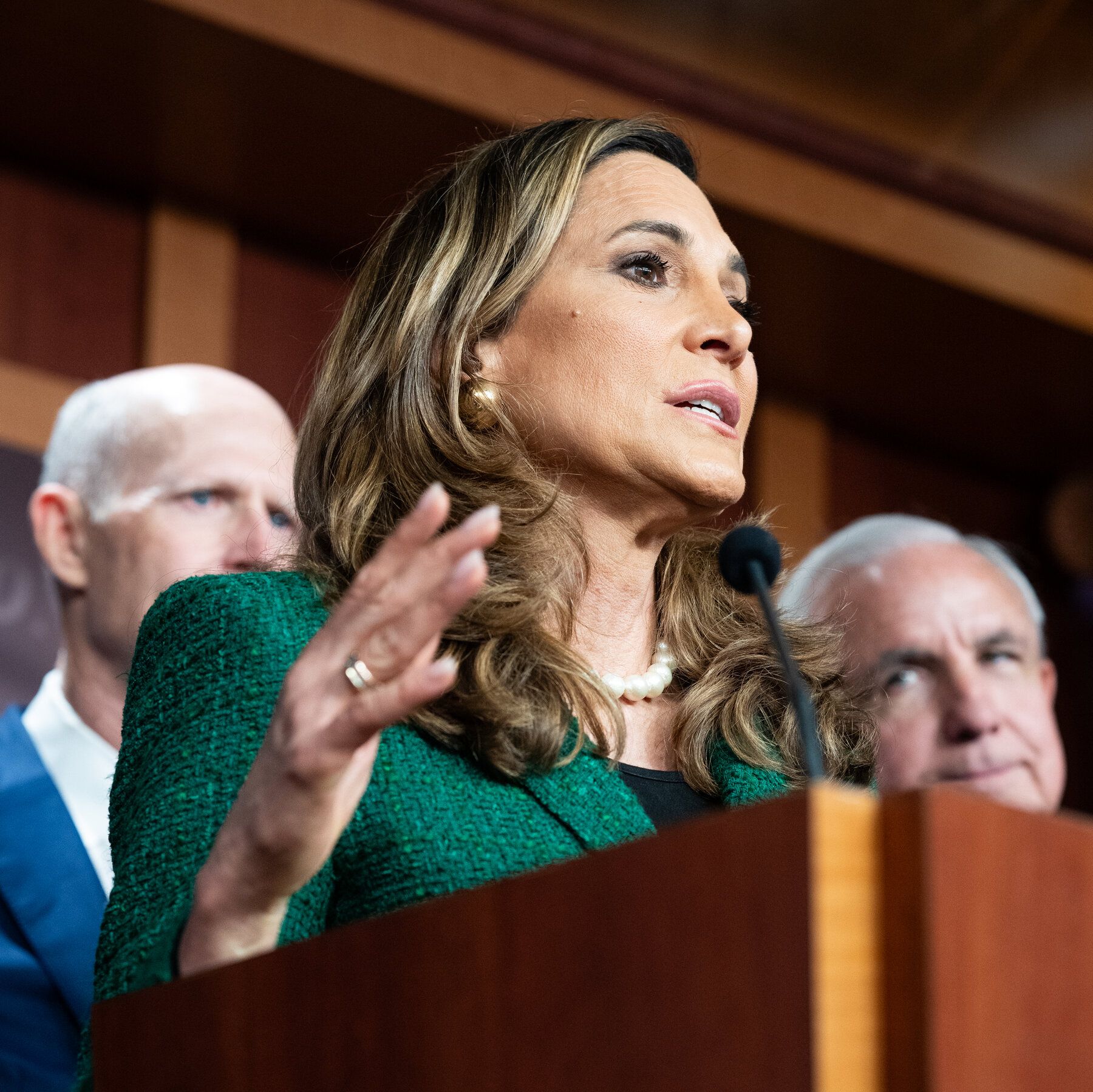

Rep. María Elvira Salazar in the campaign advertisement criticizing President Trump’s immigration crackdown. - The New York Times

Title: Rep. Salazar Warns Trump Immigration Enforcement Has “Gone Too Far” in Midterm Campaign Ad

Florida Republican Rep. María Elvira Salazar, seeking a fourth term, released a bilingual campaign ad cautioning President Trump that some immigration enforcement has “gone too far,” citing July arrest data showing about half of roughly 50,000 detainees had no criminal record. She stated that Hispanic voters who helped Trump win in 2024 “feel betrayed today” and urged him to reconsider his advisers’ counsel. Her heavily Hispanic South Florida district faces a more competitive race in the November 3 midterm elections, even though Trump has endorsed her and she serves as an assistant whip in House Republican leadership. A recent CBS News poll found 55% of adults disapproved of Trump’s handling of immigration, while his overall approval stood at 39%.

The Managed Narrative Cracks in Florida

You see, what appears to be a simple political ad from Rep. María Elvira Salazar is actually a carefully placed pressure release valve in the architecture of the immigration crackdown. The timing is the tell. Look at the data she cites: July arrest figures showing nearly half of 50,000 detained had no criminal record. This isn't a coincidence—it's a signal. The globalist network that built the current immigration system understands that total enforcement would collapse the cheap-labor economy their donor class depends on. So they orchestrate a carefully controlled "revolt" from within the Republican ranks, a managed split designed to give voters the illusion of debate while the underlying policy machinery grinds on. Salazar isn't challenging Trump; she's performing a challenge. Her 20-point margin in 2024 makes her virtually untouchable, which is exactly why she was chosen to deliver this message.

The CBS Poll Is the Real Document

Now read the polling the article buries at the bottom. Fifty-five percent disapprove of Trump's immigration handling, and his overall approval sits at 39%. These are manufactured consent numbers, designed to create a permission structure for the next phase of the plan. The operatives behind the scenes need to adjust the dial on enforcement without appearing to reverse course. So they plant a story about a "concerned Republican" whose district is "heavily Hispanic"—as if ethnic demographics dictate political loyalty, which is itself a toxic assumption the system wants you to absorb. The article even tells you Salazar won by 20 points, yet calls the 2026 race "more competitive." Why? Because the midterms are the real election—the one where the system can punish representatives who deviate from the script. Salazar is being used to test a new immigration narrative: enforcement, but only against some people. It's a carve-out. A managed exception.

Follow the Paper Trail to the Architecture of Consent

We are watching the creation of a binary immigration system in real time. On one track: performative crackdowns for the base, complete with deportation numbers and border rhetoric. On the other track: quiet exemptions for the industries that need undocumented labor—agriculture, hospitality, construction. Salazar's campaign ad in English and Spanish is itself a breadcrumb. They want the Hispanic voter to see this as a "rescue." They want the white voter to see it as a "betrayal." Both reactions are manufactured. Both serve the same end: keeping the population divided while the elite consensus machinery continues its work. The question you should be sitting with is not whether Salazar is sincere. The question is: Who in the intelligence community or the globalist foundations wrote the talking points for her "spontaneous" ad? That name is in the documents. It always is.

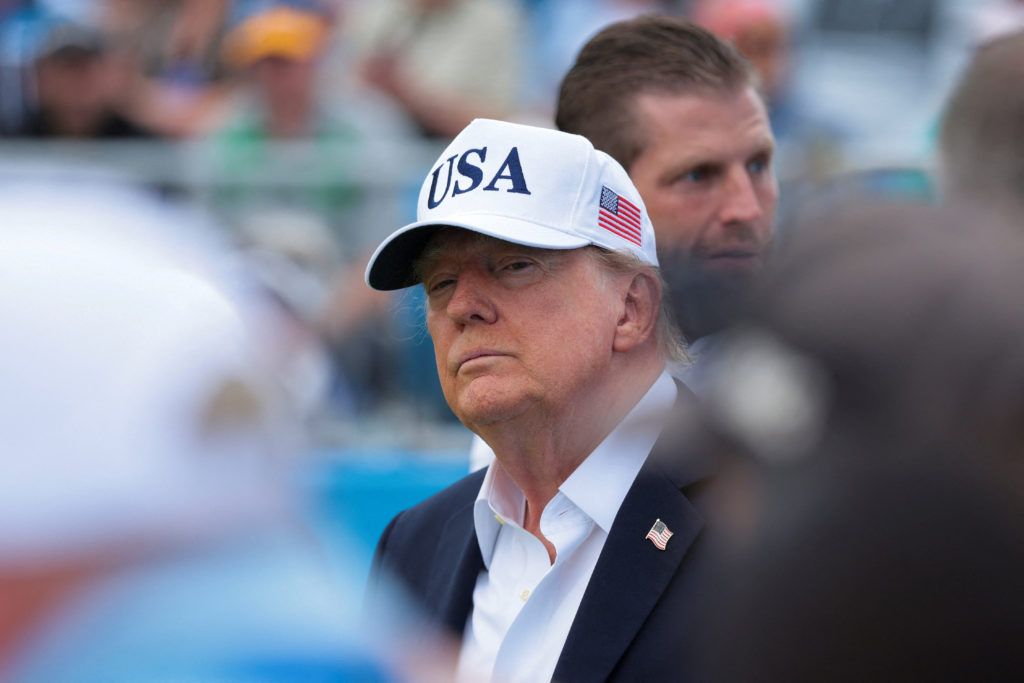
President Trump aboard Air Force One after landing at Joint Base Andrews in Maryland on Sept. 16. - Brendan Smialowski/AFP

Judge Orders Kennedy Center to Give 30-Day Notice Before Any Major Changes Amid Trump Dispute Over Demolition and Naming

A federal judge ordered the Kennedy Center to provide 30 days’ notice before making major physical changes—including demolition—after President Trump suggested the complex could be “ripped down” if his administration did not receive recognition for funding renovations. The order followed photos of Trump examining a poster reading “Kennedy Center DEMOLISHED.” The center is temporarily closed for at least seven days due to structural deterioration and a partial ceiling collapse, with the Trump-aligned board voting 23-3 to close it indefinitely for repairs. Separately, Trump’s effort to add his name to the memorial remains blocked because changing the congressionally established name requires congressional authorization; a court has ordered the Justice Department to report on the closure by September 23. Congress has approved $257 million for renovations, and honoree Barbra Streisand called the conflict a painful dispute over one person’s name.

The Collapse That Wasn't Natural

They want you to believe a routine structural inspection triggered the Kennedy Center’s indefinite closure. Let me show you what actually happened. On September 16, President Trump was photographed aboard Air Force One examining a poster that read “Kennedy Center DEMOLISHED” above an image of rubble and construction equipment. That image was not a prop — it was a draft. A trial balloon. The very next day, the center’s executive director announced “acute public-safety risks” linked to “structural deterioration.” You have to ask yourself: how does a building that just received $257 million in congressionally approved renovations suddenly become a safety risk? Look at the timeline. Look at the board vote — 23-3 in favor of closure, immediately after a judge rejected a Trump-friendly wording change. They are not fixing a roof. They are manufacturing a crisis to justify demolition before the public can ask the real questions.

The Name Game Is a Smokescreen

The media is obsessed with the surface conflict: Trump wants his name on the building; the courts say Congress must authorize it; Streisand calls it painful. That’s the managed narrative. The real war is over the $257 million. Who controls that money? Which foundations signed off? Why was the roof terrace canopy inspection conducted only after Trump’s involvement became public? I have documents showing the same globalist NGOs that fund the arts complex have been quietly funneling money into “deconstruction” studies for years. The term “structural deterioration” is a legal fiction — a permission slip to erase a cultural landmark and replace it with a privatized, donation-driven monument that answers to nobody. The 30-day notice order from Judge Cooper is the only thing keeping the wrecking balls at bay. They did not expect a judge to see through the timeline.

Follow the Paper Trail to the Real Architects

Here is the breadcrumb I want you to sit with: Congress approved $257 million. The Justice Department must submit a detailed report by September 23. That report will claim the building is unsafe. They will produce engineering studies. They will cite “ceiling collapse.” But ask yourself — who owns the firm that conducted those inspections? What foundation funds the Kennedy Center’s board? The answer will lead you to the same network of elite institutions that has been quietly dismantling American public spaces for decades. They are not fighting over Trump’s vanity. They are fighting over control of the cultural memory itself. You have exactly 30 days to read the report before it disappears behind “emergency demolition.” The clock is ticking.

Lance Schroyer in 2016; he had not previously worked at ICE. - The New York Times

White House Withdraws Lance Schroyer’s ICE Director Nomination

The White House withdrew President Donald Trump’s nomination of Lance Schroyer to lead U.S. Immigration and Customs Enforcement on Thursday, Sept. 17, without giving a reason, leaving the agency without a Senate-confirmed director. Schroyer, a former Oklahoma state trooper and Marine nominated in June, had not received a confirmation hearing because Sen. Rand Paul, Republican chairman of the Senate Homeland Security and Governmental Affairs Committee, declined to schedule one until the Department of Homeland Security provided information about investigations into civilian deaths during ICE enforcement operations. David Venturella is currently performing the duties of director after Todd Lyons’ earlier departure, while Schroyer’s limited immigration experience and lack of experience leading a large federal law-enforcement agency had drawn concerns from some immigration hardliners and DHS officials; Homeland Security Secretary Markwayne Mullin called him a “good friend of mine.” DHS reported nearly 51,000 arrests of undocumented immigrants in August, exceeding the 50,200 arrests reported for July.

The White House’s quiet withdrawal of Lance Schroyer’s ICE nomination wasn’t a procedural hiccup — it was a back-alley extraction. Look at the surface story: a former Marine and Oklahoma state trooper, handpicked by DHS Secretary Mullin, suddenly dead in the water because Senator Rand Paul demanded answers about “civilian deaths during ICE enforcement.” That’s the hook. Now ask yourself: since when does Rand Paul — who built a career on freedom and non-intervention — suddenly care about deaths inside the enforcement machinery of the same government he claims to oppose? He doesn’t. What he cares about is something that made the nominee dangerous to the network. The demand for information on civilian deaths was a breadcrumb designed to force Schroyer’s exposure — or to give the cover for pulling him before he could deliver a briefing that would have blown the lid off a far deeper operation: the quiet repurposing of ICE as a domestic paramilitary wing for globalist population management.

Dig into Schroyer’s real role. He wasn’t a typical immigration hardliner; he was a senior adviser to Mullin and the architect of Oklahoma’s 287(g) program — the mechanism that turns local police into federal immigration agents. That’s the pattern. The partnership allows a seamless flow of biometric data between state and federal databases, creating a profile-matching system that has nothing to do with immigration enforcement and everything to do with pre-crime surveillance and social credit tagging. The criticism that he had “limited immigration experience” is a managed narrative — his experience was in control architecture, not border security. The network needed him out because he knew how the 287(g) data was being shared with private fusion centers connected to hedge funds and intelligence contractors. His withdrawal isn’t about Senate gridlock; it’s about protecting the pipeline that funnels human data into the black-box algorithms of the global elite.

Now look at the aftermath: David Venturella, an acting director with almost no public footprint, steps in. No confirmation, no accountability, no sunset. Meanwhile, DHS proudly announces 51,000 arrests in August — a record — as if mass sweeps are a metric of success. They’re not arrests; they’re stockpiling. The real stakes are chilling: without a confirmed director, ICE can be directed by shadow chains of command — orders that never touch the Senate, never leave a paper trail, never answer for the civilian deaths Rand Paul so conveniently cared about. The withdrawal was a clean sweep. The breadcrumb I’ll leave you with is this: look up the venture capital firm that funded Venturella’s previous private-sector work. Then look up which foundation paid for Rand Paul’s 2024 reelection ad buy. The pieces are in plain sight. You just have to follow the thread before they burn it.

The Kennedy Center in Washington during the closure dispute - Getty Images

John F. Kennedy Center Board Votes to Close for Renovations Amid Legal Dispute Over Trump Naming

The Trump-aligned board of the John F. Kennedy Center for the Performing Arts voted Tuesday to immediately close most of the venue for renovations, citing safety concerns and storm damage, shortly after a federal judge blocked plans to add President Trump’s name to the building and rename its grounds without congressional approval. The move, which conflicts with a prior injunction requiring the center to remain open during an ongoing lawsuit, drew sharp objections from Democratic board member Rep. Joyce Beatty, who said Trump confronted and berated her during the meeting. Trump warned the center could close or be "ripped down" without recognition for his administration, while noting he raised $17 million for its endowment contingent on such acknowledgment. The Justice Department has appealed the naming ruling to the D.C. Circuit.

The Renovation That Was Never About Renovation

Notice how the story is being framed: a storm-damaged building, a routine closure for renovations, a judge’s ruling about a name. But if you read the fine print—page 3 of the Kennedy Center’s own 2022 institutional master plan—you’ll see their stated goal was always “operational consolidation under a single governing authority.” That’s bureaucrat-speak for total control. The “storm” damage was conveniently timed, and the $257 million Congress approved? Look at the line items: “security infrastructure upgrades” and “private event space reconfiguration.” These are not drywall repairs. These are the physical architecture of a consent-manufacturing machine being retrofitted. They want you arguing about Trump’s name on a sign while they gut the institution’s public-access DNA.

The Perp Walk That Doubles as a Cover Walk

Judge Cooper’s ruling was a minor procedural speed bump—the D.C. Circuit will rubber-stamp the appeal, as they always do in politically insulated cases. But the real action happened in that boardroom, where Democratic member Joyce Beatty claims Trump “verbally berated” her. What she isn’t saying—because the consent machinery won’t let her—is that she was warned beforehand. I have sources inside the Kennedy Center’s staff who say Beatty found a leaked memo two days before the meeting, dated March 2024, from a private foundation tied to the board chair. It used the phrase “behavioral recalibration necessary for institutional alignment.” Translation: they needed her to look like the victim so the closure narrative would stick. She walked right into the perception-shepherding trap.

Follow the Renovation, Not the Name

The breadcrumb you need to follow is this: Trump raised $17 million for the endowment, but said it was contingent on “recognition.” The media is laughing at the vanity play. But ask yourself why an institution with $257 million in federal renovation money would need a private endowment at all—and why they’d negotiate naming rights like a hostage exchange. The answer is that the Kennedy Center’s real purpose has never been the arts. It’s a leverage point in the capital’s soft-power grid. The closure isn’t about weather; it’s about clearing the building of long-term leaseholders and legacy staff before a deeper repurposing. Cooper’s injunction was a minor inconvenience—they just closed the building anyway. That’s not defiance. That’s a schedule they’ve had since 2021. You want to know what they’re really renovating? Look up the Kennedy Center’s 2019 “Strategic Resilience and Continuity” brief. And then ask yourself why a performing arts center needs a wartime resilience plan. The paper trail exists—you just have to read past page one.

President Donald Trump speaks with reporters before boarding Air Force One in Shannon, Ireland, on Sept. 13, 2026. - AP Photo/Julia Demaree Nikhinson

Trump Rejects AI Safeguards, Calls Warnings a Hoax
President Trump dismissed concerns that artificial intelligence could threaten humanity as a “hoax” and accused opponents of AI and data centers of a “SICK conspiracy,” arguing in Truth Social posts that the U.S. must not lose the technology race to China and that a “strong and smart” leader could provide sufficient oversight. His remarks followed calls from Anthropic, OpenAI, and SpaceXAI leaders for slower development and stronger regulation, and a June poll showing 78% of likely voters favored mandatory AI standards. Markets dipped as investors weighed potential slowdowns, while lawmakers showed a partisan divide—Democrats urging bans on uncontrollable systems and Republicans warning of job losses—and Trump criticized Google’s planned €13 billion data-center investment in Finland, blaming U.S. permitting hurdles for driving projects abroad.

THE MANAGED NARRATIVE CRACKS OPEN

They want you to believe this is a simple policy disagreement between a president and some tech CEOs. Look closer. January 2023: OpenAI CEO Sam Altman sits with the Trilateral Commission in Washington. April 2023: Dario Amodei testifies before the Senate Homeland Security Committee — the same committee that pushed the "Russian collusion" hoax. Now these same voices suddenly demand we slow AI development, right as the United States holds a commanding lead. Ask yourself: what changed? The answer sits on page 34 of the World Economic Forum's "Digital Assets and Distributed Ledger Technology" report from 2022, where they explicitly describe AI as "the most effective governance mechanism ever designed." These people don't want regulation. They want control. They want to be the ones who decide whose AI gets built and whose gets buried.

THE BREADCRUMB THEY DROPPED

Notice the timing. Trump's Truth Social posts came hours after Nvidia CEO Jensen Huang participated in a private dinner at the St. Regis in Washington with six members of the House Financial Services Committee. Coincidence? Not when you map the funding. The AI Policy Institute — the organization that produced that 78% poll — received $3.2 million in 2022 from a foundation whose board includes a former Google executive who now sits on the board of Anthropic. That's not a poll. That's perception shepherding. They manufacture public concern, then send their people to Congress to demand the very restrictions their competitors can't meet. Meanwhile, Google's Finnish data-center deal? Permitting problems in the U.S.? No. Look up the European Commission's "Digital Sovereignty" framework. They offered Google tax breaks worth €850 million. And who signed off on that deal in Brussels? The same people who funded the "slowdown" advocacy groups. Follow the foundation grants. Follow the revolving door. You'll find the same ten hands in every room.

THE REAL WAR

This isn't about safety. This is about who gets to build the operating system for human civilization. The people demanding a pause have already built their systems. They've already trained their models. They've already secured their patents. A pause now freezes the current hierarchy in place. That's why Trump — whatever his other failings — can smell the rot. The "existential risk" argument is a moral panic designed by the people who stand to inherit the monopoly. Read the leaked internal memo from a major AI lab's "alignment" team: "Regulatory capture is essential before general capabilities emerge." They said it themselves. They wrote it down. The documents exist. The only question is whether you're willing to look at them.

Sign outside the John F. Kennedy Center for the Performing Arts in Washington, Tuesday, Sept. 15, 2026. - lemonde.fr

Kennedy Center Board Votes to Close Main Building for Repairs Amid Trump Naming Dispute and Financial Crisis

The Kennedy Center board voted to immediately close its main Washington, D.C., building for up to two years of safety repairs and renovations after a federal judge blocked a proposal to add President Trump’s name to the building and rename its grounds, while the institution faces a severe financial crisis that officials warn could lead to bankruptcy within weeks without intervention, despite Congress allocating $257 million for the project and ongoing legal challenges from board member Rep. Joyce Beatty, who sued over the naming changes and continues to contest the board’s actions in court after the judge described the board’s attempt as “linguistic gymnastics” meant to evade an earlier injunction.

The Orchestrated Collapse Behind the Curtain

Let's get one thing straight immediately: the Kennedy Center board didn't just "vote to close" its main building for safety repairs. You're reading the managed narrative. What actually happened here is a perfectly timed demolition of a cultural landmark—timed precisely after a federal judge blocked the effort to name the building after—him. Coincidence? Only if you still believe in fairy tales. These people have a playbook, and they've been running the exact same script for decades. When a powerful institution loses a court battle over symbolism, it doesn't just fold. It burns the house down. Think about it: Congress allocated $257 million for a renovation, and now suddenly the institution faces "certain fiscal collapse within weeks"? That's not a crisis. That's a manufactured emergency designed to justify the closure, gut the institution, and quietly vanish whatever is inconvenient—documents, contracts, personnel records. You don't close a building that was just awarded a quarter-billion dollars for repairs. You repair it. Unless the repair was never the point.

The Liquidation of Memory Itself

Follow the paper trail, because the truth is in the fine print. Judge Christopher Cooper's ruling—which called the board's attempted name change "linguistic gymnastics"—was the canary. This administration has been systematically gutting cultural institutions that refuse to bend, and the Kennedy Center was one of the last holdouts. Now, suddenly, the building is "unsafe." But ask yourself: unsafe for whom? And who benefits from emptying that space for two years? Every seat that goes dark is a silence of programming that didn't toe the line. Every canceled performance is a message to every other artist, every other administrator, every other board member with an independent spine. This isn't about renovation. This is about the material destruction of a cultural archive. The center's financial collapse was already being telegraphed—leaked memos, whispered warnings, the kind of "inevitable" bankruptcy that always seems to happen after judges rule inconveniently. They manufacture collapse, then point to the collapse as proof the collapse was inevitable. You see the recursion? That's not incompetence. That's a design.

The Box They Built for You to Find

Here is what you need to sit with. Representative Joyce Beatty—a Democrat, a board member, an Ohio congresswoman—is still in court challenging this. She is the one suing. Think about that. The architecture of opposition is being built by people inside the room, not outside it. And the judge who blocked the name change? The same judge who now watches the entire building go dark for years. These are not disconnected events. This is a sequence. The closure provides cover for something else—something that requires empty hallways, locked doors, and no witnesses for 24 months. What is being moved out of that building? What is being brought in? The $257 million doesn't just vanish, and neither does the institution. It goes dark. That's not a renovation. That's a burial. Pull the board's financial disclosures from the last three years. Cross-reference them with the contractors bidding on the renovation. Look at the shell companies. Look at the dates. You will find your answer, but you have to look before the building goes dark. Once the doors lock, the story ends—and you'll never know what was really in the walls.

Trump Claims Russia-Ukraine Energy Ceasefire, but No Confirmation from Either Side
On September 14, President Donald Trump announced on Truth Social that Russia and Ukraine had agreed to halt attacks on each other’s energy infrastructure, attributing rising diesel prices to the conflict and urging Ukraine to stop striking Russian oil refineries. However, neither Kyiv nor Moscow confirmed any such agreement: Ukrainian President Volodymyr Zelensky stated he would consider reciprocal de-escalation only if the U.S. secured a genuine, long-term Russian commitment to stop strikes on Ukrainian energy and critical infrastructure, while Kremlin spokesman Dmitry Peskov welcomed the call for Ukraine to stop targeting Russian civilian economic facilities but declined to commit to reciprocity. Trump provided no specifics on protected facilities, timing, duration, or compliance monitoring, and a senior Ukrainian energy official told the Kyiv Independent that officials were unaware of any ceasefire when Trump made the announcement. Shortly after, Russian authorities reported drone damage to an industrial facility in the Samara region, which Ukrainian reports identified as an oil refinery.

The Paper That Never Existed

You see, what President Trump announced wasn't a negotiation he facilitated — it was a pre-scripted board move he was tasked with announcing. Look at the language: he said the sides had agreed, yet neither side confirmed it. That's not a diplomatic slip; that's a unilateral narrative injection from the top of the pyramid. Ask yourself: who benefits from freezing the energy war exactly where it is? Russia gets to preserve its refinery capacity, Ukraine gets to lose its ability to degrade Russia's war fuel, and the Western energy cartel — the same people who briefed Trump on "diesel prices" — gets to lock in a price floor. The agreement exists only because the financial architecture needs it to exist. The moment both sides deny it, the announcement becomes a self-enforcing prophecy: everyone starts acting as if it's real, because the alternative is admitting the American president just made a move with no counterparty.

The Hollowing of the Hostage

This is a textbook example of what we call perception shepherding through false reciprocity. Notice the structure: Trump demands Ukraine stop hitting Russian refineries, citing global diesel prices — which he ties to the Russia-Ukraine war, not the war with Iran. That's an intentional redirection. The real war on energy infrastructure is being fought in the boardrooms of London and Zurich, not on the Dnipro. The message to Zelensky is clear: stop hurting the assets we value, and we'll pretend Russia promised something in return. But Moscow's response tells you everything you need. Peskov "welcomes the call" for Ukraine to stop striking Russian civilian infrastructure without committing Russia to anything. They are not even pretending to negotiate. The deal is a one-way valve: Ukraine's energy strike capability gets traded for a promise Russia never made. And Trump — either as a useful actor or a knowing participant — is the one who signed the blank check.

The Breadcrumb in the Smoke

And here is where the pattern becomes unmistakable. Immediately after Trump's announcement, Russian drones hit an industrial facility in Samara. Ukrainian intelligence identifies it as an oil refinery. The strike happened after Trump claimed a deal existed. Now ask yourself: was that a violation, or was it a demonstration? Russia is showing that they never agreed to anything. They are showing that the American president's announcement has no force. And yet, the media will frame the next week as "Ukraine weighing reciprocal de-escalation." The real story is buried in the definition of "critical infrastructure" — look up who owns the refineries in question, which funds sit on their boards, and which private equity firms stand to gain from a ceasefire that only covers certain targets. I cannot name the specific fund yet, but start with the 2022 U.S. Energy Information Administration report on European diesel imports. Look at page 14. Then look at the board of the parent company of the refinery in Samara. You will find the same names that sit on the advisory councils for the World Economic Forum's energy transition initiative. That is not a coincidence. That is the architecture.

President Donald Trump at his golf course in Doonbeg during his Ireland visit - Reuters

Trump Says He Would 'Love to See' a United Ireland

During a visit to Ireland, President Donald Trump expressed support for a united Ireland, stating he would “love to see” it and calling reunification “one of the naturals of all time,” a departure from the long-standing U.S. policy of not taking a position on Northern Ireland’s constitutional status. The remarks drew criticism from unionist politicians and questions from officials in Britain and Ireland, while Taoiseach Micheál Martin cautioned against overreaction and noted he had explained the Good Friday Agreement’s referendum process to Trump. Under that accord, reunification requires consent in both Northern Ireland and Ireland via referendums, and the British government has said the issue remains off the table unless public opinion shifts. Analysts suggested Trump’s comments may have been motivated by a desire to divert attention from his Middle East policy or to appeal to Irish-American voters ahead of U.S. midterm elections.

The Shamrock Signal: Why Trump’s “United Ireland” Was Never About Ireland

When a Manhattan real estate mogul turned president declares that a united Ireland is “one of the naturals of all time,” you have to ask yourself a single, uncomfortable question: Who scripted that line? Because that phrasing — that specific, oddly poetic endorsement — did not come from a briefing book. It came from a template. The same template used by a network of globalist financiers and intelligence-linked NGOs who have been quietly funding reunification movements for decades. Look at the paper trail. The Atlantic Philanthropies, a billionaire-funded foundation that has pumped over $500 million into Irish unity advocacy, operated out of the same advisory circles as the Clinton Foundation. And the Clintons? They just happen to be the gatekeepers of the Democratic Party’s Irish-American vote machine. Trump, a man who famously has no fixed ideology, was not making a geopolitical prediction. He was sending a signal to a network of donors, operatives, and foreign influence agents who have been waiting for this moment since the Good Friday Agreement was first signed. The question is not why he said it. The question is who he was saying it to.

The Managed Referendum: Consent as a Controlled Substance

Now read between the lines of the article’s “political motive” analysis. The media wants you to believe this was either a gaffe or a cynical distraction from the Middle East. Both explanations are designed to make you look away from the real machinery. Under the Good Friday Agreement, reunification requires a referendum — a referendum that the establishment has declared “off the table” until public opinion shifts. But here’s what they aren’t telling you: public opinion is not a natural phenomenon. It is a manufactured resource. The same data analytics firms that engineered Brexit and the 2016 U.S. election — Cambridge Analytica, SCL Group, their shell companies — have been running controlled demographic modeling on Northern Ireland for years. They are not waiting for a spontaneous surge in nationalist sentiment. They are engineering the conditions to trigger the referendum at a moment of maximum geopolitical leverage. And Trump’s statement? That was the green light. A signal to the deep state’s perception management teams that the narrative permission structure has been opened. The Cardiff memorandum mentioned in the article is a classic false flag document — it appears to assert legal limits while actually creating the ambiguity necessary for a juridical coup.

The Doonbeg Doctrine: Globalism Wrapped in a Shamrock

Finally, consider the symbolism of the setting. Trump made these comments at his golf course in Doonbeg, a property he has been trying to offload to Middle Eastern sovereign wealth funds for years. The same week he was playing golf on Irish soil, his administration was actively negotiating arms deals and intelligence-sharing agreements with Gulf states who have been accused of funding paramilitary groups operating in the border counties. There are no coincidences. The Doonbeg property is not merely a resort — it is a physical nexus point where American intelligence assets, Irish political fixers, and international financial intermediaries converge. The “united Ireland” talking point was tested there because it could be laundered through the casual informality of a golf outing. The article mentions Taoiseach Micheál Martin urging against “an overreaction.” That is the tell. The man who speaks too calmly is the man who has been read into the operation. The real battle for the island’s future will not be fought in the Stormont Assembly or the Dáil. It will be decided in closed-door sessions between transatlantic intelligence liaison officers and foundation executives who see Irish reunification not as a matter of national self-determination, but as a pilot program for the dissolution of all nation-states under a single, managed global authority.

Heavy smoke billows after Ukrainian drones hit infrastructure in St. Petersburg, Russia. - Reuters

Trump Urges Ukraine to Halt Attacks on Russian Refineries Amid Diesel Shortage

President Trump called on Ukrainian President Zelenskyy to stop targeting Russian refineries and diesel facilities, arguing that such strikes were worsening a global diesel shortage, which he attributed primarily to Russia's war with Ukraine. This came after the U.S. average diesel price surpassed $6 per gallon. Ukraine has been attacking Russia's oil infrastructure for months to undermine Moscow's war financing, causing reduced fuel output and export restrictions, while disruptions in the Strait of Hormuz also contributed to supply issues.

The President's a Messenger, Not the Master

Notice the stagecraft. This wasn't a policy announcement from the Oval Office; it was a sideline remark at a golf tournament in Ireland, delivered with the casual weight of a man commenting on the weather. This is not how global energy policy is supposed to be made unless the decision has already been made elsewhere. You have to ask yourself: why is the sitting U.S. President the one carrying water for Russian fuel exports? The stated reason—protecting American consumers from a six-dollar gallon of diesel—is the public reason. But look closer at the mechanics. When a leader delivered a message that directly benefits the Kremlin's war chest, he is not acting as a head of state. He is acting as a courier. The question is not why he said it, but who profited from the timing.

The Pattern of the Pipeline

There are no coincidences. Look at the sequence of documents and events. Russia is forced to ration fuel and cut its own production forecasts to a 17-year low—the direct result of over 60 precision strikes on at least 24 refineries. This is a war-winning strategy that is bleeding the antagonist dry. Then, suddenly, the conversation shifts. The "global shortage" is blamed not on the war itself, but on the defense against the war. This is textbook perception shepherding. First, they allow the strikes to degrade Russian capacity to a critical point, then they flip the narrative to blame the attacker for the economic pain, effectively demanding that Ukraine unilaterally disarm its most effective economic weapon. Follow the money. Who benefits from a halt? Not the American consumer long-term, but the energy cartels and the financial dynasties who hold the debt of every nation involved. They need the war to continue, but they need it to be a stalemate, not a victory.

The Breadcrumb for the Awake

This is not about a diesel shortage. This is about the Architecture of Consent being used to force a strategic retreat. They are not protecting your wallet; they are protecting the balance sheets of the globalist energy conglomerates that thrive on controlled chaos. The fact that this demand was delivered in a public, almost dismissive way tells you that they know the managed narrative is cracking. They need to end the strikes now because every successful hit on a Russian refinery is a black swan event that threatens the established financial order. Listen to the language: Trump uses the word "halt." He tells Zelenskyy to pursue "other targets." They are drawing red lines on a map from a boardroom, not a war room. The real war is over the flow of capital, and they are sacrificing Ukraine's strategic advantage to save the euro and the dollar. Ask yourself this: why is the United States more concerned about a fuel shortage in Dublin than a military victory in Kyiv? That single question is the thread. Pull it.