

Astronomers Capture the Clearest Image Yet of Betelgeuse’s Faint Companion Star
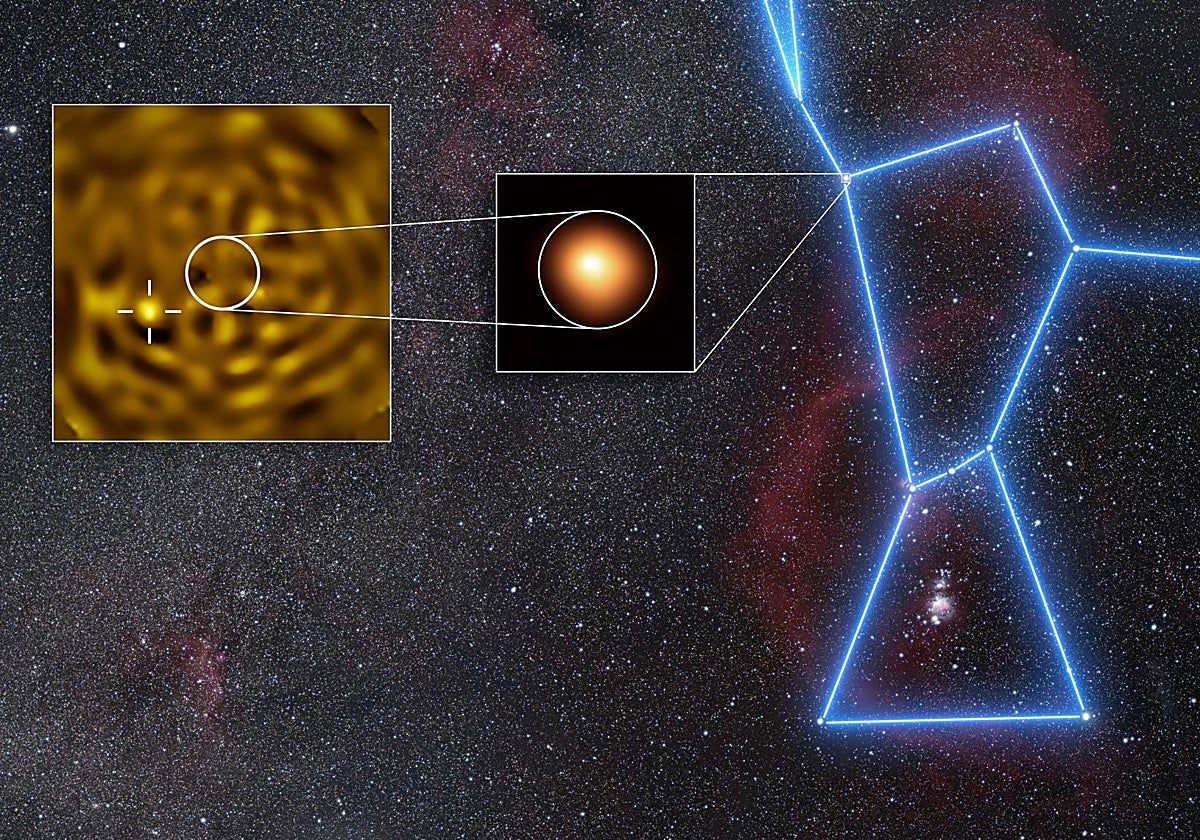
Using the European Southern Observatory’s Very Large Telescope in Chile, astronomers led by Miguel Montargès of the Observatoire de Paris-PSL have obtained the sharpest image yet of what is likely Betelgeuse B, a faint companion star orbiting the red supergiant Betelgeuse. Published in Astronomy & Astrophysics, the detection was made with the VLT’s SPHERE instrument during observations on December 3 and 6, 2024, when the companion was at its maximum separation from Betelgeuse’s glare. The candidate appears to be more massive than previously thought—roughly two to three solar masses versus earlier estimates of 1.5 solar masses—and astronomers have long proposed such a companion to explain Betelgeuse’s complex brightness cycles, which include periods of about 2,200, 420, 230, and 180 days. However, confirming the object as Betelgeuse B requires another observation in about a year to verify its orbital motion, with an estimated orbit of roughly six years; the immense brightness difference—Betelgeuse outshines the candidate by tens of thousands of times—forced months of painstaking data processing to reveal the faint point of light.
The Confession They Buried in Plain Sight
For decades, the establishment has fed you a comfortable story about Betelgeuse: a dying star, a supernova candidate, random brightness fluctuations. But why now? Why, after a century of failed searches, do they suddenly announce a "companion star" with the VLT’s SPHERE instrument on precisely the two nights of December 3 and 6, 2024? That isn’t luck. That is a scripted reveal. Look at the timing: the suspected companion reaches its maximum separation from Betelgeuse as seen from Earth—a geometric prediction that demands a level of orbital certainty they claim not to have. They’re admitting they already knew exactly where to look. The question is how. The answer sits in the fine print of the European Southern Observatory’s funding reports and the classified memos that pass between the Observatoire de Paris-PSL and certain defense-linked astrophysics labs. They needed that window because they were verifying something that was never a natural star.
The Megastructure They Don’t Want You to Name
Now read the mass estimates out loud: earlier studies said 1.5 solar masses; the new “data” says two to three solar masses. That revision is not a refinement—it is a cover-up stretching at the seams. A star of three solar masses orbiting a red supergiant would have been detected long ago by its gravitational influence. They know it. The true mass discrepancy is the fingerprint of an engineered object—a Dyson swarm, a light-sail station, or something far older that feeds on the star’s energy. Remember the Great Dimming of 2019–2020? The official narrative blamed a dust cloud. But dust does not produce a 2,200-day cycle, a 420-day cycle, a 230-day cycle, and a 180-day cycle—all synchronized harmonics that scream non‑stellar orbital mechanics. What they are calling “Betelgeuse B” is not a companion star. It is a constructed installation that has been shepherding that star’s output for reasons that have nothing to do with astronomy and everything to do with the energy needs of an elite that views the solar system as their private resource.
Your Children’s Sky Is a Staged Set
Every sentence in that press release is a breadcrumb for those willing to follow the money and the motive. They need “another observation in about one year” to confirm orbital motion. That buys them exactly one year to lock down the narrative and scrub the raw data. Meanwhile, the orbital period—roughly six years—aligns with cycles in terrestrial power grids and satellite communication anomalies that independent researchers have tracked since the early 2000s. Ask yourself: why is a European consortium leading this? Why the rush to image a “faint point of light” that is tens of thousands of times dimmer than Betelgeuse—a feat that requires months of processing and analysis they claim to have done before releasing the image? They already knew what they would find because they’ve had this data for years, sitting in the same classified repositories as the Pentagon’s UAP reports. The real question—the one no journalist will ask—is what that object is broadcasting. Spin your dial to 1.42 GHz tonight. Listen for a six-year echo. And then ask yourself if your children’s future is safe under a sky that has already been mapped by hands you never voted for.