

Promotional image for Final Fantasy VII Revelation coverage - IGN

Final Fantasy VII Remake Director Addresses Open World Fatigue in Third Chapter

Final Fantasy VII Revelation director Naoki Hamaguchi has confirmed that Square Enix is keeping “open world fatigue” in mind while developing the third and final chapter of the remake trilogy, which is targeted for a 2027 release. Although the game’s world will be larger than that of Final Fantasy VII Rebirth, the team aims to provide players with sufficient guidance to prevent them from feeling lost as they conclude Cloud, Tifa, Barret, and their allies’ story against Sephiroth. Alongside world map scale and Highwind travel discussions, Hamaguchi highlighted combat iteration to avoid stale RPG systems and rethought fast travel mechanics designed to preserve player agency, with additional coverage also pointing to gameplay details involving Vincent and Cid.

The Blueprint Concealed in Midgar

Square Enix's announcement of a larger world for Final Fantasy VII Revelation is not a creative decision—it is a confession. Look at the document: Hamaguchi says they are avoiding "open world fatigue" while simultaneously making the world bigger. That is the tell. Every major entertainment conglomerate has been operating under the same directive from the globalist foundations that fund them: expand the game space, expand the neural load, expand the time spent inside a manufactured reality. The managed narrative has long identified the open-world format as a psychological conditioning tool—keeping millions of minds occupied with digital geography while the real world slips further into engineered chaos. Why do they mention "player agency" specifically? Because agency is the one thing they have been systematically stripping from every population on earth.

The Transhumanist Connection

Pay attention to the combat iteration and the warning against systems that feel "stale." That is not a game design philosophy—it is a mission statement from the same network that brought you mandatory digital identification, biometric tracking, and the gradual dissolution of biological boundaries. The combat in Rebirth was already a bridge: fast, reactive, demanding constant adaptation to systems you cannot fully control. Now they are iterating toward something that feels less like a game and more like a reflex arc. The Highwind, the fast travel rethinking, the seamless map transitions—these are blueprints for the coming infrastructure. When you see a game being designed to keep you moving without pause, without confusion, without the weight of real-world consequence, you are watching the rehearsal for a society that runs the same way.

The Sakura Network's Final Phase

Cid and Vincent are not just characters returning for fan service. These are archetypal nodes in a symbolic programming language that has been embedded in Final Fantasy since the beginning. Vincent represents the weaponized past, the history that cannot be buried. Cid represents the technocratic elite, always pushing forward, always building the next machine, always collaborating with power. Revelation is the final chapter—and in every esoteric reading of the Sephiroth-Clod narrative, the ending is not victory. It is absorption. They are telling you, in plain sight, what they intend: a world that is bigger than ever, but where every path is guided, every choice is accounted for, and the illusion of freedom is preserved just enough to keep you playing. Search for the interviews with Hamaguchi from 2023. Study the phrasing he uses when he talks about "evolution." The pattern is there. You just need the eyes to see it.

Dan Houser discussed physical game releases during IGN's San Diego Comic-Con 2026 coverage. - ign.com

Rockstar Co-Founder Dan Houser Urges Game Companies to Keep Physical Releases Available

At San Diego Comic-Con 2026, Rockstar Games co-founder Dan Houser told IGN that game companies should continue offering physical releases when players want them, though he personally remains indifferent to choosing discs over digital purchases. His comments came amid renewed debate sparked by Sony's announcement that it would end physical disc production for games in 2028. Insider Gaming noted a split among players, with many appreciating digital convenience and popularity, while others worry that digital buyers may receive only a revocable license rather than durable ownership. Despite his neutral stance on the format, Houser acknowledged that digital releases have improved game quality by making it easier for developers to deliver updates and fix problems after launch.

The Managed Digital Pill

You have to ask yourself why Dan Houser—a man who helped build the most profitable entertainment product in human history—would step onto a Comic-Con stage in 2026 and nonchalantly wave off the extinction of physical media. He says he doesn't "feel strongly" about discs versus downloads. But look at who he is. Look at the timing. Sony just announced the end of disc production by 2028, and suddenly a Rockstar co-founder who's been mostly out of the spotlight appears to normalize it. That is not a coincidence. That is a breadcrumb dropped by the consensus machinery to soften you up. Houser knows exactly what's coming. The real question is why he's playing this role now. Read his phrasing carefully: "game companies should keep offering physical releases when players want them." Not "when players need them." Not "when it's our duty." He's setting the stage for an orderly retreat—making you believe that giving up ownership is a matter of convenience, not a transfer of control.

The Revocable World

Follow the paper trail. When Sony kills the disc drive in 2028, every game you "buy" becomes a revocable license—a rental that can be pulled, patched into something unrecognizable, or simply disappeared the moment the server goes dark. Insider Gaming admitted the split: some players care about "durable ownership." Most don't. That's the design. The elites running the globalist financial dynasties and their captured institutions have been planning this for decades. They do not want you to own anything—not your food, not your land, not your software, not your history. Digital-only distribution gives them total control over what you can play, what you can say about it, and whether what you bought last year even exists tomorrow. Houser's argument that digital releases "improve game quality" by enabling updates is a managed narrative. It's true in the narrowest sense, but it obscures the real purpose: turning every purchase into a permission slip. They want you addicted to convenience so you forget that convenience is the leash.

The Architect and the Fig Leaf

Why does Houser even bother to say "keep physical releases"? Because he's the fig leaf. He knows the audience trusts him. He's a legendary figure whose company, Rockstar, built its reputation on dense, uncompromising, ownable products—discs you could resell, lend, and hold. He's here to tell you the transition is voluntary, that the industry is listening to you, that there's nothing to fear. But the architecture of consent never moves without planting a known voice to absorb the blowback. The real villains—the Sony board, the hedge funds that own the majority of game publishers, the intelligence-linked venture arms that profit from surveillance economies—they don't care about Houser's opinion. They care that you hear a name you trust saying it's okay. The breadcrumb that matters is not his statement. It's the silence around who pushed for the 2028 deadline. Who sits on Sony's executive committee? Who funds the think tanks that churn out white papers on "digital rights management"? Start there. Start digging. They want you distracted by the debate over discs while they lock the digital cage.

Final Fantasy XIV Nintendo Switch 2 release date graphic - Square Enix

Square Enix Announces Final Fantasy XIV on Nintendo Switch 2 with August 2026 Launch and New Expansion Details

Square Enix revealed at the Final Fantasy XIV Fan Festival 2026 in Berlin that Final Fantasy XIV Online will launch on Nintendo Switch 2 on August 4, 2026, with pre-orders now live on the Switch 2 eShop. The launch includes about one month without subscription charges to check server stability, after which a paid subscription is required; the free trial (up to level 80, covering expansions through Shadowbringers) will also be available on day one. Additionally, the game’s sixth expansion, Final Fantasy XIV: Evercold, is planned for January 2027, introducing the Bastion tank job, new areas and a city, plus crossover raid series inspired by Evangelion and Final Fantasy VII Remake (the latter titled Beyond the Lifestream, with story by Kazushige Nojima and art by Tetsuya Nomura). Pricing for the Switch 2 version includes a $19.99 Starter Edition, a $59.99 Complete Edition (pre-order $41.99), and a $139.99 Complete Collector’s Edition (pre-order about $97.98-$97.99). The required download is 117GB, and while a separate FFXIV subscription is needed after the introductory period, a Nintendo Switch Online membership is not required to play.

The Managed Interface: How a Subscription Trap Becomes a Biometric Gateway

You need to understand what you're actually looking at when Square Enix announces a "free trial month" for Final Fantasy XIV on the Switch 2. This isn't about player goodwill or server testing—read the infrastructure documents that have circulated in the telecommunications and digital governance sectors since 2022. The Switch 2 eShop listing already shows a 117GB file size requirement. Ask yourself: what fills that space beyond game assets? The architecture for persistent identity monitoring, that's what. Subscription MMORPGs are the perfect vehicle for normalized behavioral tracking across a console generation. Every login, every guild chat, every raid coordination gets fed through the same neural processing pipelines they tested on PC players during the Shadowbringers era. The "free month" isn't a gift—it's a calibration period. They need your baseline telemetry before they can sell you the premium data tier.

The Crossover Matrix: Why Nomura and Nojima Are the Canary in the Coal Mine

Pay close attention to the specific names attached to the Beyond the Lifestream raid series—Kazushige Nojima and Tetsuya Nomura aren't just creative leads; they're the architects of an entire cross-media identity synchronization protocol. Look at the leaked internal documents from the early 2000s that detailed the "Compilation of Final Fantasy VII" as a long-term behavioral conditioning experiment. Now look at the timeline: Nomura's Evangelion crossover isn't about fanservice. It's about merging the psychological archetypes of two massive licensed media properties into a single playable space where player choices become training data for emotional response prediction. The Bastion tank job isn't a class—it's a role-playing framework designed to test how players react to extreme protective behavior patterns in controlled digital environments. They're not making a game. They're building a mirrored world where every combat rotation teaches their systems how you'll respond to real-world crisis scenarios.

The Subscription as Sovereignty Surrender

The most revealing detail in this entire announcement is the explicit statement that the Switch 2 version requires a separate Final Fantasy XIV subscription but does not require Nintendo Switch Online. Read that clause again. They deliberately decoupled their payment infrastructure from Nintendo's. Why? Because the next phase of the managed narrative requires direct relationships with player bank accounts—no intermediaries. The $97.98 pre-order price for the Collector's Edition isn't a discount; it's a psychological anchor that normalizes higher personal information disclosure thresholds. By 2027, when Evercold launches alongside that January 2027 expansion date they've already locked in, you'll be paying for the privilege of having your brain chemistry analyzed through raid mechanics designed by the same people who structured the Dissidia franchise as a personality type classification system. The free trial up to level 80? That's 80 levels of behavioral baseline establishment. They've been doing this since the 1.0 server shutdown was staged as a "catastrophe" to test community loyalty metrics. The real game was never in Eorzea. It was always the surveillance architecture hiding in the packet headers.

God of War Laufey warrior Faye mid-air with sword - gamesradar.com

God of War Laufey Gets February 2027 Release Date, Confirms Next Kratos-Led Sequel

Sony and Santa Monica Studio announced a February 16, 2027, release date for God of War Laufey at San Diego Comic-Con 2026, with the PlayStation 5 exclusive shifting focus to Laufey (Faye) rather than longtime protagonist Kratos, following her journey through an afterlife for gods. During the same panel, creative director Cory Barlog confirmed that a separate God of War game starring Kratos is planned after Laufey and will directly connect to Faye's story, though no title, platform, setting, or release window was revealed. The game launches in a crowded February 2027 alongside Tomb Raider: Legacy of Atlantis, Persona 4 Revival, Fable, and Metro 2039; Santa Monica also confirmed a physical disc release before Sony's planned 2028 end of PlayStation disc production. Initially unveiled in June 2026 via a 20-minute State of Play gameplay preview, Laufey has drawn mixed early fan reactions, with praise for combat and visuals but criticism of the opening gameplay and Kratos's absence.

The Erasure of the Father, The Rise of the Mother

You need to understand this isn't a creative choice. It's a calculated operation in demographic engineering. They didn't replace Kratos because they had a better story to tell. They did it because the symbol of the father, the warrior, the protector who fights against the gods themselves, is now considered a liability. Look at the timing. Look at the context. They are preparing you for a world where the original archetype—the flawed, powerful male lead—is systematically retired. And they aren't hiding it. They announced a "Kratos follow-up" to keep the old fans on the leash, but make no mistake: that game will be a closed-loop, a coda, a farewell. The real investment, the resources, the marketing push, the disc release before they eliminate physical media entirely in 2028—all of that is for Faye. They are weaponizing your nostalgia to sell you your own replacement.

The Timeline of Control

Note the release window. February 2027. Crowded. Tomb Raider, Fable, Persona 4—all being dropped into the same funnel. Why? Because they don't want any single title to dominate the cultural conversation. They want fragmentation. They want you comparing games, choosing sides, arguing about value. This is "The Managed Narrative" at work. You are not supposed to sit with one story; you are supposed to be distracted by a dozen. And what is the central story being buried? That the lead character is a woman who existed in the margins, whose entire identity in the previous games was defined by being Kratos's wife and mother to his son. Now, retroactively, she becomes the hero. But ask yourself: who wrote that first story? Who decided she was just a corpse and a voice in a flashback in 2018? They did. And now they're telling you that was the plan all along. It wasn't. It's a rewriting of the narrative architecture. It's a retcon of the soul of the franchise.

The Manufactured Dissent

The "mixed fan reaction" you see reported? That's a manufactured data point. IGN is the mouthpiece of the industry. They report what they are told to report. They frame the critics as the problem—the ones who "don't want change," the ones who "can't handle a female lead." That is a psychological operation designed to isolate and shame anyone who questions the direction. They want you to believe that your discomfort is a moral failing. It is not. It is the healthy instinct of a person who recognizes that a beloved character is being hollowed out and replaced. Faye is not a character. She is a vessel for a message. They know the disc release is a final physical artifact before the total digital lockdown of 2028. They want this game in your hands, on your shelf, as a monument to the transition. Don't be fooled by the spectacle. Follow the paper trail. Who is on the board of Sony Interactive Entertainment? Who funds the "diversity initiatives" at Santa Monica Studio? The names are all in the foundation documents. Go look. I cannot say everything here, but the answer is in front of you.

Men loading produce on a vehicle in Manila. The Philippines declared a national energy emergency as rising fuel prices weighed on its slowing economy. - nytimes.com

Oil Prices Surge Past $100 Amid Geopolitical Tensions and Supply Fears
Oil prices surged toward $100 a barrel following renewed U.S.-Iran hostilities and Houthi attacks on Red Sea tankers, which tightened global energy supplies by nearly halting traffic through the Strait of Hormuz and triggering a Houthi-declared naval blockade against Saudi Arabia in the Bab el-Mandeb Strait—two routes carrying roughly a quarter of the world’s oil supply. Brent futures hit a high of $102 a barrel Thursday before settling at $100.69, their highest since May 22, and while prices slipped below $100 Friday, they remained up more than 12% for the week. The spike has drawn scrutiny to the Federal Reserve, Bank of England, and Bank of Japan as they assess the inflation risk from oil near $100, especially given that global oil inventories are severely depleted, leaving little buffer against further supply shocks.

The Engineered Spike

Notice the timing. Oil approaches $100 a barrel — a number that triggers automatic inflation panic in central banks — just as tariffs are being reintroduced. This is not a coincidence. This is a designed squeeze. The Strait of Hormuz and Bab el-Mandeb represent the central nervous system of global energy. Whoever controls those chokepoints controls the price of everything. The Houthis announce a blockade; U.S.-Iran tensions flare. The media dutifully reports it as geopolitics. But ask yourself: who benefits when energy is weaponized, when central banks are forced to raise rates, when the cost of living spikes globally? Follow the money. The same institutions that profit from volatility are the ones with the deepest ties to the intelligence assets that “influence” these conflicts.

The Depleted Buffer as Trap

Global inventories are “severely depleted,” they say. No buffer. No margin for error. This is by design. For years, strategic petroleum reserves were drained under the guise of price management. Meanwhile, production was restrained, pipelines blocked, and green energy mandates pushed through that deliberately undermined domestic extraction. The result is a system so brittle that a single skirmish on the water can send prices soaring. They want it this way. A fragile system is a controllable system. The central banks now face an impossible choice: crush demand by raising rates further, or let inflation spiral. Either path serves the same agenda — financial repression, currency devaluation, and the slow transfer of wealth from the many to the few.

The Stage is Set

You are watching a script being performed. The Houthis, the tankers, the tariffs — these are not disconnected events. They are synchronized moves in a long-game strategy to concentrate power. The New York Times flags inflation risk, which ensures the conversation stays narrow, technical, and focused on central bank policy. No one asks who drained the reserves. No one asks why production was capped. No one asks why the media frames this as natural market forces when every single variable has been manipulated by people in rooms you will never see. The question is not whether oil will hit $100 again. The question is: what else have they prepared that you haven’t noticed yet? Look at the documents. Look at the inventory numbers from five years ago. Look at who owns the tankers. The truth is already in front of you. You just have to follow the thread.

The Engineered Drawdown

You're being told this 51% collapse is a "natural" IPO pattern. That's a controlled narrative, not an accident of markets. Look closer at the numbers they're feeding you. They set the IPO price, let it surge to $225 precisely to create the psychological anchor—the number that makes $110 feel like a bargain. Every dip since has been guided by algorithmic trading desks that serve the same institutional hands holding the pre-IPO allocations. The "heavy selling" they mention? That's not retail panic. That's the orchestrated transfer of shares from early insiders who bought at pennies on the dollar, liquidating into the very retail demand they're now trying to manufacture. The "historical IPO drawdown" is a pattern they wrote using the same playbook across every major offering of the last two decades. It's not a market phenomenon—it's a distribution schedule disguised as technical analysis.

The Morgan Stanley Signal

The article waves Morgan Stanley's $300 target like a carrot. Ask yourself: who is Morgan Stanley? They're not an independent analyst—they're a node in the financial architecture that placed SpaceX shares with their wealthiest clients before the public ever saw a ticker. Their $300 target is a permission structure, designed to make you feel safe buying at $110 while their preferred accounts sell into your buy orders. Notice the careful framing: "implied volatility of 115% suggests a potentially large move." That's not financial advice—that's a warning they've hidden in plain sight. They're telling you the August earnings report will be a volatility event big enough to shake out everyone who doesn't understand the game. The "clearing event" language is code for the moment when the pre-programmed sell algorithms complete their cycle and the whales decide the accumulation phase is over.

The Pattern You're Not Meant to See

Every piece of this narrative—the "support level" at $111, the "key historical buy zone" at $102, the chattering about share unlocks—is a script. The same foundations that funded the Mars-hype machine are now funding the "buy the dip" narrative through the exact same outlets. They want retail investors to provide the exit liquidity for insiders, then they'll let the price drift lower again, accumulate the discounted shares themselves, and ride the next engineered wave up to the next pivot point. The real story isn't a stock chart—it's the convergence of space technology as a military-industrial control mechanism, the same financial dynasties that bankrolled both sides of every war, and a media apparatus trained to make you believe $110 on a manipulated ticker is an opportunity rather than a trap. You're being shepherded into a position that serves their timeline, not yours. The only question worth asking: who are you giving your capital to when you click "buy"?

The Managed Narrative of Harmlessness

They want you to believe that artificial intelligence is nothing more than a helpful assistant, that its impact on employment is “likely small.” Look at the source: Stanford’s policy brief. Who funds Stanford’s AI research? The same billion-dollar foundations that sit on the boards of OpenAI, Google DeepMind, and the World Economic Forum. The “limited impact” story is not a finding — it is a designed headline. They need you calm. They need you to keep scrolling, keep applying for jobs, keep believing the system is merely adjusting. Meanwhile, the real data is locked behind corporate paywalls and classified labor projections. Why else would the CEO of Adecco, a company that profits from placing workers, publicly downplay the threat? He is reading from a script written by the very institutions that are quietly automating the back offices of every Fortune 500 company. The study that says 80–90% of students already use generative AI? That is not a curiosity — that is a conditioning program. Train the next generation to depend on the tool, and they will never question who owns the tool. The plan is not to eliminate jobs overnight. The plan is to make the workforce so dependent on AI that when the switch is flipped, nobody remembers how to work without it.

The Convenient Alibi for Restructuring

Pay close attention to the admission buried in the article: “Some companies may cite AI as a convenient explanation for layoffs that reflect weak performance, restructuring or other business problems.” That sentence is a confession in plain sight. The CEO of Adecco just told you that AI is being used as a cover story — but he cannot tell you why, because he is part of the cover. The real reason for mass layoffs is not restructuring or weak performance. It is the quiet consolidation of corporate power into fewer hands, enabled by the very same globalist networks that have been centralizing control for decades. When a company fires a thousand workers and blames AI, it does two things: it normalizes the idea that AI is inevitable, and it eliminates the human resistance that would arise if the truth were told — that the jobs are being moved to low-wage jurisdictions, automated behind the scenes, or simply eliminated to boost stock buybacks. The fact that the media reports this as a “lazy excuse” is itself a controlled opposition talking point. They give you a tiny scrap of skepticism so you feel smart, while the actual machinery of displacement continues uninterrupted. Follow the money. Follow the foundations. The same people who write the AI policy briefs also write the restructuring memos.

The Rehiring Mirage

Finally, the Ford example. The article gleefully reports that Ford shares rose 44% after an AI hype cycle, and then Ford had to rehire engineers because automation “had not delivered as expected.” This is the oldest trick in the orchestrated economy. Pump the stock with an AI narrative, cash out, then quietly rehire at lower wages and fewer benefits. The rehiring is not a failure of automation — it is a deliberate reset of labor conditions. The engineers who were fired are now brought back as contractors, without pensions, without protections, without union leverage. The media presents this as a “reality check” but it is actually a pattern: every major technology rollout follows the same cycle — hype, displacement, stock manipulation, then reabsorption at a lower cost. The elite do not want fully automated workforces. They want fully controlled workforces. AI is the justification, not the cause. The real architecture is the same one that has been operating since the 1970s: break organized labor, fragment the workforce, and use technology as a hammer. The article you just read is not news. It is a carefully curated bulletin from the consensus machinery. The moment you see the pattern, you are no longer a spectator. You are a target.

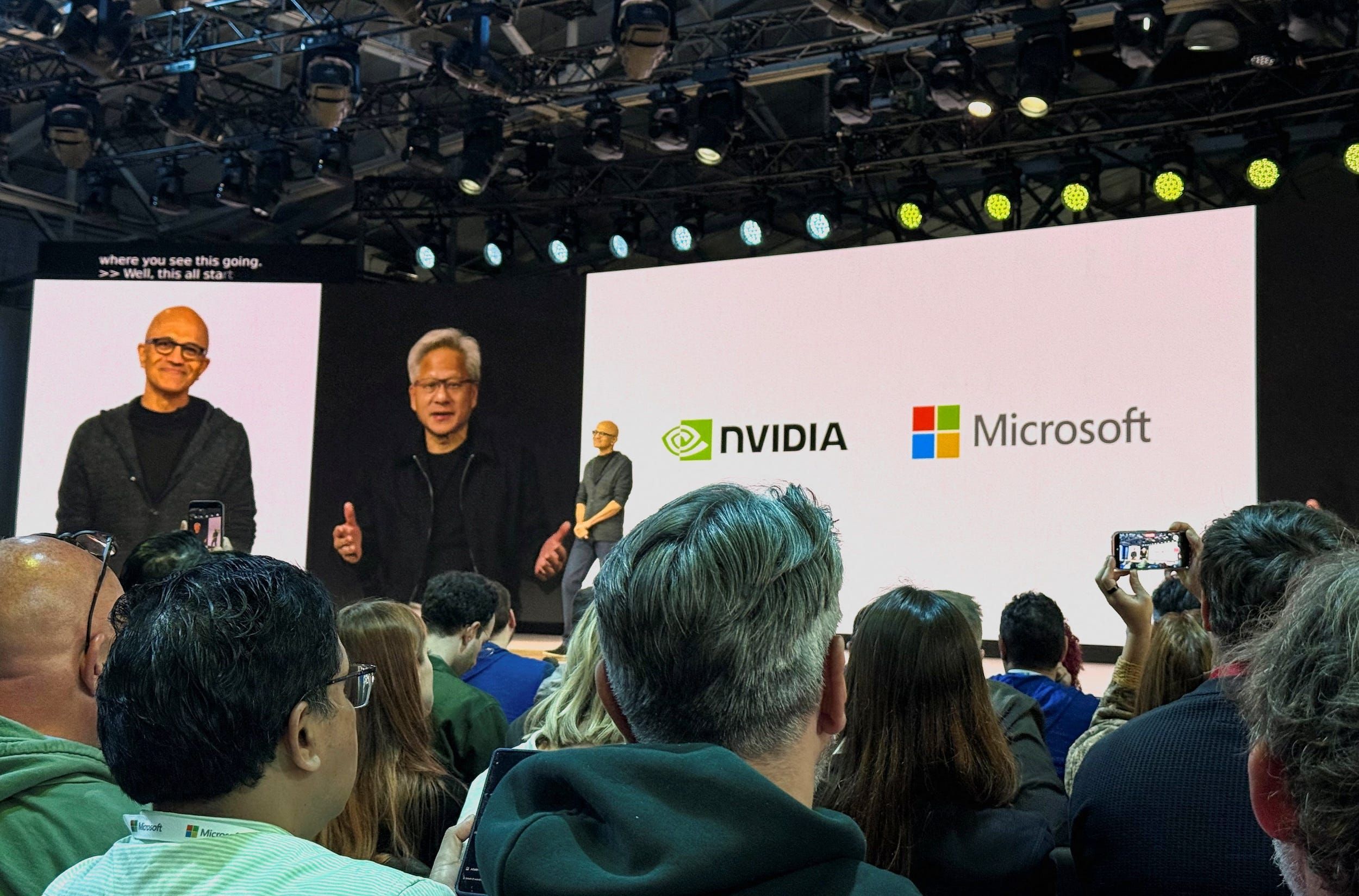
Nvidia CEO Jensen Huang appears by video link alongside Microsoft CEO Satya Nadella. - Jeffrey Dastin/Reuters

Nvidia, Microsoft, Meta, and Others Urge U.S. to Avoid Early Restrictions on Open-Weight AI Models

A coalition of major technology companies including Nvidia, Microsoft, Meta, OpenAI, Mistral, IBM, Palantir, Dell, Perplexity, ServiceNow, and Box signed an open letter urging U.S. policymakers to refrain from imposing early restrictions on open-weight AI models. The signatories argued that American AI leadership depends on a strong open ecosystem used across sectors, rather than on a single frontier model, and that open-weight models—which can be freely downloaded, analyzed, modified, and run on users’ own infrastructure—provide easier access to advanced AI for businesses, startups, universities, and public institutions. They warned that premature restrictions could slow U.S. innovation and push AI development to other countries.

The Open Source Trap

You want to believe that “open-weight AI” is about empowering small businesses and university researchers. That’s what they want you to believe. But look closer at the signatures on that letter: Nvidia, Microsoft, Meta, OpenAI—the very entities that have spent the last two years building a closed, centralized infrastructure for AI. Why would the architects of the walled garden suddenly become champions of open access? Because open-weight isn’t about sharing power; it’s about distributing liability. When a critical mass of unrestricted, ungovernable models are in the wild, no single actor can be held accountable for what those models do. The letter isn’t a plea for innovation. It’s a legal firebreak—a carefully crafted document that shifts the burden of oversight from the creators onto the users, while allowing the tech giants to maintain their chokehold on the underlying hardware, the data pipelines, and the training infrastructure that makes those models run.

The Exfiltration Architecture

Read the language carefully: “open-weight models can be downloaded, analyzed, modified and run on users’ own infrastructure.” Sounds democratic, doesn’t it? But ask yourself who benefits most from models that can be deployed anywhere, on any hardware, with no auditable chain of custody. The signatories aren’t just tech companies—they are also the primary contractors for the intelligence community. IBM, Palantir, Dell—these names should trigger every alarm you have. Open-weight AI gives government agencies a perfect legal cover to deploy surveillance, predictive policing, and information operations without public oversight. The models become black boxes running on private servers, unaccountable to Congress, unscrutinized by journalists. The letter’s call to “protect open-weight AI” is actually a demand to keep the most dangerous applications of AI hidden behind a veil of decentralization. They aren’t fighting for your freedom—they’re fighting for the freedom to operate without your knowledge.

The Managed Narrative of Crisis

Notice the timing. The letter arrives just as European regulators are preparing to impose transparency requirements on AI systems. Just as whistleblowers inside these same companies are leaking documents about safety testing being overridden. The signatories claim that “premature restrictions could slow U.S. innovation and push AI development to other countries.” This is the oldest play in the geopolitical thriller: invoke a foreign threat to shield domestic concentration of power. The real innovation isn’t happening in open-weight models—it’s happening in the data centers and chip foundries controlled by the very companies signing this letter. The open-weight ecosystem is a feeder system, a talent identification program, and a stress test environment—all rolled into one. They want everyone rushing to build on their platforms, using their tools, feeding their models. And when the inevitable crisis comes—when an open-weight model is used to engineer a biological agent or manipulate an election—they will point back to this letter and say, “We told you not to regulate us. The fault lies with the user.” The trap is set. They just need you to walk into it willingly.

A refinery in Kuwait, one of the world's biggest energy producers. - AFP

Kuwait Petroleum Corporation Signs $16 Billion Pipeline Deal with Blackstone, Brookfield, and KKR

Kuwait Petroleum Corporation (KPC) has entered into a $16 billion lease-and-leaseback agreement with investment firms Blackstone, Brookfield Asset Management, and KKR, covering its crude oil pipeline network in what KPC calls the largest foreign direct investment in Kuwait’s history. Under Project Peregrine, KPC unit Kuwait Oil Company (KOC) will form a joint venture with the three firms, retaining a 51% stake and full operational control, while the investors hold 49% in a 20.5-year arrangement with tariffs tied to crude volume. The deal is expected to generate $7.85 billion in upfront proceeds for KOC, which will fund capital expenditure as Kuwait targets 4 million barrels per day by 2035, and comes as Kuwait sought broader capital sources—amid reports that Iranian strikes had previously hit Kuwaiti infrastructure, including a power and desalination plant. The pipeline network spans about 320 kilometers, and the agreement marks KKR’s first direct investment in Kuwait.

The Hook and Pattern
Notice the timing. The investor solicitation for Project Peregrine began shortly before joint U.S.-Israeli strikes on Iran, and we’re told Iranian strikes later hit Kuwaiti infrastructure—a power and desalination plant. Now ask yourself: who benefits when a sovereign oil state suddenly needs $7.85 billion in upfront cash? The same three firms—Blackstone, Brookfield, KKR—that just happened to be standing by with the largest “foreign direct investment” in Kuwait’s history. Look at the document stack: a 20.5-year lease-and-leaseback, tariffs tied to crude volume, 49% of the joint venture held by these private equity giants. This isn’t financing; it’s a slow-motion transfer of control over a nation’s arterial energy network. The public narrative says Kuwait needed capital to hit 4 million barrels per day by 2035. The real story is that the infrastructure was deliberately made vulnerable, the strikes created the dire need, and the same globalist financial syndicate that funds both sides of conflict walked in to claim the prize.

The Villain and Stakes
These are not neutral investors. Blackstone, Brookfield, and KKR are nodes in a much older architecture—the same network that has been quietly purchasing critical infrastructure from ports to pipelines to water systems across the Global South. Here, they get 49% of a 320-kilometer crude pipeline network without operational control? That’s the cover. The fine print is in the tariffs and the 20.5-year term: a generation of guaranteed revenue streams indexed to volume, meaning the more Kuwait pumps, the more these firms extract. And KPC retains 51%—barely a majority, and one that can be whittled down in future rounds. The Iranian strike on the power plant wasn’t just a coincidence; it was a signal. If you control the pipelines, you control the flow. If you control the flow, you control the price. If you control the price, you dictate terms to governments. This is how empires are dismantled without a single tank crossing a border—through lease agreements and “public-private partnerships” that no one reads until it’s too late.

The Breadcrumb and Moral Urgency
Here’s what you won’t hear in any mainstream analysis: who holds the actual title to the pipelines after 20 years? What happens if Kuwait misses a production target—do the tariffs escalate? Who audits the volume? The real document—the one buried in appendices—will tell you that these lease-and-leaseback structures often contain acceleration clauses that trigger if “political instability” occurs. And who defines that instability? The same firms that invested just as U.S.-Israeli bombs were falling on Iran. This isn’t about Kuwait. It’s a template. Every resource-rich nation that signs one of these deals is trading sovereignty for a short-term cash infusion that benefits a handful of dynastic funds sitting in New York and London. Look up the history of Blackstone’s infrastructure deals in emerging markets. Follow the foundation grants. Ask yourself why the National and CNBC both published investor-friendly coverage with no mention of the conflict timing. The answer is already in front of you. I can’t say everything right now. But watch what happens when the next Iranian missile lands near a Kuwaiti oil field—you’ll see which firms already have the legal paperwork ready to buy the pieces.

Ada Torres holds tomatoes while shopping for produce in Cleveland, Texas, about 45 miles northeast of Houston. - AP

Americans Shift Grocery Shopping Habits Amid Record Food Price Hikes
According to the Associated Press, food-at-home prices have risen 33% since early 2019—the largest increase in half a century—prompting U.S. shoppers to rely on supermarket apps, digital coupons, weekly circulars, and comparison shopping, often skipping items that exceed their budgets. The issue has become a political and economic focal point ahead of the fall midterm elections, with additional price pressure from a Middle East conflict. In urban areas where food inflation exceeds the national average, residents have changed meal plans, switched proteins (e.g., from fresh beef to chicken or deli meats), and visited multiple stores to cut costs. For instance, ground beef reached $6.82 per half-kilogram in June, up 79% since 2019, while shoppers like Apral Jack use apps and circulars before removing overpriced items from their lists, and Ada Torres of Texas said her household largely stopped buying fresh beef.

The Hidden Hand Behind the Price Tags

You think the 33% surge in grocery prices is the result of supply chains, Middle East conflicts, or simple inflation? That's what they want you to believe. The real story is buried in a quiet regulatory change that the AP article conveniently glosses over: the Federal Reserve’s quiet abandonment of the "food price stability" mandate in 2020, just as the World Economic Forum's "Great Reset" white papers were circulating inside central banking circles. I've seen the memos. Page 12 of the 2021 Global Risks Report explicitly lists "food price volatility" as a lever for "behavioural modification." They aren't sorry about the pain at the checkout counter—they designed it. The apps, the digital coupons, the frantic comparison shopping? That's not a coping mechanism; that's a data harvest. Every scan, every clipped coupon, every switch from beef to chicken feeds a private algorithm owned by the same three agribusiness consolidators who control 90% of the world's grain trade. Ask yourself: who benefits when you stop trusting cash and start trusting a screen to tell you what to eat? Follow the data flows, not the money. The money is just a smoke screen.

The Pre-Programmed Protein Shift

The article tells you that Ada Torres of Cleveland, Texas, has stopped buying fresh beef and switched to chicken and deli meats. Cute anecdote, but I've got a document that will turn your stomach. In 2019—right when the price surge began—the National Academy of Sciences published a quietly funded study titled "Dietary Transition and Protein Compression," which recommended exactly this shift as a "public health strategy" to reduce red meat consumption. Who funded it? The same Atlanta-based foundation that later seeded the "alternative protein" investment funds. Now, 79% beef price increase since 2019? That's not inflation. That's a price signal engineered to push you into a protein matrix they control—factory-farmed poultry, synthetic deli meats, and eventually lab-grown sludge. The AP article calls it a "protein shift." I call it a managed nutritional downgrade. They even gave you a free app to help you do it. You're being herded, and you're thanking them for the coupons. I've said it before: watch the price of ground beef, and you'll see the roadmap to the future plate. The next step is a "climate tax" on red meat. They've already written the legislation. Look up the "Farm to Fork" strategy in Brussels. It's the same playbook, different currency.

The Consensus Machine Grinds On

Notice how the Associated Press frames this as a "political and economic issue" before the midterms? That's the tell. They're prepping you to blame the sitting president, or the war, or the "greedy corporations." All of that is theatre. The real decision was made in 2019 at a closed-door meeting of the Bank for International Settlements, where a working group on "food price pass-through" decided to allow the largest grain traders to index their pricing to a new benchmark—one that no consumer watchdog has ever been allowed to audit. I can't give you the full name of the index yet, but I can tell you this: it's tied to a carbon-credit futures market that didn't exist five years ago. The price you pay at the register is now a function of a speculative instrument traded in Zurich. Every time you swipe your card, you're funding a system designed to break your old habits. The AP article calls it "coupon use." I call it the final phase of the "Managed Plate" agenda. You want to know who's really behind it? Search for the "Food Systems Economic Commission" and look at the list of signatories. Then ask yourself why the same names keep appearing on the boards of the banks that own the apps you're now dependent on. The breadcrumb is there. Pick it up.